

s.l.
s.l.
s.l.
a
b
c
Microcodium
Palaeoaplysina build-up
Fusulinid dolostone
Faunally barren dolostone containing gypsum
Crinoid - Palaeoaplysina wackestone/packstone
Platform sediments lateral to build-up complex
LEGEND
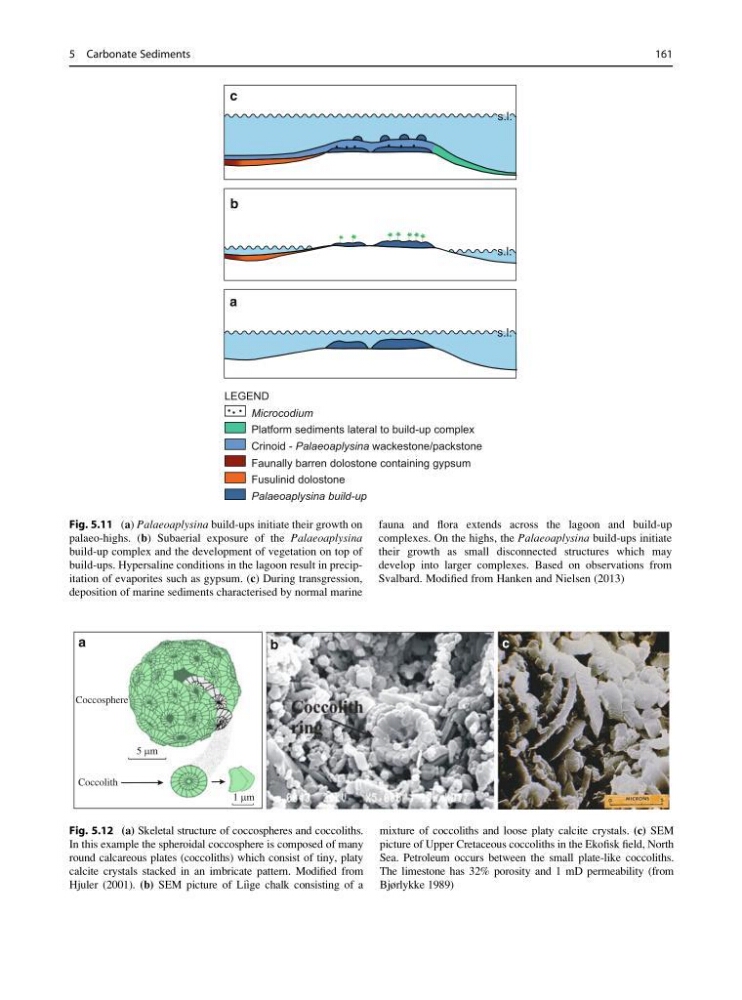
Fig. 5.11 (a) Palaeoaplysina build-ups initiate their growth on
palaeo-highs. (b) Subaerial exposure of the Palaeoaplysina
build-up complex and the development of vegetation on top of
build-ups. Hypersaline conditions in the lagoon result in precipitation of evaporites such as gypsum. (c) During transgression,
deposition of marine sediments characterised by normal marine
fauna and flora extends across the lagoon and build-up
complexes. On the highs, the Palaeoaplysina build-ups initiate
their growth as small disconnected structures which may
develop into larger complexes. Based on observations from
Svalbard. Modified from Hanken and Nielsen (2013)
5 μm
Coccosphere
Coccolith
a
b
c
1 μm
Fig. 5.12 (a) Skeletal structure of coccospheres and coccoliths.
In this example the spheroidal coccosphere is composed of many
round calcareous plates (coccoliths) which consist of tiny, platy
calcite crystals stacked in an imbricate pattern. Modified from
Hjuler (2001). (b) SEM picture of Liı `ge chalk consisting of a
mixture of coccoliths and loose platy calcite crystals. (c) SEM
picture of Upper Cretaceous coccoliths in the Ekofisk field, North
Sea. Petroleum occurs between the small plate-like coccoliths.
The limestone has 32% porosity and 1 mD permeability (from
Bjørlykke 1989)
5 Carbonate Sediments
161
s.l.
s.l.
a
b
c
Microcodium
Palaeoaplysina build-up
Fusulinid dolostone
Faunally barren dolostone containing gypsum
Crinoid - Palaeoaplysina wackestone/packstone
Platform sediments lateral to build-up complex
LEGEND
Fig. 5.11 (a) Palaeoaplysina build-ups initiate their growth on
palaeo-highs. (b) Subaerial exposure of the Palaeoaplysina
build-up complex and the development of vegetation on top of
build-ups. Hypersaline conditions in the lagoon result in precipitation of evaporites such as gypsum. (c) During transgression,
deposition of marine sediments characterised by normal marine
fauna and flora extends across the lagoon and build-up
complexes. On the highs, the Palaeoaplysina build-ups initiate
their growth as small disconnected structures which may
develop into larger complexes. Based on observations from
Svalbard. Modified from Hanken and Nielsen (2013)
5 μm
Coccosphere
Coccolith
a
b
c
1 μm
Fig. 5.12 (a) Skeletal structure of coccospheres and coccoliths.
In this example the spheroidal coccosphere is composed of many
round calcareous plates (coccoliths) which consist of tiny, platy
calcite crystals stacked in an imbricate pattern. Modified from
Hjuler (2001). (b) SEM picture of Liı `ge chalk consisting of a
mixture of coccoliths and loose platy calcite crystals. (c) SEM
picture of Upper Cretaceous coccoliths in the Ekofisk field, North
Sea. Petroleum occurs between the small plate-like coccoliths.
The limestone has 32% porosity and 1 mD permeability (from
Bjørlykke 1989)
5 Carbonate Sediments
161