

swamps. Some species can grow on firm substrates,
but most grow in sand or mud. They generally prefer
environments with only moderate wave energy. The
calcareous green algae are major producers of small
aragonite crystals which form lime mud. The presence
of green algae therefore ensures that lime mud is
deposited in the lagoons.
5.4.2.2 Mineralogy
The skeletal material in living algae is either calcite or
aragonite, never mixtures of these two minerals in the
same species. The extent of calcification is highly
variable and may be only partial in some groups
while other groups have a pervasive calcification of
the whole plant body. Recent calcareous algae consist
usually of small crystals (<4 μm) of precipitated calcite (e.g. coccolithophores produces low-Mg calcite
and Lithophyllum produces high-Mg calcite) or aragonite (e.g. Peyssonnelia). The same is assumed to apply
to pre-Quaternary species too. The preservation of the
plant bodies depends on the extent of calcification,
with the most calcified parts selectively preserved in
the fossil record.
Modern red algae deposit either aragonite or highMg calcite with a Mg content up to about 30 mol%
MgCO 3 . The skeletal elements in green algae consist
only of aragonite. This primary difference in their
skeletal composition is an important preservation factor. The solubility of skeletal aragonite in pure water is
about twice that of low-Mg calcite, whereas the solubility of skeletal high-Mg calcite is up to 10 times that
of low-Mg calcite. Hence, the fine-grained aragonite
skeleton of the green algae is replaced by sparry calcite, whereas coralline red algae with a primary calcitic composition of varying magnesium content show
different degrees of alteration (often partial
dissolution).
5.4.2.3 Geological Range
Calcareous green algae first appeared in the Cambrian,
which led to the production of large amounts of lime
mud. These algae are still an important factor in
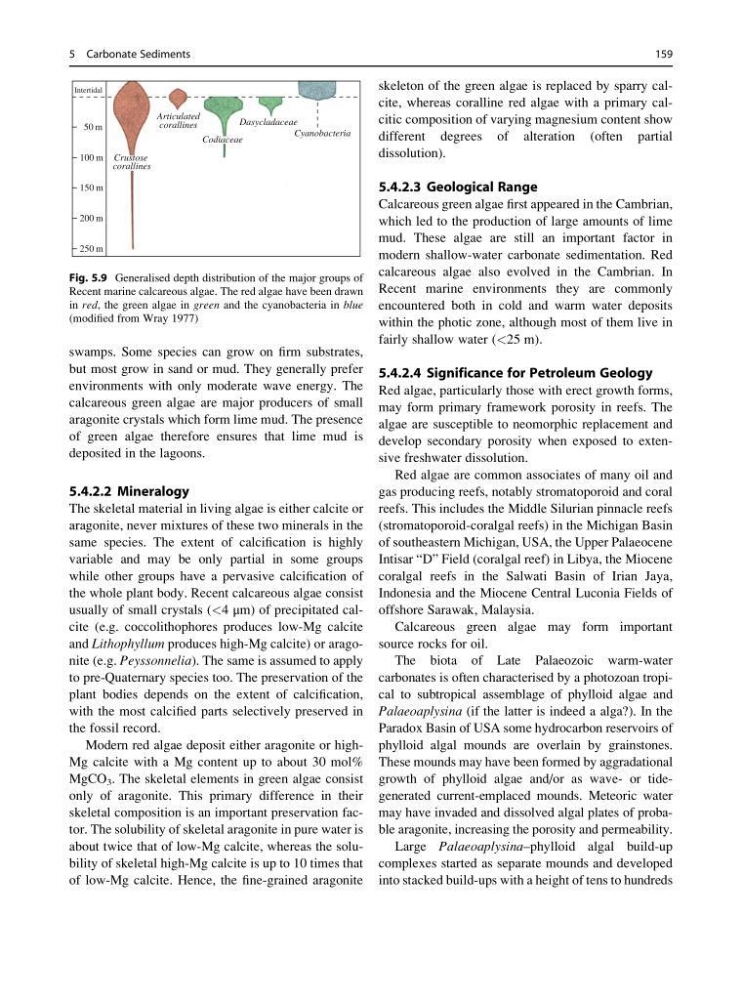
modern shallow-water carbonate sedimentation. Red
calcareous algae also evolved in the Cambrian. In
Recent marine environments they are commonly
encountered both in cold and warm water deposits
within the photic zone, although most of them live in
fairly shallow water (<25 m).
5.4.2.4 Significance for Petroleum Geology
Red algae, particularly those with erect growth forms,
may form primary framework porosity in reefs. The
algae are susceptible to neomorphic replacement and
develop secondary porosity when exposed to extensive freshwater dissolution.
Red algae are common associates of many oil and
gas producing reefs, notably stromatoporoid and coral
reefs. This includes the Middle Silurian pinnacle reefs
(stromatoporoid-coralgal reefs) in the Michigan Basin
of southeastern Michigan, USA, the Upper Palaeocene
Intisar “D” Field (coralgal reef) in Libya, the Miocene
coralgal reefs in the Salwati Basin of Irian Jaya,
Indonesia and the Miocene Central Luconia Fields of
offshore Sarawak, Malaysia.
Calcareous green algae may form important
source rocks for oil.
The biota of Late Palaeozoic warm-water
carbonates is often characterised by a photozoan tropical to subtropical assemblage of phylloid algae and
Palaeoaplysina (if the latter is indeed a alga?). In the
Paradox Basin of USA some hydrocarbon reservoirs of
phylloid algal mounds are overlain by grainstones.
These mounds may have been formed by aggradational
growth of phylloid algae and/or as wave- or tidegenerated current-emplaced mounds. Meteoric water
may have invaded and dissolved algal plates of probable aragonite, increasing the porosity and permeability.
Large Palaeoaplysina–phylloid algal build-up
complexes started as separate mounds and developed
into stacked build-ups with a height of tens to hundreds
Cyanobacteria
Crustose
corallines
Articulated
Intertidal
50 m
100 m
150 m
200 m
250 m
Dasycladaceae
Codiaceae
corallines
Fig. 5.9 Generalised depth distribution of the major groups of
Recent marine calcareous algae. The red algae have been drawn
in red, the green algae in green and the cyanobacteria in blue
(modified from Wray 1977)
5 Carbonate Sediments
159
but most grow in sand or mud. They generally prefer
environments with only moderate wave energy. The
calcareous green algae are major producers of small
aragonite crystals which form lime mud. The presence
of green algae therefore ensures that lime mud is
deposited in the lagoons.
5.4.2.2 Mineralogy
The skeletal material in living algae is either calcite or
aragonite, never mixtures of these two minerals in the
same species. The extent of calcification is highly
variable and may be only partial in some groups
while other groups have a pervasive calcification of
the whole plant body. Recent calcareous algae consist
usually of small crystals (<4 μm) of precipitated calcite (e.g. coccolithophores produces low-Mg calcite
and Lithophyllum produces high-Mg calcite) or aragonite (e.g. Peyssonnelia). The same is assumed to apply
to pre-Quaternary species too. The preservation of the
plant bodies depends on the extent of calcification,
with the most calcified parts selectively preserved in
the fossil record.
Modern red algae deposit either aragonite or highMg calcite with a Mg content up to about 30 mol%
MgCO 3 . The skeletal elements in green algae consist
only of aragonite. This primary difference in their
skeletal composition is an important preservation factor. The solubility of skeletal aragonite in pure water is
about twice that of low-Mg calcite, whereas the solubility of skeletal high-Mg calcite is up to 10 times that
of low-Mg calcite. Hence, the fine-grained aragonite
skeleton of the green algae is replaced by sparry calcite, whereas coralline red algae with a primary calcitic composition of varying magnesium content show
different degrees of alteration (often partial
dissolution).
5.4.2.3 Geological Range
Calcareous green algae first appeared in the Cambrian,
which led to the production of large amounts of lime
mud. These algae are still an important factor in
modern shallow-water carbonate sedimentation. Red
calcareous algae also evolved in the Cambrian. In
Recent marine environments they are commonly
encountered both in cold and warm water deposits
within the photic zone, although most of them live in
fairly shallow water (<25 m).
5.4.2.4 Significance for Petroleum Geology
Red algae, particularly those with erect growth forms,
may form primary framework porosity in reefs. The
algae are susceptible to neomorphic replacement and
develop secondary porosity when exposed to extensive freshwater dissolution.
Red algae are common associates of many oil and
gas producing reefs, notably stromatoporoid and coral
reefs. This includes the Middle Silurian pinnacle reefs
(stromatoporoid-coralgal reefs) in the Michigan Basin
of southeastern Michigan, USA, the Upper Palaeocene
Intisar “D” Field (coralgal reef) in Libya, the Miocene
coralgal reefs in the Salwati Basin of Irian Jaya,
Indonesia and the Miocene Central Luconia Fields of
offshore Sarawak, Malaysia.
Calcareous green algae may form important
source rocks for oil.
The biota of Late Palaeozoic warm-water
carbonates is often characterised by a photozoan tropical to subtropical assemblage of phylloid algae and
Palaeoaplysina (if the latter is indeed a alga?). In the
Paradox Basin of USA some hydrocarbon reservoirs of
phylloid algal mounds are overlain by grainstones.
These mounds may have been formed by aggradational
growth of phylloid algae and/or as wave- or tidegenerated current-emplaced mounds. Meteoric water
may have invaded and dissolved algal plates of probable aragonite, increasing the porosity and permeability.
Large Palaeoaplysina–phylloid algal build-up
complexes started as separate mounds and developed
into stacked build-ups with a height of tens to hundreds
Cyanobacteria
Crustose
corallines
Articulated
Intertidal
50 m
100 m
150 m
200 m
250 m
Dasycladaceae
Codiaceae
corallines
Fig. 5.9 Generalised depth distribution of the major groups of
Recent marine calcareous algae. The red algae have been drawn
in red, the green algae in green and the cyanobacteria in blue
(modified from Wray 1977)
5 Carbonate Sediments
159