

in this manner may reach up to 10 cm in diameter.
Large oncoids are flattish and often called “bacterial
(previously algal) biscuits”. A deposit of oncoid sand
is called an oncolite.
5.4.1.1 Ecology
Cyanobacteria have inhabited mostly open marine,
shallow water and intertidal environments throughout
geological time. However, hypersaline and rare freshwater forms have been recorded too.
Stromatolites are most common in upper intertidal
to supratidal environments (Fig. 5.6), but have also
occasionally been described from subtidal environments.
Intertidal to supratidal stromatolites are often associated
with fenestral (birdseye) structures, mud cracks and
evaporites. The specific growth form may be used for
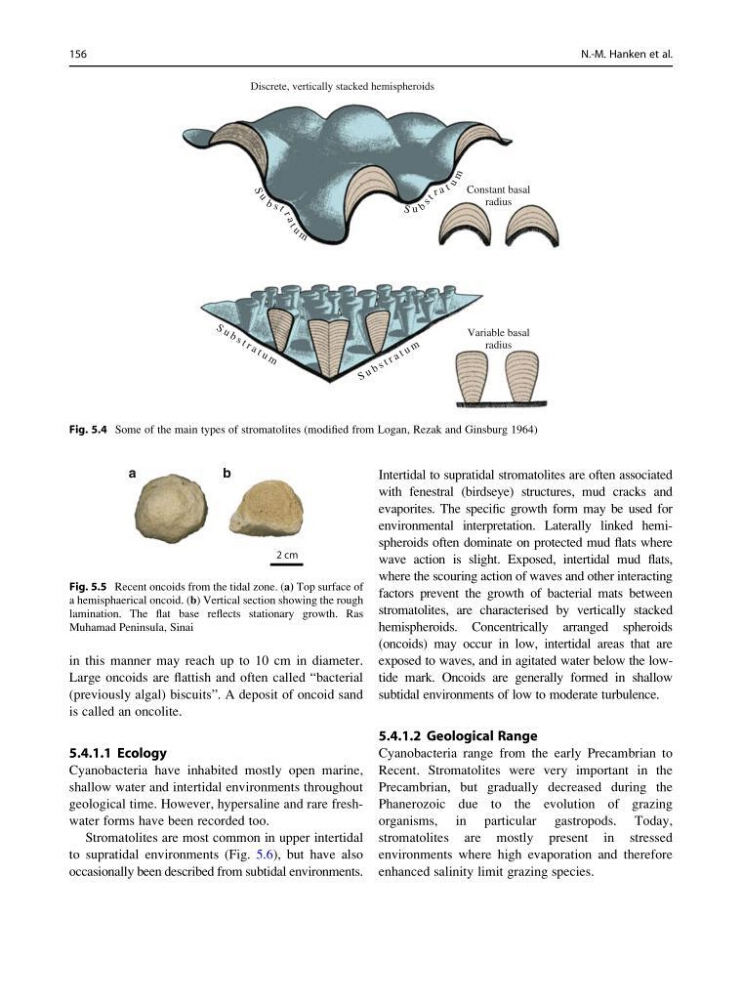
environmental interpretation. Laterally linked hemispheroids often dominate on protected mud flats where
wave action is slight. Exposed, intertidal mud flats,
where the scouring action of waves and other interacting
factors prevent the growth of bacterial mats between
stromatolites, are characterised by vertically stacked
hemispheroids. Concentrically arranged spheroids
(oncoids) may occur in low, intertidal areas that are
exposed to waves, and in agitated water below the lowtide mark. Oncoids are generally formed in shallow
subtidal environments of low to moderate turbulence.
5.4.1.2 Geological Range
Cyanobacteria range from the early Precambrian to
Recent. Stromatolites were very important in the
Precambrian, but gradually decreased during the
Phanerozoic due to the evolution of grazing
organisms, in particular gastropods. Today,
stromatolites are mostly present in stressed
environments where high evaporation and therefore
enhanced salinity limit grazing species.
Discrete, vertically stacked hemispheroids
Constant basal
radius
Variable basal
radius
S u b s t r a t u m
S u b s t r a t u m
S u
b s t
r a t u
m
m
u
t
a
r
t
s
b
S u
Fig. 5.4 Some of the main types of stromatolites (modified from Logan, Rezak and Ginsburg 1964)
a
b
2 cm
Fig. 5.5 Recent oncoids from the tidal zone. (a) Top surface of
a hemisphaerical oncoid. (b) Vertical section showing the rough
lamination. The flat base reflects stationary growth. Ras
Muhamad Peninsula, Sinai
156
N.-M. Hanken et al.
Large oncoids are flattish and often called “bacterial
(previously algal) biscuits”. A deposit of oncoid sand
is called an oncolite.
5.4.1.1 Ecology
Cyanobacteria have inhabited mostly open marine,
shallow water and intertidal environments throughout
geological time. However, hypersaline and rare freshwater forms have been recorded too.
Stromatolites are most common in upper intertidal
to supratidal environments (Fig. 5.6), but have also
occasionally been described from subtidal environments.
Intertidal to supratidal stromatolites are often associated
with fenestral (birdseye) structures, mud cracks and
evaporites. The specific growth form may be used for
environmental interpretation. Laterally linked hemispheroids often dominate on protected mud flats where
wave action is slight. Exposed, intertidal mud flats,
where the scouring action of waves and other interacting
factors prevent the growth of bacterial mats between
stromatolites, are characterised by vertically stacked
hemispheroids. Concentrically arranged spheroids
(oncoids) may occur in low, intertidal areas that are
exposed to waves, and in agitated water below the lowtide mark. Oncoids are generally formed in shallow
subtidal environments of low to moderate turbulence.
5.4.1.2 Geological Range
Cyanobacteria range from the early Precambrian to
Recent. Stromatolites were very important in the
Precambrian, but gradually decreased during the
Phanerozoic due to the evolution of grazing
organisms, in particular gastropods. Today,
stromatolites are mostly present in stressed
environments where high evaporation and therefore
enhanced salinity limit grazing species.
Discrete, vertically stacked hemispheroids
Constant basal
radius
Variable basal
radius
S u b s t r a t u m
S u b s t r a t u m
S u
b s t
r a t u
m
m
u
t
a
r
t
s
b
S u
Fig. 5.4 Some of the main types of stromatolites (modified from Logan, Rezak and Ginsburg 1964)
a
b
2 cm
Fig. 5.5 Recent oncoids from the tidal zone. (a) Top surface of
a hemisphaerical oncoid. (b) Vertical section showing the rough
lamination. The flat base reflects stationary growth. Ras
Muhamad Peninsula, Sinai
156
N.-M. Hanken et al.