

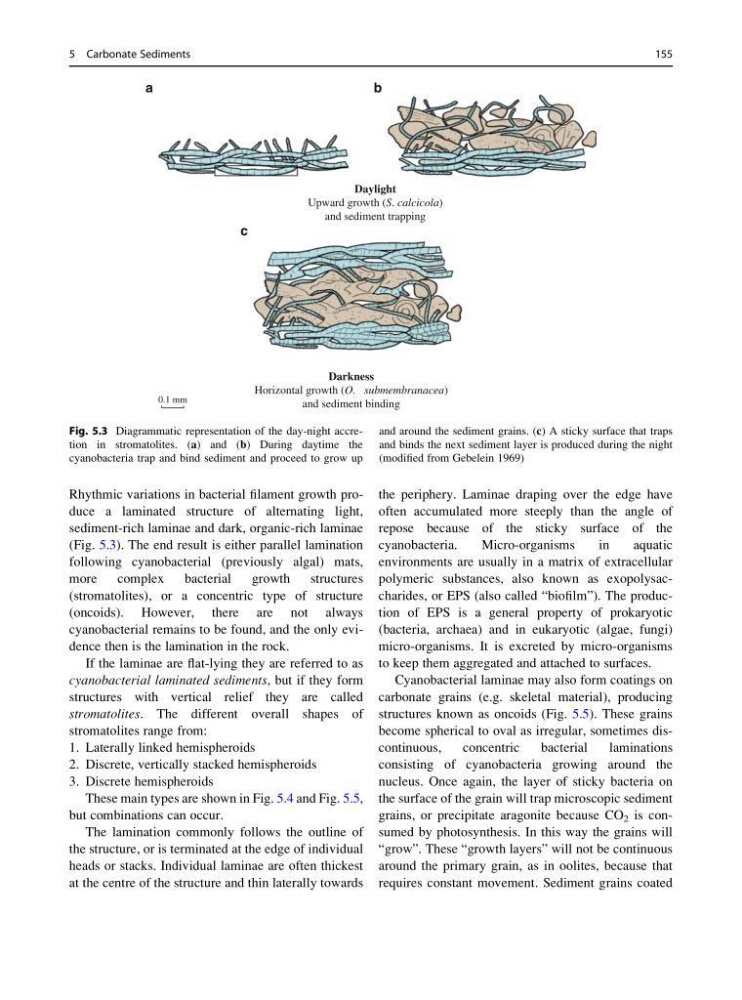
Rhythmic variations in bacterial filament growth produce a laminated structure of alternating light,
sediment-rich laminae and dark, organic-rich laminae
(Fig. 5.3). The end result is either parallel lamination
following cyanobacterial (previously algal) mats,
more
complex
bacterial
growth
structures
(stromatolites), or a concentric type of structure
(oncoids). However, there are not always
cyanobacterial remains to be found, and the only evidence then is the lamination in the rock.
If the laminae are flat-lying they are referred to as
cyanobacterial laminated sediments, but if they form
structures with vertical relief they are called
stromatolites. The different overall shapes of
stromatolites range from:
1. Laterally linked hemispheroids
2. Discrete, vertically stacked hemispheroids
3. Discrete hemispheroids
These main types are shown in Fig. 5.4 and Fig. 5.5,
but combinations can occur.
The lamination commonly follows the outline of
the structure, or is terminated at the edge of individual
heads or stacks. Individual laminae are often thickest
at the centre of the structure and thin laterally towards
the periphery. Laminae draping over the edge have
often accumulated more steeply than the angle of
repose because of the sticky surface of the
cyanobacteria.
Micro-organisms
in
aquatic
environments are usually in a matrix of extracellular
polymeric substances, also known as exopolysaccharides, or EPS (also called “biofilm”). The production of EPS is a general property of prokaryotic
(bacteria, archaea) and in eukaryotic (algae, fungi)
micro-organisms. It is excreted by micro-organisms
to keep them aggregated and attached to surfaces.
Cyanobacterial laminae may also form coatings on
carbonate grains (e.g. skeletal material), producing
structures known as oncoids (Fig. 5.5). These grains
become spherical to oval as irregular, sometimes discontinuous,
concentric
bacterial
laminations
consisting of cyanobacteria growing around the
nucleus. Once again, the layer of sticky bacteria on
the surface of the grain will trap microscopic sediment
grains, or precipitate aragonite because CO 2 is consumed by photosynthesis. In this way the grains will
“grow”. These “growth layers” will not be continuous
around the primary grain, as in oolites, because that
requires constant movement. Sediment grains coated
Daylight
Upward growth (S. calcicola)
and sediment trapping
Darkness
Horizontal growth (O. submembranacea)
and sediment binding
a
b
c
0.1 mm
Fig. 5.3 Diagrammatic representation of the day-night accretion in stromatolites. (a) and (b) During daytime the
cyanobacteria trap and bind sediment and proceed to grow up
and around the sediment grains. (c) A sticky surface that traps
and binds the next sediment layer is produced during the night
(modified from Gebelein 1969)
5 Carbonate Sediments
155
sediment-rich laminae and dark, organic-rich laminae
(Fig. 5.3). The end result is either parallel lamination
following cyanobacterial (previously algal) mats,
more
complex
bacterial
growth
structures
(stromatolites), or a concentric type of structure
(oncoids). However, there are not always
cyanobacterial remains to be found, and the only evidence then is the lamination in the rock.
If the laminae are flat-lying they are referred to as
cyanobacterial laminated sediments, but if they form
structures with vertical relief they are called
stromatolites. The different overall shapes of
stromatolites range from:
1. Laterally linked hemispheroids
2. Discrete, vertically stacked hemispheroids
3. Discrete hemispheroids
These main types are shown in Fig. 5.4 and Fig. 5.5,
but combinations can occur.
The lamination commonly follows the outline of
the structure, or is terminated at the edge of individual
heads or stacks. Individual laminae are often thickest
at the centre of the structure and thin laterally towards
the periphery. Laminae draping over the edge have
often accumulated more steeply than the angle of
repose because of the sticky surface of the
cyanobacteria.
Micro-organisms
in
aquatic
environments are usually in a matrix of extracellular
polymeric substances, also known as exopolysaccharides, or EPS (also called “biofilm”). The production of EPS is a general property of prokaryotic
(bacteria, archaea) and in eukaryotic (algae, fungi)
micro-organisms. It is excreted by micro-organisms
to keep them aggregated and attached to surfaces.
Cyanobacterial laminae may also form coatings on
carbonate grains (e.g. skeletal material), producing
structures known as oncoids (Fig. 5.5). These grains
become spherical to oval as irregular, sometimes discontinuous,
concentric
bacterial
laminations
consisting of cyanobacteria growing around the
nucleus. Once again, the layer of sticky bacteria on
the surface of the grain will trap microscopic sediment
grains, or precipitate aragonite because CO 2 is consumed by photosynthesis. In this way the grains will
“grow”. These “growth layers” will not be continuous
around the primary grain, as in oolites, because that
requires constant movement. Sediment grains coated
Daylight
Upward growth (S. calcicola)
and sediment trapping
Darkness
Horizontal growth (O. submembranacea)
and sediment binding
a
b
c
0.1 mm
Fig. 5.3 Diagrammatic representation of the day-night accretion in stromatolites. (a) and (b) During daytime the
cyanobacteria trap and bind sediment and proceed to grow up
and around the sediment grains. (c) A sticky surface that traps
and binds the next sediment layer is produced during the night
(modified from Gebelein 1969)
5 Carbonate Sediments
155