

It is typical that clean well-sorted sandstone has
the best porosity down to about 3.5–4 km but then
loses its porosity rapidly due to quartz cementation.
Sandstones with a moderate clay content lose more
porosity during mechanical compaction compared to
the clean sandstone, but may preserve more porosity at
greater depth due to retarded quartz overgrowth.
4.11 Fluid Inclusions in Quartz Cement
Inclusions of small drops of oil may be trapped in
quartz cement and show up well in fluorescent light
(Fig. 4.12a). Fluid inclusion data from quartz helps to
constrain the temperature for quartz cementation and
in sandstone reservoirs it has been demonstrated quite
clearly that quartz cementation continues after oil
emplacements in a reservoir (Karlsen et al. 1993,
Walderhaug 1990).
The lowest fluid inclusion temperatures in quartz
cement indicate an onset of quartz cementation close
to 70–80
C (Burley et al. 1989, Walderhaug 1994a).
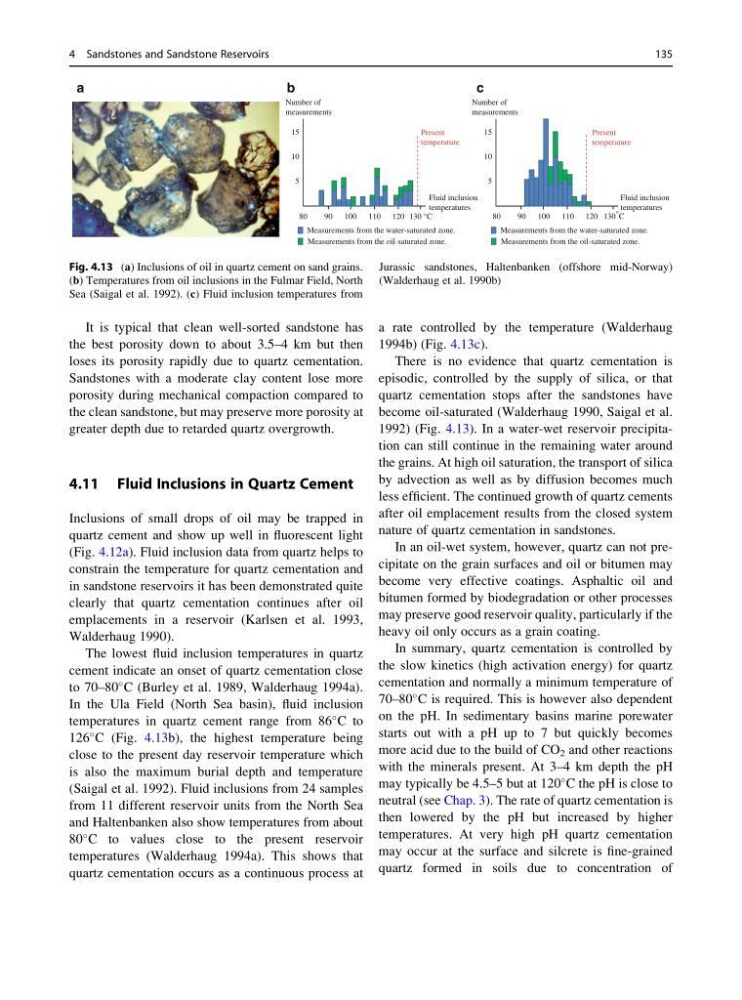
In the Ula Field (North Sea basin), fluid inclusion
temperatures in quartz cement range from 86
C to
126
C (Fig. 4.13b), the highest temperature being
close to the present day reservoir temperature which
is also the maximum burial depth and temperature
(Saigal et al. 1992). Fluid inclusions from 24 samples
from 11 different reservoir units from the North Sea
and Haltenbanken also show temperatures from about
80
C to values close to the present reservoir
temperatures (Walderhaug 1994a). This shows that
quartz cementation occurs as a continuous process at
a rate controlled by the temperature (Walderhaug
1994b) (Fig. 4.13c).
There is no evidence that quartz cementation is
episodic, controlled by the supply of silica, or that
quartz cementation stops after the sandstones have
become oil-saturated (Walderhaug 1990, Saigal et al.
1992) (Fig. 4.13). In a water-wet reservoir precipitation can still continue in the remaining water around
the grains. At high oil saturation, the transport of silica
by advection as well as by diffusion becomes much
less efficient. The continued growth of quartz cements
after oil emplacement results from the closed system
nature of quartz cementation in sandstones.
In an oil-wet system, however, quartz can not precipitate on the grain surfaces and oil or bitumen may
become very effective coatings. Asphaltic oil and
bitumen formed by biodegradation or other processes
may preserve good reservoir quality, particularly if the
heavy oil only occurs as a grain coating.
In summary, quartz cementation is controlled by
the slow kinetics (high activation energy) for quartz
cementation and normally a minimum temperature of
70–80
C is required. This is however also dependent
on the pH. In sedimentary basins marine porewater
starts out with a pH up to 7 but quickly becomes
more acid due to the build of CO 2 and other reactions
with the minerals present. At 3–4 km depth the pH
may typically be 4.5–5 but at 120
C the pH is close to
neutral (see Chap. 3). The rate of quartz cementation is
then lowered by the pH but increased by higher
temperatures. At very high pH quartz cementation
may occur at the surface and silcrete is fine-grained
quartz formed in soils due to concentration of
Number of
measurements
15
10
5
80
90 100 110 120 130 °C
Measurements from the water-saturated zone.
Measurements from the oil-saturated zone.
Measurements from the water-saturated zone.
Measurements from the oil-saturated zone.
Fluid inclusion
temperatures
Present
temperature
80
90 100 110 120 130 ° C
Number of
measurements
15
10
5
Fluid inclusion
temperatures
Present
temperature
b
a
c
Fig. 4.13 (a) Inclusions of oil in quartz cement on sand grains.
(b) Temperatures from oil inclusions in the Fulmar Field, North
Sea (Saigal et al. 1992). (c) Fluid inclusion temperatures from
Jurassic sandstones, Haltenbanken (offshore mid-Norway)
(Walderhaug et al. 1990b)
4 Sandstones and Sandstone Reservoirs
135
the best porosity down to about 3.5–4 km but then
loses its porosity rapidly due to quartz cementation.
Sandstones with a moderate clay content lose more
porosity during mechanical compaction compared to
the clean sandstone, but may preserve more porosity at
greater depth due to retarded quartz overgrowth.
4.11 Fluid Inclusions in Quartz Cement
Inclusions of small drops of oil may be trapped in
quartz cement and show up well in fluorescent light
(Fig. 4.12a). Fluid inclusion data from quartz helps to
constrain the temperature for quartz cementation and
in sandstone reservoirs it has been demonstrated quite
clearly that quartz cementation continues after oil
emplacements in a reservoir (Karlsen et al. 1993,
Walderhaug 1990).
The lowest fluid inclusion temperatures in quartz
cement indicate an onset of quartz cementation close
to 70–80
C (Burley et al. 1989, Walderhaug 1994a).
In the Ula Field (North Sea basin), fluid inclusion
temperatures in quartz cement range from 86
C to
126
C (Fig. 4.13b), the highest temperature being
close to the present day reservoir temperature which
is also the maximum burial depth and temperature
(Saigal et al. 1992). Fluid inclusions from 24 samples
from 11 different reservoir units from the North Sea
and Haltenbanken also show temperatures from about
80
C to values close to the present reservoir
temperatures (Walderhaug 1994a). This shows that
quartz cementation occurs as a continuous process at
a rate controlled by the temperature (Walderhaug
1994b) (Fig. 4.13c).
There is no evidence that quartz cementation is
episodic, controlled by the supply of silica, or that
quartz cementation stops after the sandstones have
become oil-saturated (Walderhaug 1990, Saigal et al.
1992) (Fig. 4.13). In a water-wet reservoir precipitation can still continue in the remaining water around
the grains. At high oil saturation, the transport of silica
by advection as well as by diffusion becomes much
less efficient. The continued growth of quartz cements
after oil emplacement results from the closed system
nature of quartz cementation in sandstones.
In an oil-wet system, however, quartz can not precipitate on the grain surfaces and oil or bitumen may
become very effective coatings. Asphaltic oil and
bitumen formed by biodegradation or other processes
may preserve good reservoir quality, particularly if the
heavy oil only occurs as a grain coating.
In summary, quartz cementation is controlled by
the slow kinetics (high activation energy) for quartz
cementation and normally a minimum temperature of
70–80
C is required. This is however also dependent
on the pH. In sedimentary basins marine porewater
starts out with a pH up to 7 but quickly becomes
more acid due to the build of CO 2 and other reactions
with the minerals present. At 3–4 km depth the pH
may typically be 4.5–5 but at 120
C the pH is close to
neutral (see Chap. 3). The rate of quartz cementation is
then lowered by the pH but increased by higher
temperatures. At very high pH quartz cementation
may occur at the surface and silcrete is fine-grained
quartz formed in soils due to concentration of
Number of
measurements
15
10
5
80
90 100 110 120 130 °C
Measurements from the water-saturated zone.
Measurements from the oil-saturated zone.
Measurements from the water-saturated zone.
Measurements from the oil-saturated zone.
Fluid inclusion
temperatures
Present
temperature
80
90 100 110 120 130 ° C
Number of
measurements
15
10
5
Fluid inclusion
temperatures
Present
temperature
b
a
c
Fig. 4.13 (a) Inclusions of oil in quartz cement on sand grains.
(b) Temperatures from oil inclusions in the Fulmar Field, North
Sea (Saigal et al. 1992). (c) Fluid inclusion temperatures from
Jurassic sandstones, Haltenbanken (offshore mid-Norway)
(Walderhaug et al. 1990b)
4 Sandstones and Sandstone Reservoirs
135