

sandstones of Southern Louisiana (Pittman and Larese
1992).
Sandstones with grain coatings may remain
uncemented down to 4–5 km burial depth and be
subjected to 40–50 MPa effective stress, causing pervasive grain crushing (Chuhan et al. 2002).
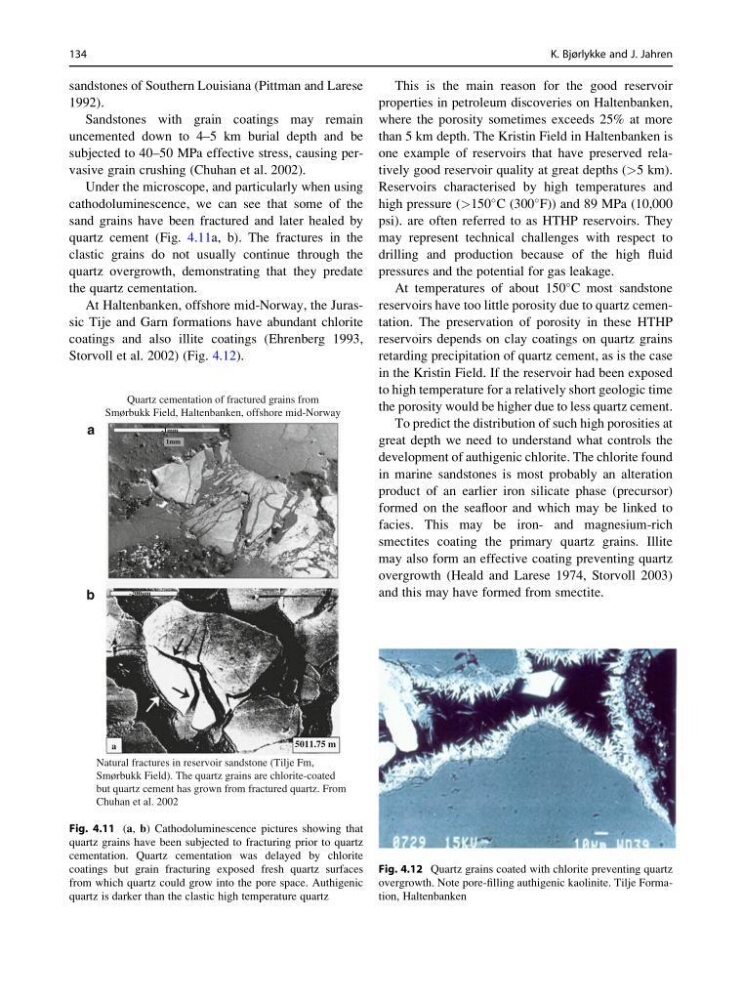
Under the microscope, and particularly when using
cathodoluminescence, we can see that some of the
sand grains have been fractured and later healed by
quartz cement (Fig. 4.11a, b). The fractures in the
clastic grains do not usually continue through the
quartz overgrowth, demonstrating that they predate
the quartz cementation.
At Haltenbanken, offshore mid-Norway, the Jurassic Tije and Garn formations have abundant chlorite
coatings and also illite coatings (Ehrenberg 1993,
Storvoll et al. 2002) (Fig. 4.12).
This is the main reason for the good reservoir
properties in petroleum discoveries on Haltenbanken,
where the porosity sometimes exceeds 25% at more
than 5 km depth. The Kristin Field in Haltenbanken is
one example of reservoirs that have preserved relatively good reservoir quality at great depths (>5 km).
Reservoirs characterised by high temperatures and
high pressure (>150
C (300
F)) and 89 MPa (10,000
psi). are often referred to as HTHP reservoirs. They
may represent technical challenges with respect to
drilling and production because of the high fluid
pressures and the potential for gas leakage.
At temperatures of about 150
C most sandstone
reservoirs have too little porosity due to quartz cementation. The preservation of porosity in these HTHP
reservoirs depends on clay coatings on quartz grains
retarding precipitation of quartz cement, as is the case
in the Kristin Field. If the reservoir had been exposed
to high temperature for a relatively short geologic time
the porosity would be higher due to less quartz cement.
To predict the distribution of such high porosities at
great depth we need to understand what controls the
development of authigenic chlorite. The chlorite found
in marine sandstones is most probably an alteration
product of an earlier iron silicate phase (precursor)
formed on the seafloor and which may be linked to
facies. This may be iron- and magnesium-rich
smectites coating the primary quartz grains. Illite
may also form an effective coating preventing quartz
overgrowth (Heald and Larese 1974, Storvoll 2003)
and this may have formed from smectite.
Natural fractures in reservoir sandstone (Tilje Fm,
Smørbukk Field). The quartz grains are chlorite-coated
but quartz cement has grown from fractured quartz. From
Chuhan et al. 2002
Quartz cementation of fractured grains from
Smørbukk Field, Haltenbanken, offshore mid-Norway
a
b
5011.75 m
a
-200µm
1mm
-1mm
Fig. 4.11 (a, b) Cathodoluminescence pictures showing that
quartz grains have been subjected to fracturing prior to quartz
cementation. Quartz cementation was delayed by chlorite
coatings but grain fracturing exposed fresh quartz surfaces
from which quartz could grow into the pore space. Authigenic
quartz is darker than the clastic high temperature quartz
Fig. 4.12 Quartz grains coated with chlorite preventing quartz
overgrowth. Note pore-filling authigenic kaolinite. Tilje Formation, Haltenbanken
134
K. Bjørlykke and J. Jahren
1992).
Sandstones with grain coatings may remain
uncemented down to 4–5 km burial depth and be
subjected to 40–50 MPa effective stress, causing pervasive grain crushing (Chuhan et al. 2002).
Under the microscope, and particularly when using
cathodoluminescence, we can see that some of the
sand grains have been fractured and later healed by
quartz cement (Fig. 4.11a, b). The fractures in the
clastic grains do not usually continue through the
quartz overgrowth, demonstrating that they predate
the quartz cementation.
At Haltenbanken, offshore mid-Norway, the Jurassic Tije and Garn formations have abundant chlorite
coatings and also illite coatings (Ehrenberg 1993,
Storvoll et al. 2002) (Fig. 4.12).
This is the main reason for the good reservoir
properties in petroleum discoveries on Haltenbanken,
where the porosity sometimes exceeds 25% at more
than 5 km depth. The Kristin Field in Haltenbanken is
one example of reservoirs that have preserved relatively good reservoir quality at great depths (>5 km).
Reservoirs characterised by high temperatures and
high pressure (>150
C (300
F)) and 89 MPa (10,000
psi). are often referred to as HTHP reservoirs. They
may represent technical challenges with respect to
drilling and production because of the high fluid
pressures and the potential for gas leakage.
At temperatures of about 150
C most sandstone
reservoirs have too little porosity due to quartz cementation. The preservation of porosity in these HTHP
reservoirs depends on clay coatings on quartz grains
retarding precipitation of quartz cement, as is the case
in the Kristin Field. If the reservoir had been exposed
to high temperature for a relatively short geologic time
the porosity would be higher due to less quartz cement.
To predict the distribution of such high porosities at
great depth we need to understand what controls the
development of authigenic chlorite. The chlorite found
in marine sandstones is most probably an alteration
product of an earlier iron silicate phase (precursor)
formed on the seafloor and which may be linked to
facies. This may be iron- and magnesium-rich
smectites coating the primary quartz grains. Illite
may also form an effective coating preventing quartz
overgrowth (Heald and Larese 1974, Storvoll 2003)
and this may have formed from smectite.
Natural fractures in reservoir sandstone (Tilje Fm,
Smørbukk Field). The quartz grains are chlorite-coated
but quartz cement has grown from fractured quartz. From
Chuhan et al. 2002
Quartz cementation of fractured grains from
Smørbukk Field, Haltenbanken, offshore mid-Norway
a
b
5011.75 m
a
-200µm
1mm
-1mm
Fig. 4.11 (a, b) Cathodoluminescence pictures showing that
quartz grains have been subjected to fracturing prior to quartz
cementation. Quartz cementation was delayed by chlorite
coatings but grain fracturing exposed fresh quartz surfaces
from which quartz could grow into the pore space. Authigenic
quartz is darker than the clastic high temperature quartz
Fig. 4.12 Quartz grains coated with chlorite preventing quartz
overgrowth. Note pore-filling authigenic kaolinite. Tilje Formation, Haltenbanken
134
K. Bjørlykke and J. Jahren