

compaction and during production, but may not be
completely continuous laterally.
We have seen that the rate of quartz cementation is
a function of temperature, the degree of supersaturation and the surface area available for quartz
cementation. A consequence of a surface-controlled
quartz precipitation model is that quartz cementation
will continue as long as the temperature is above the
threshold temperature for quartz growth (70–80
C)
and there is remaining porosity in the sandstone. It is
important to note that quartz cementation, and hence
sandstone compaction, will continue also during basin
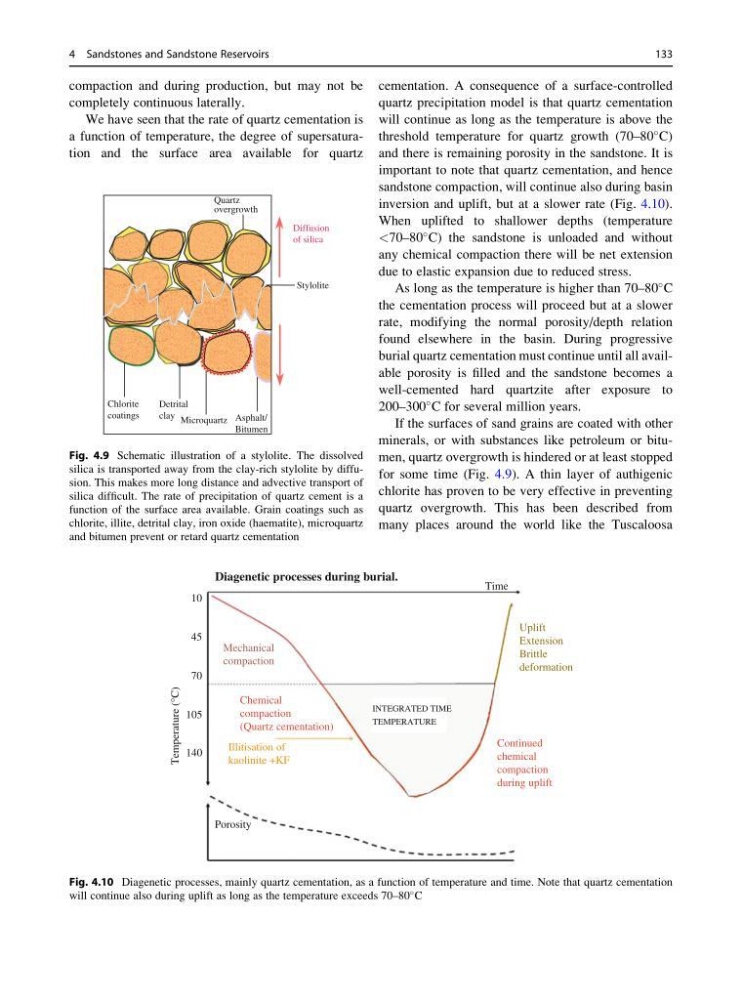
inversion and uplift, but at a slower rate (Fig. 4.10).
When uplifted to shallower depths (temperature
<70–80
C) the sandstone is unloaded and without
any chemical compaction there will be net extension
due to elastic expansion due to reduced stress.
As long as the temperature is higher than 70–80
C
the cementation process will proceed but at a slower
rate, modifying the normal porosity/depth relation
found elsewhere in the basin. During progressive
burial quartz cementation must continue until all available porosity is filled and the sandstone becomes a
well-cemented hard quartzite after exposure to
200–300
C for several million years.
If the surfaces of sand grains are coated with other
minerals, or with substances like petroleum or bitumen, quartz overgrowth is hindered or at least stopped
for some time (Fig. 4.9). A thin layer of authigenic
chlorite has proven to be very effective in preventing
quartz overgrowth. This has been described from
many places around the world like the Tuscaloosa
Diffusion
of silica
Stylolite
Asphalt/
Bitumen
Microquartz
Detrital
clay
Chlorite
coatings
Quartz
overgrowth
Fig. 4.9 Schematic illustration of a stylolite. The dissolved
silica is transported away from the clay-rich stylolite by diffusion. This makes more long distance and advective transport of
silica difficult. The rate of precipitation of quartz cement is a
function of the surface area available. Grain coatings such as
chlorite, illite, detrital clay, iron oxide (haematite), microquartz
and bitumen prevent or retard quartz cementation
Diagenetic processes during burial.
10
45
70
105
140
Temperature (°C)
Porosity
Chemical
compaction
(Quartz cementation)
Continued
chemical
compaction
during uplift
Uplift
Extension
Brittle
deformation
Illitisation of
kaolinite +KF
Mechanical
compaction
Time
INTEGRATED TIME
TEMPERATURE
Fig. 4.10 Diagenetic processes, mainly quartz cementation, as a function of temperature and time. Note that quartz cementation
will continue also during uplift as long as the temperature exceeds 70–80
C
4 Sandstones and Sandstone Reservoirs
133
completely continuous laterally.
We have seen that the rate of quartz cementation is
a function of temperature, the degree of supersaturation and the surface area available for quartz
cementation. A consequence of a surface-controlled
quartz precipitation model is that quartz cementation
will continue as long as the temperature is above the
threshold temperature for quartz growth (70–80
C)
and there is remaining porosity in the sandstone. It is
important to note that quartz cementation, and hence
sandstone compaction, will continue also during basin
inversion and uplift, but at a slower rate (Fig. 4.10).
When uplifted to shallower depths (temperature
<70–80
C) the sandstone is unloaded and without
any chemical compaction there will be net extension
due to elastic expansion due to reduced stress.
As long as the temperature is higher than 70–80
C
the cementation process will proceed but at a slower
rate, modifying the normal porosity/depth relation
found elsewhere in the basin. During progressive
burial quartz cementation must continue until all available porosity is filled and the sandstone becomes a
well-cemented hard quartzite after exposure to
200–300
C for several million years.
If the surfaces of sand grains are coated with other
minerals, or with substances like petroleum or bitumen, quartz overgrowth is hindered or at least stopped
for some time (Fig. 4.9). A thin layer of authigenic
chlorite has proven to be very effective in preventing
quartz overgrowth. This has been described from
many places around the world like the Tuscaloosa
Diffusion
of silica
Stylolite
Asphalt/
Bitumen
Microquartz
Detrital
clay
Chlorite
coatings
Quartz
overgrowth
Fig. 4.9 Schematic illustration of a stylolite. The dissolved
silica is transported away from the clay-rich stylolite by diffusion. This makes more long distance and advective transport of
silica difficult. The rate of precipitation of quartz cement is a
function of the surface area available. Grain coatings such as
chlorite, illite, detrital clay, iron oxide (haematite), microquartz
and bitumen prevent or retard quartz cementation
Diagenetic processes during burial.
10
45
70
105
140
Temperature (°C)
Porosity
Chemical
compaction
(Quartz cementation)
Continued
chemical
compaction
during uplift
Uplift
Extension
Brittle
deformation
Illitisation of
kaolinite +KF
Mechanical
compaction
Time
INTEGRATED TIME
TEMPERATURE
Fig. 4.10 Diagenetic processes, mainly quartz cementation, as a function of temperature and time. Note that quartz cementation
will continue also during uplift as long as the temperature exceeds 70–80
C
4 Sandstones and Sandstone Reservoirs
133