

4.10 Deeply Buried Sandstones
(>3.5–4 km, >120
C)
Once quartz cementation has started and quartz overgrowth has formed, quartz cementation does not stop
until nearly all the porosity is lost, unless the temperature drops below 70–80
C.
In most sedimentary basins we find there is a rather
strong reduction in porosity and permeability in sandstone reservoirs from about 3–3.5 km to 4–4.5 km
burial depth, corresponding to a temperature range
from about 120 to 160
C. This is due in most cases
to precipitation of quartz cement and diagenetic illite.
The rate of quartz cementation increases as an exponential function of temperature and we estimate that
the rate may increase by a factor of 1.7 for every 10
C
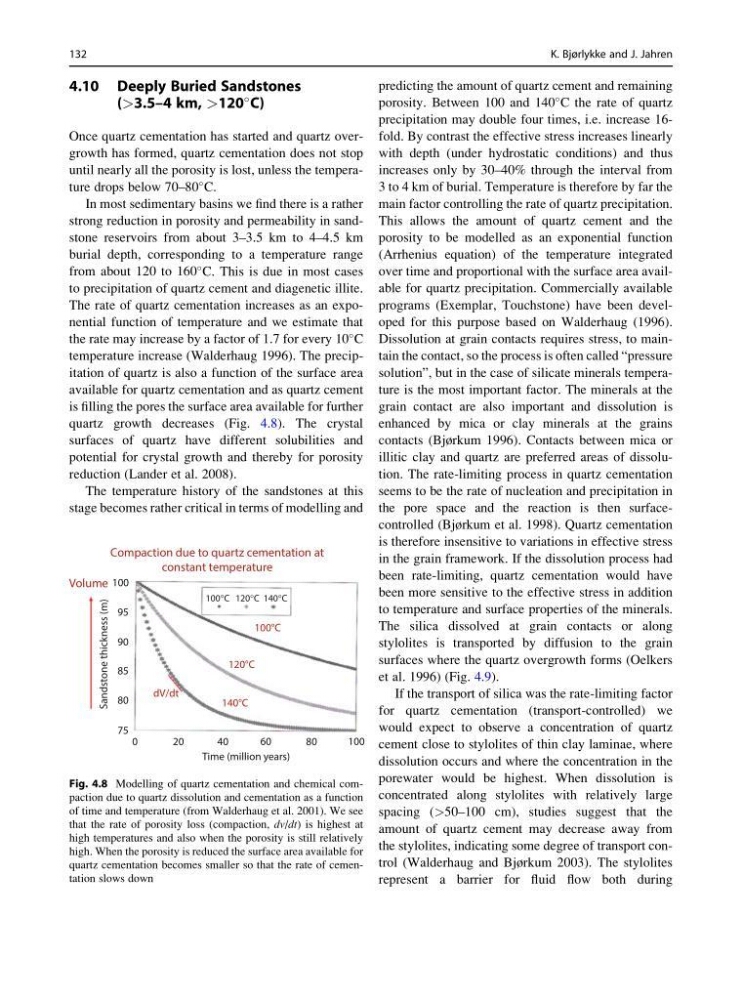
temperature increase (Walderhaug 1996). The precipitation of quartz is also a function of the surface area
available for quartz cementation and as quartz cement
is filling the pores the surface area available for further
quartz growth decreases (Fig. 4.8). The crystal
surfaces of quartz have different solubilities and
potential for crystal growth and thereby for porosity
reduction (Lander et al. 2008).
The temperature history of the sandstones at this
stage becomes rather critical in terms of modelling and
predicting the amount of quartz cement and remaining
porosity. Between 100 and 140
C the rate of quartz
precipitation may double four times, i.e. increase 16fold. By contrast the effective stress increases linearly
with depth (under hydrostatic conditions) and thus
increases only by 30–40% through the interval from
3 to 4 km of burial. Temperature is therefore by far the
main factor controlling the rate of quartz precipitation.
This allows the amount of quartz cement and the
porosity to be modelled as an exponential function
(Arrhenius equation) of the temperature integrated
over time and proportional with the surface area available for quartz precipitation. Commercially available
programs (Exemplar, Touchstone) have been developed for this purpose based on Walderhaug (1996).
Dissolution at grain contacts requires stress, to maintain the contact, so the process is often called “pressure
solution”, but in the case of silicate minerals temperature is the most important factor. The minerals at the
grain contact are also important and dissolution is
enhanced by mica or clay minerals at the grains
contacts (Bjørkum 1996). Contacts between mica or
illitic clay and quartz are preferred areas of dissolution. The rate-limiting process in quartz cementation
seems to be the rate of nucleation and precipitation in
the pore space and the reaction is then surfacecontrolled (Bjørkum et al. 1998). Quartz cementation
is therefore insensitive to variations in effective stress
in the grain framework. If the dissolution process had
been rate-limiting, quartz cementation would have
been more sensitive to the effective stress in addition
to temperature and surface properties of the minerals.
The silica dissolved at grain contacts or along
stylolites is transported by diffusion to the grain
surfaces where the quartz overgrowth forms (Oelkers
et al. 1996) (Fig. 4.9).
If the transport of silica was the rate-limiting factor
for quartz cementation (transport-controlled) we
would expect to observe a concentration of quartz
cement close to stylolites of thin clay laminae, where
dissolution occurs and where the concentration in the
porewater would be highest. When dissolution is
concentrated along stylolites with relatively large
spacing (>50–100 cm), studies suggest that the
amount of quartz cement may decrease away from
the stylolites, indicating some degree of transport control (Walderhaug and Bjørkum 2003). The stylolites
represent a barrier for fluid flow both during
Compaction due to quartz cementation at
constant temperature
Volume 100
95
90
85
80
75
0
Sandstone thickness (m)
Time (million years)
20
40
60
80
100
100°C
100°C
120°C
140°C
dV/dt
120°C 140°C
Fig. 4.8 Modelling of quartz cementation and chemical compaction due to quartz dissolution and cementation as a function
of time and temperature (from Walderhaug et al. 2001). We see
that the rate of porosity loss (compaction, dv/dt) is highest at
high temperatures and also when the porosity is still relatively
high. When the porosity is reduced the surface area available for
quartz cementation becomes smaller so that the rate of cementation slows down
132
K. Bjørlykke and J. Jahren
(>3.5–4 km, >120
C)
Once quartz cementation has started and quartz overgrowth has formed, quartz cementation does not stop
until nearly all the porosity is lost, unless the temperature drops below 70–80
C.
In most sedimentary basins we find there is a rather
strong reduction in porosity and permeability in sandstone reservoirs from about 3–3.5 km to 4–4.5 km
burial depth, corresponding to a temperature range
from about 120 to 160
C. This is due in most cases
to precipitation of quartz cement and diagenetic illite.
The rate of quartz cementation increases as an exponential function of temperature and we estimate that
the rate may increase by a factor of 1.7 for every 10
C
temperature increase (Walderhaug 1996). The precipitation of quartz is also a function of the surface area
available for quartz cementation and as quartz cement
is filling the pores the surface area available for further
quartz growth decreases (Fig. 4.8). The crystal
surfaces of quartz have different solubilities and
potential for crystal growth and thereby for porosity
reduction (Lander et al. 2008).
The temperature history of the sandstones at this
stage becomes rather critical in terms of modelling and
predicting the amount of quartz cement and remaining
porosity. Between 100 and 140
C the rate of quartz
precipitation may double four times, i.e. increase 16fold. By contrast the effective stress increases linearly
with depth (under hydrostatic conditions) and thus
increases only by 30–40% through the interval from
3 to 4 km of burial. Temperature is therefore by far the
main factor controlling the rate of quartz precipitation.
This allows the amount of quartz cement and the
porosity to be modelled as an exponential function
(Arrhenius equation) of the temperature integrated
over time and proportional with the surface area available for quartz precipitation. Commercially available
programs (Exemplar, Touchstone) have been developed for this purpose based on Walderhaug (1996).
Dissolution at grain contacts requires stress, to maintain the contact, so the process is often called “pressure
solution”, but in the case of silicate minerals temperature is the most important factor. The minerals at the
grain contact are also important and dissolution is
enhanced by mica or clay minerals at the grains
contacts (Bjørkum 1996). Contacts between mica or
illitic clay and quartz are preferred areas of dissolution. The rate-limiting process in quartz cementation
seems to be the rate of nucleation and precipitation in
the pore space and the reaction is then surfacecontrolled (Bjørkum et al. 1998). Quartz cementation
is therefore insensitive to variations in effective stress
in the grain framework. If the dissolution process had
been rate-limiting, quartz cementation would have
been more sensitive to the effective stress in addition
to temperature and surface properties of the minerals.
The silica dissolved at grain contacts or along
stylolites is transported by diffusion to the grain
surfaces where the quartz overgrowth forms (Oelkers
et al. 1996) (Fig. 4.9).
If the transport of silica was the rate-limiting factor
for quartz cementation (transport-controlled) we
would expect to observe a concentration of quartz
cement close to stylolites of thin clay laminae, where
dissolution occurs and where the concentration in the
porewater would be highest. When dissolution is
concentrated along stylolites with relatively large
spacing (>50–100 cm), studies suggest that the
amount of quartz cement may decrease away from
the stylolites, indicating some degree of transport control (Walderhaug and Bjørkum 2003). The stylolites
represent a barrier for fluid flow both during
Compaction due to quartz cementation at
constant temperature
Volume 100
95
90
85
80
75
0
Sandstone thickness (m)
Time (million years)
20
40
60
80
100
100°C
100°C
120°C
140°C
dV/dt
120°C 140°C
Fig. 4.8 Modelling of quartz cementation and chemical compaction due to quartz dissolution and cementation as a function
of time and temperature (from Walderhaug et al. 2001). We see
that the rate of porosity loss (compaction, dv/dt) is highest at
high temperatures and also when the porosity is still relatively
high. When the porosity is reduced the surface area available for
quartz cementation becomes smaller so that the rate of cementation slows down
132
K. Bjørlykke and J. Jahren