

a
2272
100 μm
200 μm
5 μm
100 μm
15KV
10μm WD32
Primary clastic grain
Quartz cement (overgrowth)
b
c
d
e
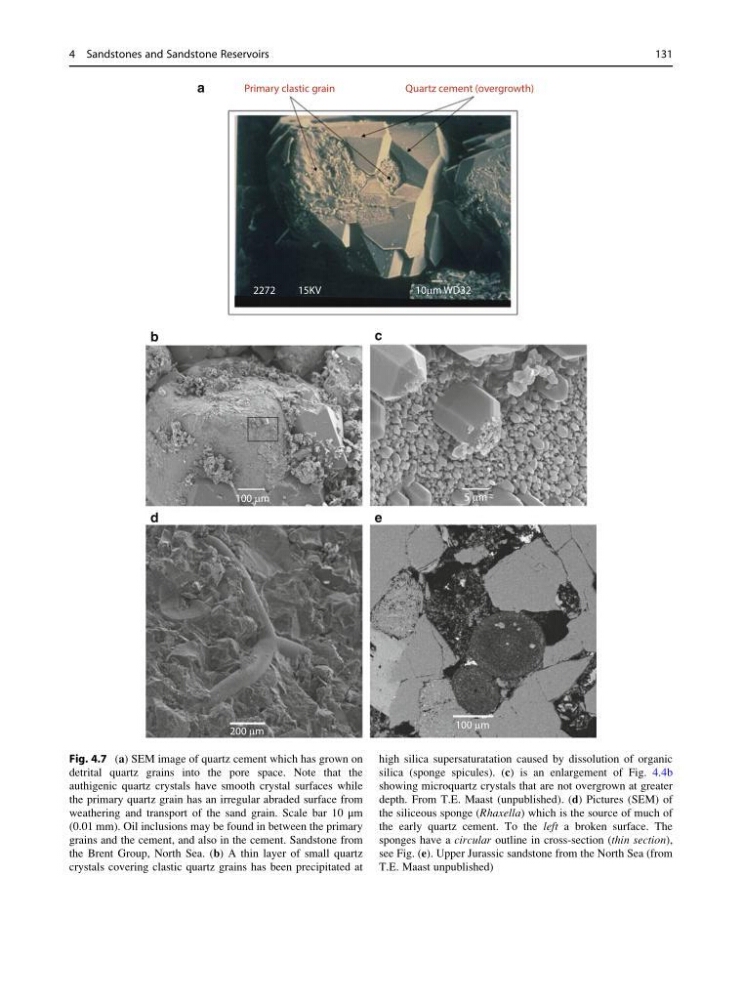
Fig. 4.7 (a) SEM image of quartz cement which has grown on
detrital quartz grains into the pore space. Note that the
authigenic quartz crystals have smooth crystal surfaces while
the primary quartz grain has an irregular abraded surface from
weathering and transport of the sand grain. Scale bar 10 μm
(0.01 mm). Oil inclusions may be found in between the primary
grains and the cement, and also in the cement. Sandstone from
the Brent Group, North Sea. (b) A thin layer of small quartz
crystals covering clastic quartz grains has been precipitated at
high silica supersaturatation caused by dissolution of organic
silica (sponge spicules). (c) is an enlargement of Fig. 4.4b
showing microquartz crystals that are not overgrown at greater
depth. From T.E. Maast (unpublished). (d) Pictures (SEM) of
the siliceous sponge (Rhaxella) which is the source of much of
the early quartz cement. To the left a broken surface. The
sponges have a circular outline in cross-section (thin section),
see Fig. (e). Upper Jurassic sandstone from the North Sea (from
T.E. Maast unpublished)
4 Sandstones and Sandstone Reservoirs
131
2272
100 μm
200 μm
5 μm
100 μm
15KV
10μm WD32
Primary clastic grain
Quartz cement (overgrowth)
b
c
d
e
Fig. 4.7 (a) SEM image of quartz cement which has grown on
detrital quartz grains into the pore space. Note that the
authigenic quartz crystals have smooth crystal surfaces while
the primary quartz grain has an irregular abraded surface from
weathering and transport of the sand grain. Scale bar 10 μm
(0.01 mm). Oil inclusions may be found in between the primary
grains and the cement, and also in the cement. Sandstone from
the Brent Group, North Sea. (b) A thin layer of small quartz
crystals covering clastic quartz grains has been precipitated at
high silica supersaturatation caused by dissolution of organic
silica (sponge spicules). (c) is an enlargement of Fig. 4.4b
showing microquartz crystals that are not overgrown at greater
depth. From T.E. Maast (unpublished). (d) Pictures (SEM) of
the siliceous sponge (Rhaxella) which is the source of much of
the early quartz cement. To the left a broken surface. The
sponges have a circular outline in cross-section (thin section),
see Fig. (e). Upper Jurassic sandstone from the North Sea (from
T.E. Maast unpublished)
4 Sandstones and Sandstone Reservoirs
131