

porewater by evaporation, and quartz is also forming
in some alkaline African lakes.
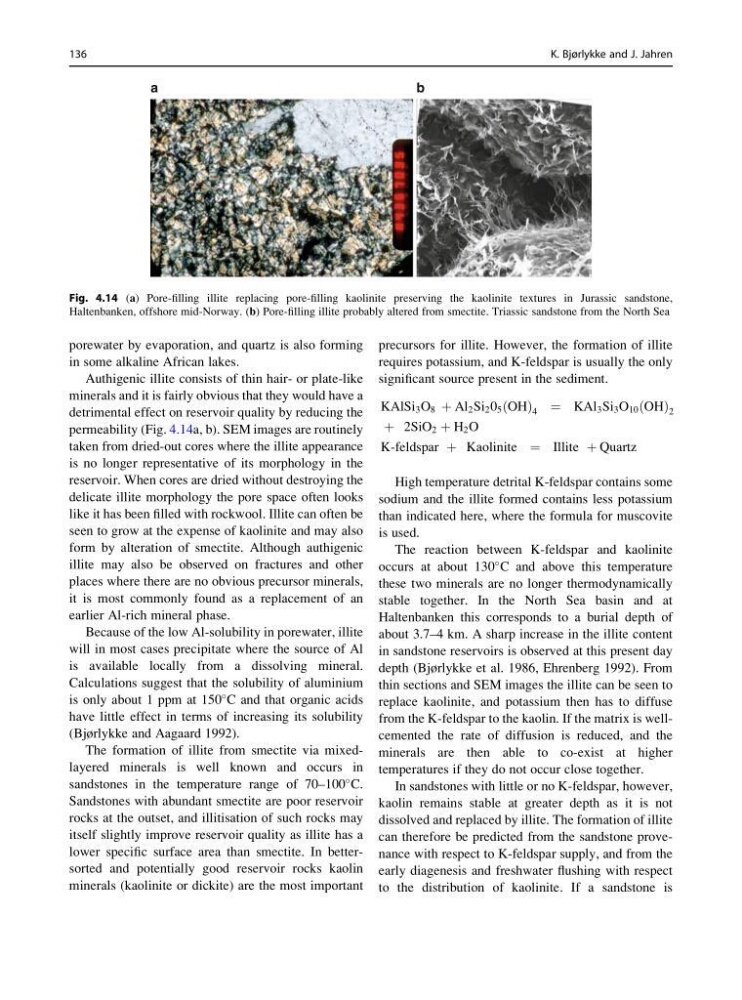
Authigenic illite consists of thin hair- or plate-like
minerals and it is fairly obvious that they would have a
detrimental effect on reservoir quality by reducing the
permeability (Fig. 4.14a, b). SEM images are routinely
taken from dried-out cores where the illite appearance
is no longer representative of its morphology in the
reservoir. When cores are dried without destroying the
delicate illite morphology the pore space often looks
like it has been filled with rockwool. Illite can often be
seen to grow at the expense of kaolinite and may also
form by alteration of smectite. Although authigenic
illite may also be observed on fractures and other
places where there are no obvious precursor minerals,
it is most commonly found as a replacement of an
earlier Al-rich mineral phase.
Because of the low Al-solubility in porewater, illite
will in most cases precipitate where the source of Al
is available locally from a dissolving mineral.
Calculations suggest that the solubility of aluminium
is only about 1 ppm at 150
C and that organic acids
have little effect in terms of increasing its solubility
(Bjørlykke and Aagaard 1992).
The formation of illite from smectite via mixedlayered minerals is well known and occurs in
sandstones in the temperature range of 70–100
C.
Sandstones with abundant smectite are poor reservoir
rocks at the outset, and illitisation of such rocks may
itself slightly improve reservoir quality as illite has a
lower specific surface area than smectite. In bettersorted and potentially good reservoir rocks kaolin
minerals (kaolinite or dickite) are the most important
precursors for illite. However, the formation of illite
requires potassium, and K-feldspar is usually the only
significant source present in the sediment.
KAlSi 3 O 8 þ Al 2 Si 2 0 5 ðOHÞ 4 ¼ KAl 3 Si 3 O 10 ðOHÞ 2
þ 2SiO 2 þ H 2 O
K-feldspar þ Kaolinite ¼ Illite þ Quartz
High temperature detrital K-feldspar contains some
sodium and the illite formed contains less potassium
than indicated here, where the formula for muscovite
is used.
The reaction between K-feldspar and kaolinite
occurs at about 130
C and above this temperature
these two minerals are no longer thermodynamically
stable together. In the North Sea basin and at
Haltenbanken this corresponds to a burial depth of
about 3.7–4 km. A sharp increase in the illite content
in sandstone reservoirs is observed at this present day
depth (Bjørlykke et al. 1986, Ehrenberg 1992). From
thin sections and SEM images the illite can be seen to
replace kaolinite, and potassium then has to diffuse
from the K-feldspar to the kaolin. If the matrix is wellcemented the rate of diffusion is reduced, and the
minerals are then able to co-exist at higher
temperatures if they do not occur close together.
In sandstones with little or no K-feldspar, however,
kaolin remains stable at greater depth as it is not
dissolved and replaced by illite. The formation of illite
can therefore be predicted from the sandstone provenance with respect to K-feldspar supply, and from the
early diagenesis and freshwater flushing with respect
to the distribution of kaolinite. If a sandstone is
a
b
Fig. 4.14 (a) Pore-filling illite replacing pore-filling kaolinite preserving the kaolinite textures in Jurassic sandstone,
Haltenbanken, offshore mid-Norway. (b) Pore-filling illite probably altered from smectite. Triassic sandstone from the North Sea
136
K. Bjørlykke and J. Jahren
in some alkaline African lakes.
Authigenic illite consists of thin hair- or plate-like
minerals and it is fairly obvious that they would have a
detrimental effect on reservoir quality by reducing the
permeability (Fig. 4.14a, b). SEM images are routinely
taken from dried-out cores where the illite appearance
is no longer representative of its morphology in the
reservoir. When cores are dried without destroying the
delicate illite morphology the pore space often looks
like it has been filled with rockwool. Illite can often be
seen to grow at the expense of kaolinite and may also
form by alteration of smectite. Although authigenic
illite may also be observed on fractures and other
places where there are no obvious precursor minerals,
it is most commonly found as a replacement of an
earlier Al-rich mineral phase.
Because of the low Al-solubility in porewater, illite
will in most cases precipitate where the source of Al
is available locally from a dissolving mineral.
Calculations suggest that the solubility of aluminium
is only about 1 ppm at 150
C and that organic acids
have little effect in terms of increasing its solubility
(Bjørlykke and Aagaard 1992).
The formation of illite from smectite via mixedlayered minerals is well known and occurs in
sandstones in the temperature range of 70–100
C.
Sandstones with abundant smectite are poor reservoir
rocks at the outset, and illitisation of such rocks may
itself slightly improve reservoir quality as illite has a
lower specific surface area than smectite. In bettersorted and potentially good reservoir rocks kaolin
minerals (kaolinite or dickite) are the most important
precursors for illite. However, the formation of illite
requires potassium, and K-feldspar is usually the only
significant source present in the sediment.
KAlSi 3 O 8 þ Al 2 Si 2 0 5 ðOHÞ 4 ¼ KAl 3 Si 3 O 10 ðOHÞ 2
þ 2SiO 2 þ H 2 O
K-feldspar þ Kaolinite ¼ Illite þ Quartz
High temperature detrital K-feldspar contains some
sodium and the illite formed contains less potassium
than indicated here, where the formula for muscovite
is used.
The reaction between K-feldspar and kaolinite
occurs at about 130
C and above this temperature
these two minerals are no longer thermodynamically
stable together. In the North Sea basin and at
Haltenbanken this corresponds to a burial depth of
about 3.7–4 km. A sharp increase in the illite content
in sandstone reservoirs is observed at this present day
depth (Bjørlykke et al. 1986, Ehrenberg 1992). From
thin sections and SEM images the illite can be seen to
replace kaolinite, and potassium then has to diffuse
from the K-feldspar to the kaolin. If the matrix is wellcemented the rate of diffusion is reduced, and the
minerals are then able to co-exist at higher
temperatures if they do not occur close together.
In sandstones with little or no K-feldspar, however,
kaolin remains stable at greater depth as it is not
dissolved and replaced by illite. The formation of illite
can therefore be predicted from the sandstone provenance with respect to K-feldspar supply, and from the
early diagenesis and freshwater flushing with respect
to the distribution of kaolinite. If a sandstone is
a
b
Fig. 4.14 (a) Pore-filling illite replacing pore-filling kaolinite preserving the kaolinite textures in Jurassic sandstone,
Haltenbanken, offshore mid-Norway. (b) Pore-filling illite probably altered from smectite. Triassic sandstone from the North Sea
136
K. Bjørlykke and J. Jahren