

groundwater reacts with minerals and in some cases
with amorphous phases, it will approach equilibrium
with many of the minerals present and this will happen
first with carbonates. In the case of silicate minerals
these reactions are very slow so the porewater may
remain under- or supersaturated for a long time with
respect to silicate minerals like quartz and feldspar.
Depending on the elevation of the groundwater
table and the distribution of permeable layers
(sandstones), the flow of meteoric water can extend
beneath the seafloor far out into sedimentary basins.
Reactions between meteoric water and minerals occur
in the ground and are a kind of subsurface weathering
along the groundwater flow paths. Leaching by meteoric water is generally strong in fluvial and alluvial
sediments. Even within dry river beds there is a
focused flow of groundwater.
The groundwater level represents the head (potentiometric surface) for groundwater flow and groundwater therefore has a potential to flow through
sediments or other aquifers far below sea level.
The rates of leaching of minerals like feldspar and
mica and the precipitation of kaolinite are functions of
the flux of groundwater flowing through each rock
volume per unit of time. These are in principle
weathering reactions similar to those which take
place during normal weathering in a humid climate.
Cations like Na
+ and K
+ are stripped from silicate
minerals like feldspar and mica and brought into
solution.
We see from these reactions that low K
+
/H
+ ratios
will drive the reactions to the right. Dissolution of
feldspar and mica and precipitation of kaolinite
require that the reaction products, Na
+ , K
+ and silica,
are constantly removed and that there is a supply of
new freshwater which is undersaturated with respect to
feldspar and mica. Without a through flow of water
these reactions stop because the reaction products on
the right hand side of the equations are not removed.
Groundwater must flow into the ground and up to the
surface again or on to the seafloor. A clay coating on
feldspar often remains and the dissolved aluminium
and some of the silica is precipitated as kaolinite, so
there is a rather small increase in porosity and reduced
permeability (Fig. 4.4a). The pores between the kaolinite crystals may be too small (Fig. 4.4b, c) to be
filled with oil so that the oil saturation is reduced in
kaolinite-rich sandstones (see Chap. 20).
The silica released from feldspar dissolution can
normally not be precipitated as quartz because of the
low temperature near the surface, but remains in solution even if the porewater is highly supersaturated with
respect to quartz. Silica must, however, also be
removed along with potassium by the flowing water.
If the silica concentration in the porewater increases
too much, kaolinite is no longer stable and smectite
will precipitate instead. This happens in sediments rich
in volcanic material or biogenic silica and where the
flux of meteoric water is low. In a desert environment
evaporation of groundwater may increase the silica
concentration and make smectite more stable.
The porewater does not have to be acidic for kaolinite to form, but the K
+ /H
+ ratio must be low. If the
pH is high the K
+ concentration has to be correspondingly lower. Authigenic kaolinite may also form in
impure limestones as a result of meteoric water
flushing, and the porewater is then certainly not acidic.
Even if there is only a small amount of carbonate it
will buffer the composition of the porewater.
The average groundwater flux is determined by the
rainfall and the percentage of water infiltration into the
ground. In moderately humid climates the rainfall may
be 1 metre/year and the infiltration in the order of
0.1–0.3 metres/year. High-permeability subsurface
pathways (aquifers) focus the flow. The aquifers may
be sand or gravel beds in muddy sediments. Meteoric
water may penetrate deeply into sedimentary basins
because of the potential created by the head of the
groundwater table but the flux of meteoric water
decreases strongly in the deeper parts of basins.
The meteoric water will gradually become less
undersaturated with respect to minerals like feldspar
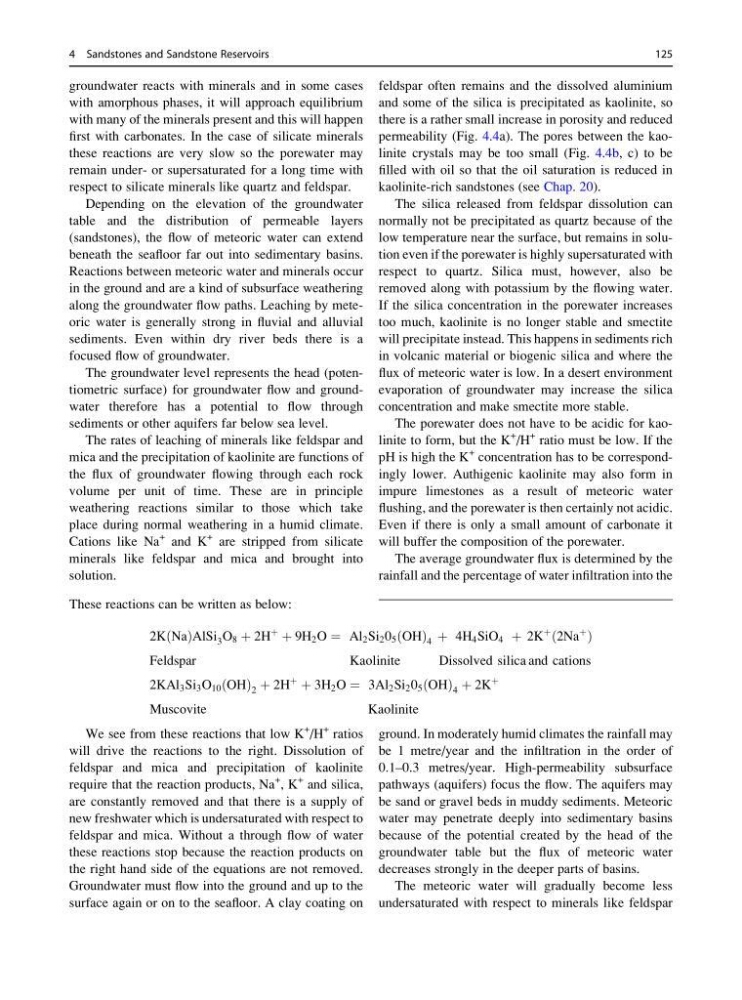
These reactions can be written as below:
2KðNaÞAlSi 3 O 8 þ 2H
þ
þ 9H 2 O ¼ Al 2 Si 2 0 5 ðOHÞ 4 þ 4H 4 SiO 4 þ 2K
þ
ð2Na
þ
Þ
Feldspar
Kaolinite
Dissolved silica and cations
2KAl 3 Si 3 O 10 ðOHÞ 2 þ 2H
þ
þ 3H 2 O ¼ 3Al 2 Si 2 0 5 ðOHÞ 4 þ 2K
þ
Muscovite
Kaolinite
4 Sandstones and Sandstone Reservoirs
125
with amorphous phases, it will approach equilibrium
with many of the minerals present and this will happen
first with carbonates. In the case of silicate minerals
these reactions are very slow so the porewater may
remain under- or supersaturated for a long time with
respect to silicate minerals like quartz and feldspar.
Depending on the elevation of the groundwater
table and the distribution of permeable layers
(sandstones), the flow of meteoric water can extend
beneath the seafloor far out into sedimentary basins.
Reactions between meteoric water and minerals occur
in the ground and are a kind of subsurface weathering
along the groundwater flow paths. Leaching by meteoric water is generally strong in fluvial and alluvial
sediments. Even within dry river beds there is a
focused flow of groundwater.
The groundwater level represents the head (potentiometric surface) for groundwater flow and groundwater therefore has a potential to flow through
sediments or other aquifers far below sea level.
The rates of leaching of minerals like feldspar and
mica and the precipitation of kaolinite are functions of
the flux of groundwater flowing through each rock
volume per unit of time. These are in principle
weathering reactions similar to those which take
place during normal weathering in a humid climate.
Cations like Na
+ and K
+ are stripped from silicate
minerals like feldspar and mica and brought into
solution.
We see from these reactions that low K
+
/H
+ ratios
will drive the reactions to the right. Dissolution of
feldspar and mica and precipitation of kaolinite
require that the reaction products, Na
+ , K
+ and silica,
are constantly removed and that there is a supply of
new freshwater which is undersaturated with respect to
feldspar and mica. Without a through flow of water
these reactions stop because the reaction products on
the right hand side of the equations are not removed.
Groundwater must flow into the ground and up to the
surface again or on to the seafloor. A clay coating on
feldspar often remains and the dissolved aluminium
and some of the silica is precipitated as kaolinite, so
there is a rather small increase in porosity and reduced
permeability (Fig. 4.4a). The pores between the kaolinite crystals may be too small (Fig. 4.4b, c) to be
filled with oil so that the oil saturation is reduced in
kaolinite-rich sandstones (see Chap. 20).
The silica released from feldspar dissolution can
normally not be precipitated as quartz because of the
low temperature near the surface, but remains in solution even if the porewater is highly supersaturated with
respect to quartz. Silica must, however, also be
removed along with potassium by the flowing water.
If the silica concentration in the porewater increases
too much, kaolinite is no longer stable and smectite
will precipitate instead. This happens in sediments rich
in volcanic material or biogenic silica and where the
flux of meteoric water is low. In a desert environment
evaporation of groundwater may increase the silica
concentration and make smectite more stable.
The porewater does not have to be acidic for kaolinite to form, but the K
+ /H
+ ratio must be low. If the
pH is high the K
+ concentration has to be correspondingly lower. Authigenic kaolinite may also form in
impure limestones as a result of meteoric water
flushing, and the porewater is then certainly not acidic.
Even if there is only a small amount of carbonate it
will buffer the composition of the porewater.
The average groundwater flux is determined by the
rainfall and the percentage of water infiltration into the
ground. In moderately humid climates the rainfall may
be 1 metre/year and the infiltration in the order of
0.1–0.3 metres/year. High-permeability subsurface
pathways (aquifers) focus the flow. The aquifers may
be sand or gravel beds in muddy sediments. Meteoric
water may penetrate deeply into sedimentary basins
because of the potential created by the head of the
groundwater table but the flux of meteoric water
decreases strongly in the deeper parts of basins.
The meteoric water will gradually become less
undersaturated with respect to minerals like feldspar
These reactions can be written as below:
2KðNaÞAlSi 3 O 8 þ 2H
þ
þ 9H 2 O ¼ Al 2 Si 2 0 5 ðOHÞ 4 þ 4H 4 SiO 4 þ 2K
þ
ð2Na
þ
Þ
Feldspar
Kaolinite
Dissolved silica and cations
2KAl 3 Si 3 O 10 ðOHÞ 2 þ 2H
þ
þ 3H 2 O ¼ 3Al 2 Si 2 0 5 ðOHÞ 4 þ 2K
þ
Muscovite
Kaolinite
4 Sandstones and Sandstone Reservoirs
125