

and mica and its leaching capacity will gradually
diminish. In the North Sea basin Middle Jurassic sandstone has been uplifted and eroded during the late
Jurassic, and later overlain by Cretaceous sediments.
Evidence of meteoric water leaching is however limited to a few metres below the unconformity (Bjørkum
et al. 1990). The most intense mineral leaching will
therefore occur near the surface or at relatively shallow depth beneath the seafloor. In areas with low
sedimentation rates the total flow of water through
the sediment will be higher because the sediments
remain longer at shallow depth. If the sediment stays
in the zone intensively flushed by meteoric water, the
amount of feldspar leaching will be high. In basins
with high sedimentation rates, synsedimentary
faulting (i.e. growth faults) may disconnect sand bodies from the main freshwater aquifers. The degree of
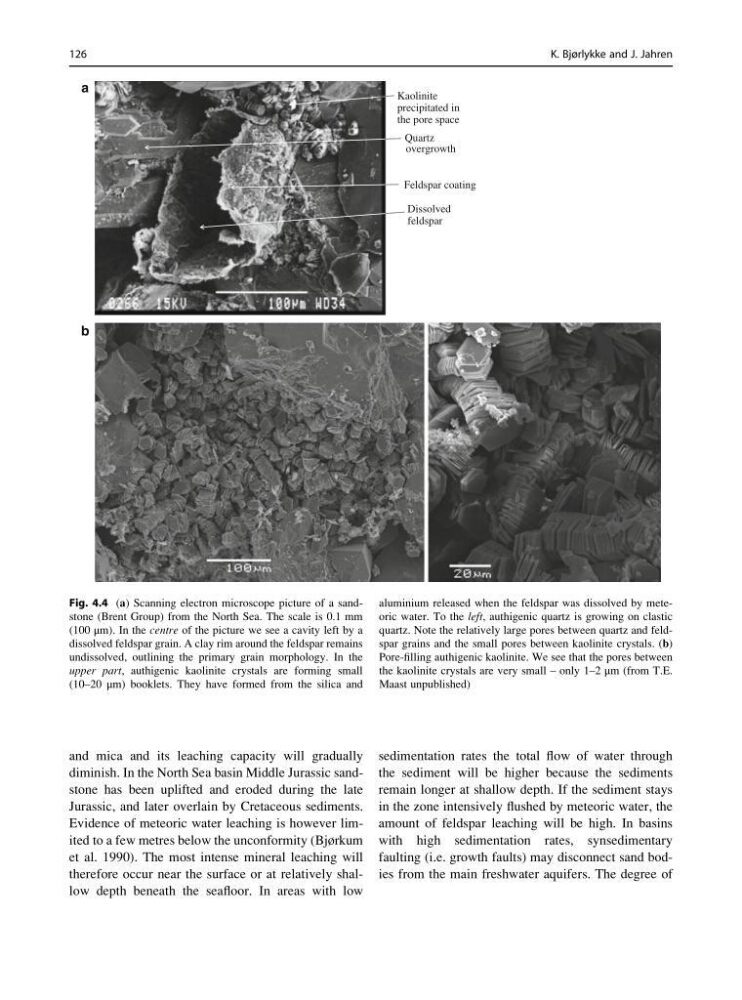
Dissolved
feldspar
Feldspar coating
Kaolinite
precipitated in
the pore space
Quartz
overgrowth
a
b
Fig. 4.4 (a) Scanning electron microscope picture of a sandstone (Brent Group) from the North Sea. The scale is 0.1 mm
(100 μm). In the centre of the picture we see a cavity left by a
dissolved feldspar grain. A clay rim around the feldspar remains
undissolved, outlining the primary grain morphology. In the
upper part, authigenic kaolinite crystals are forming small
(10–20 μm) booklets. They have formed from the silica and
aluminium released when the feldspar was dissolved by meteoric water. To the left, authigenic quartz is growing on clastic
quartz. Note the relatively large pores between quartz and feldspar grains and the small pores between kaolinite crystals. (b)
Pore-filling authigenic kaolinite. We see that the pores between
the kaolinite crystals are very small – only 1–2 μm (from T.E.
Maast unpublished)
126
K. Bjørlykke and J. Jahren
diminish. In the North Sea basin Middle Jurassic sandstone has been uplifted and eroded during the late
Jurassic, and later overlain by Cretaceous sediments.
Evidence of meteoric water leaching is however limited to a few metres below the unconformity (Bjørkum
et al. 1990). The most intense mineral leaching will
therefore occur near the surface or at relatively shallow depth beneath the seafloor. In areas with low
sedimentation rates the total flow of water through
the sediment will be higher because the sediments
remain longer at shallow depth. If the sediment stays
in the zone intensively flushed by meteoric water, the
amount of feldspar leaching will be high. In basins
with high sedimentation rates, synsedimentary
faulting (i.e. growth faults) may disconnect sand bodies from the main freshwater aquifers. The degree of
Dissolved
feldspar
Feldspar coating
Kaolinite
precipitated in
the pore space
Quartz
overgrowth
a
b
Fig. 4.4 (a) Scanning electron microscope picture of a sandstone (Brent Group) from the North Sea. The scale is 0.1 mm
(100 μm). In the centre of the picture we see a cavity left by a
dissolved feldspar grain. A clay rim around the feldspar remains
undissolved, outlining the primary grain morphology. In the
upper part, authigenic kaolinite crystals are forming small
(10–20 μm) booklets. They have formed from the silica and
aluminium released when the feldspar was dissolved by meteoric water. To the left, authigenic quartz is growing on clastic
quartz. Note the relatively large pores between quartz and feldspar grains and the small pores between kaolinite crystals. (b)
Pore-filling authigenic kaolinite. We see that the pores between
the kaolinite crystals are very small – only 1–2 μm (from T.E.
Maast unpublished)
126
K. Bjørlykke and J. Jahren