

recognise that they are concretions (Walderhaug and
Bjørkum 1998). Even if CO 2 is generated from organic
matter, there are few Ca
2+ sources available in
sandstones or mudstones for making calcite. Leaching
of plagioclase can supply some Ca
2+ , which can be
precipitated as calcite, but this can only account for
very small amounts of the calcite observed in such
sediments. The distribution of carbonate cement is
related to facies and sequence stratigraphy.
The evolution of pelagic planktonic calcareous
organisms in the Mesozoic drastically increased the
supply of carbonate on the seafloor, including in
deeper waters. Before then most of the carbonate was
produced by benthic organisms restricted to shallow
water facies. Upper Jurassic and younger sandstones
often contain abundant calcite cement due to the ‘rain’
of calcareous algae, foraminifera and other planktonic
organisms settling on the seafloor. Silica-producing
organisms may also be important for diagenesis and
reservoir quality at greater burial. Organisms like siliceous sponges are composed of amorphous silica
which at higher temperatures will be dissolved and
replaced by opal CT and quartz. Diatoms and
radiolarians may also be a major source of silica
which will be precipitated as quartz. Diatoms appeared
during the Cretaceous and have been a major source of
amorphous silica during the Cenozoic. Diatoms can
produce pure siliceous rocks like the Tertiary
Monterey Fm of California, which is both a source
rock and a fractured reservoir rock.
Biogenic carbonate is in most cases the main source
of calcite cement. The distribution of such cement
must therefore be linked to sedimentary facies, more
specifically to biological productivity relative to the
clastic sedimentation rate. Environments with low
clastic sedimentation rates, particularly submarine
highs, often have high organic carbonate production.
4.6
Meteoric Water Flow and Mineral
Dissolution
Meteoric water is rainwater which infiltrates the
ground. Initially this water is distilled water and therefore undersaturated with respect to all minerals. The
reactions between meteoric water and the land surface
are an important part of the weathering process. Rainwater contains carbon dioxide (CO 2 ) and sulphur dioxide (SO 2 ) from the air and is therefore slightly acidic,
producing carbonic acid ðH 2 CO 3 Þ and sulphuric acid
ðH 2 SO 4 Þ.
Some of the rainwater seeps down to the groundwater, and as long as the groundwater table is above
sea level, meteoric water will flow along the most
permeable beds into the basin. Meteoric water will
first dissolve carbonates and then slowly dissolve
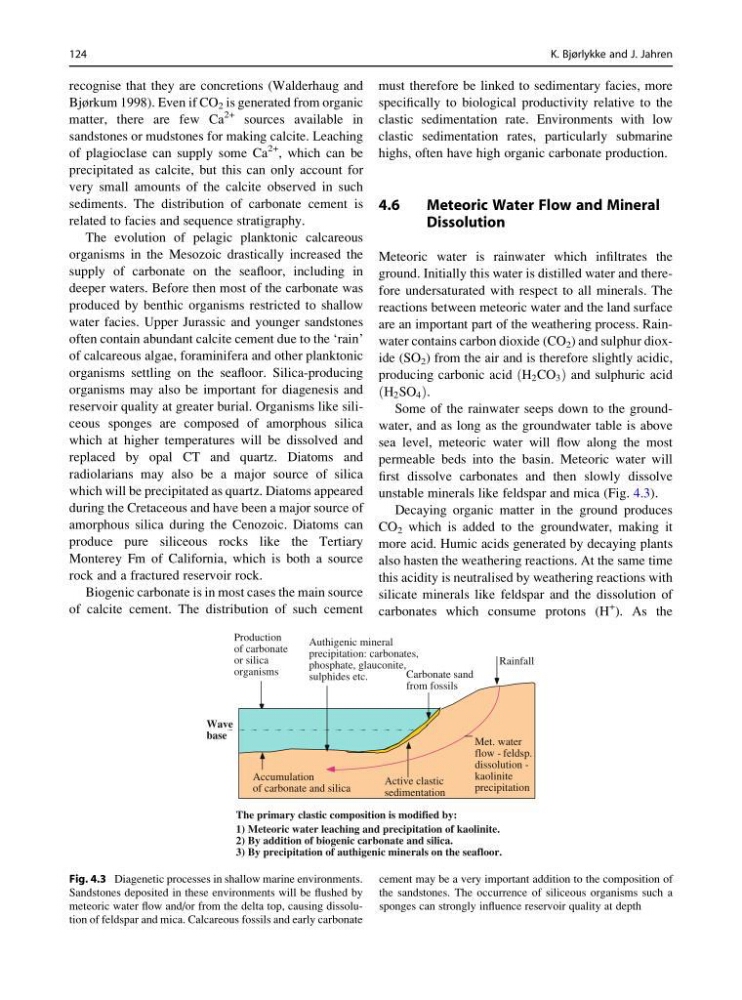
unstable minerals like feldspar and mica (Fig. 4.3).
Decaying organic matter in the ground produces
CO 2 which is added to the groundwater, making it
more acid. Humic acids generated by decaying plants
also hasten the weathering reactions. At the same time
this acidity is neutralised by weathering reactions with
silicate minerals like feldspar and the dissolution of
carbonates which consume protons (H
+
). As the
Carbonate sand
from fossils
Authigenic mineral
precipitation: carbonates,
phosphate, glauconite,
sulphides etc.
Active clastic
sedimentation
Production
of carbonate
or silica
organisms
Accumulation
of carbonate and silica
Met. water
flow - feldsp.
dissolution -
kaolinite
precipitation
The primary clastic composition is modified by:
1) Meteoric water leaching and precipitation of kaolinite.
2) By addition of biogenic carbonate and silica.
3) By precipitation of authigenic minerals on the seafloor.
Wave
base
Rainfall
Fig. 4.3 Diagenetic processes in shallow marine environments.
Sandstones deposited in these environments will be flushed by
meteoric water flow and/or from the delta top, causing dissolution of feldspar and mica. Calcareous fossils and early carbonate
cement may be a very important addition to the composition of
the sandstones. The occurrence of siliceous organisms such a
sponges can strongly influence reservoir quality at depth
124
K. Bjørlykke and J. Jahren
Bjørkum 1998). Even if CO 2 is generated from organic
matter, there are few Ca
2+ sources available in
sandstones or mudstones for making calcite. Leaching
of plagioclase can supply some Ca
2+ , which can be
precipitated as calcite, but this can only account for
very small amounts of the calcite observed in such
sediments. The distribution of carbonate cement is
related to facies and sequence stratigraphy.
The evolution of pelagic planktonic calcareous
organisms in the Mesozoic drastically increased the
supply of carbonate on the seafloor, including in
deeper waters. Before then most of the carbonate was
produced by benthic organisms restricted to shallow
water facies. Upper Jurassic and younger sandstones
often contain abundant calcite cement due to the ‘rain’
of calcareous algae, foraminifera and other planktonic
organisms settling on the seafloor. Silica-producing
organisms may also be important for diagenesis and
reservoir quality at greater burial. Organisms like siliceous sponges are composed of amorphous silica
which at higher temperatures will be dissolved and
replaced by opal CT and quartz. Diatoms and
radiolarians may also be a major source of silica
which will be precipitated as quartz. Diatoms appeared
during the Cretaceous and have been a major source of
amorphous silica during the Cenozoic. Diatoms can
produce pure siliceous rocks like the Tertiary
Monterey Fm of California, which is both a source
rock and a fractured reservoir rock.
Biogenic carbonate is in most cases the main source
of calcite cement. The distribution of such cement
must therefore be linked to sedimentary facies, more
specifically to biological productivity relative to the
clastic sedimentation rate. Environments with low
clastic sedimentation rates, particularly submarine
highs, often have high organic carbonate production.
4.6
Meteoric Water Flow and Mineral
Dissolution
Meteoric water is rainwater which infiltrates the
ground. Initially this water is distilled water and therefore undersaturated with respect to all minerals. The
reactions between meteoric water and the land surface
are an important part of the weathering process. Rainwater contains carbon dioxide (CO 2 ) and sulphur dioxide (SO 2 ) from the air and is therefore slightly acidic,
producing carbonic acid ðH 2 CO 3 Þ and sulphuric acid
ðH 2 SO 4 Þ.
Some of the rainwater seeps down to the groundwater, and as long as the groundwater table is above
sea level, meteoric water will flow along the most
permeable beds into the basin. Meteoric water will
first dissolve carbonates and then slowly dissolve
unstable minerals like feldspar and mica (Fig. 4.3).
Decaying organic matter in the ground produces
CO 2 which is added to the groundwater, making it
more acid. Humic acids generated by decaying plants
also hasten the weathering reactions. At the same time
this acidity is neutralised by weathering reactions with
silicate minerals like feldspar and the dissolution of
carbonates which consume protons (H
+
). As the
Carbonate sand
from fossils
Authigenic mineral
precipitation: carbonates,
phosphate, glauconite,
sulphides etc.
Active clastic
sedimentation
Production
of carbonate
or silica
organisms
Accumulation
of carbonate and silica
Met. water
flow - feldsp.
dissolution -
kaolinite
precipitation
The primary clastic composition is modified by:
1) Meteoric water leaching and precipitation of kaolinite.
2) By addition of biogenic carbonate and silica.
3) By precipitation of authigenic minerals on the seafloor.
Wave
base
Rainfall
Fig. 4.3 Diagenetic processes in shallow marine environments.
Sandstones deposited in these environments will be flushed by
meteoric water flow and/or from the delta top, causing dissolution of feldspar and mica. Calcareous fossils and early carbonate
cement may be a very important addition to the composition of
the sandstones. The occurrence of siliceous organisms such a
sponges can strongly influence reservoir quality at depth
124
K. Bjørlykke and J. Jahren