

Mica (muscovite and biotite) lose some potassium
which is replaced by water (H 2 O, H 3 O
+
) to form illite
(hydro mica). Clay minerals are also formed through
weathering reactions, for example by the breakdown
of feldspar and mica. Clay minerals which are formed
by the breakdown of other minerals within the sediment, are called authigenic.
Sheet silicates have a structure consisting of sheets
of alternating layers of SiO 4 tetrahedra and
octahedra. In the tetrahedral layers, silicon or aluminium atoms are surrounded by four oxygen atoms. In
the octahedral layers the cation is surrounded by six
oxygen or hydroxyl ions. Both bi and trivalent ions
can act as cations in the octahedral layer. In sheet
silicates with trivalent ions (e.g. Al
3+ ) only two of the
three positions in the octahedral layer are occupied,
and such minerals are therefore called dioctahedral.
With bivalent ions (Mg
++ , Fe
++ ) all three positions
must be filled to achieve a balance between the positive and negative charges, so these minerals are
called trioctohedral.
The main method of identifying clay minerals is Xray diffraction (XRD), by which the thickness of the
layers in the sheet silicate structure is determined
using X-rays which are diffracted according to
Bragg’s Law: nλ ¼ 2d sin φ. Here λ is the wavelength
of the X-ray, φ the angle of incidence and d the
thickness of the reflecting silicate layers; d is thus a
function of angle φ.
Sheet silicates may also be identified by means of
differential thermal analysis (DTA), which records
characteristic exothermal or endothermal reactions as
a function of temperature.
Figure 3.9 shows the structure of some of the main
clay minerals. Illite consists of sheets with two layers
of tetrahedra and one of octohedra, bonded together by
potassium. This ionic bonding is relatively weak so the
mineral cleaves easily along this plane. The bonds
within the tetrahedral and octahedral layers are more
covalent and stronger. The potassium content in mica
corresponding to the formula of mica is about 9%
K 2 O, while illite has a greater or lesser deficit of
potassium. Smectite (montmorillonite) has the same
structure except that most of the potassium is replaced
by water ðH 3 O
þ
Þ, other cations or organic compounds.
There are strong indications that smectite consists of
small particles of 10 A ˚ , plus water.
0.709
0.708
0.707
0
100
200
300
400
500
600 m.yr.
Ceno
zoic
Cret.
Jur.
Trias. Perm.. Carbon. Dev. Sil. Ord.
Cambr.
Precambr.
87
Sr/
86 Sr
High rates of
seafloor
spreading
87 Sr from land
(weathering and
erosion)
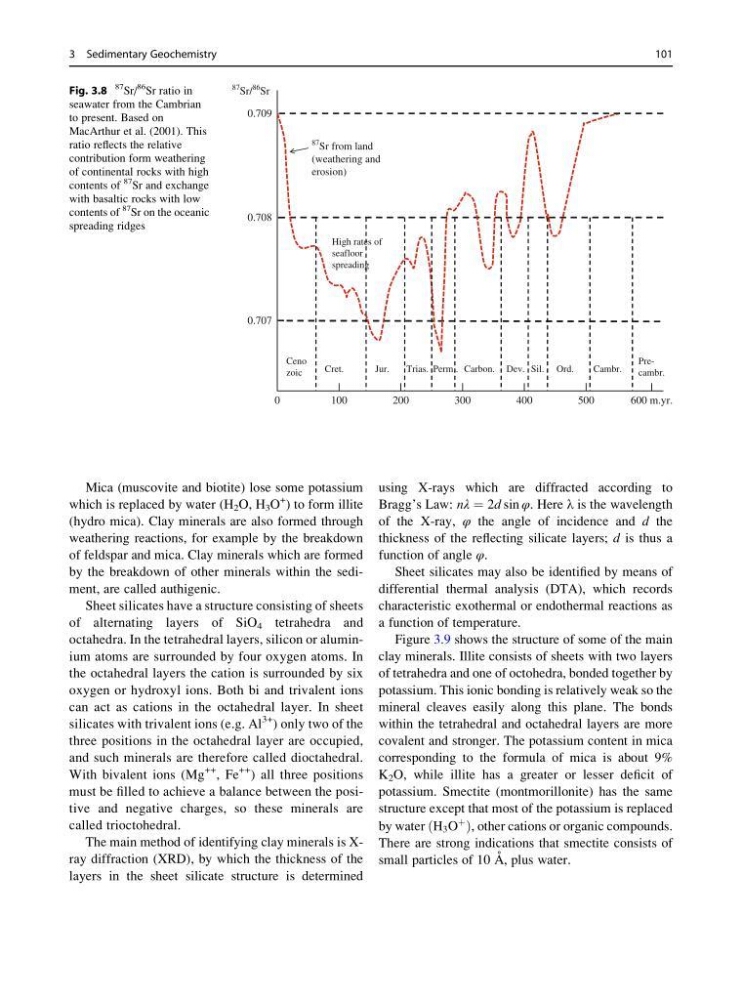
Fig. 3.8
87
Sr/
86
Sr ratio in
seawater from the Cambrian
to present. Based on
MacArthur et al. (2001). This
ratio reflects the relative
contribution form weathering
of continental rocks with high
contents of
87
Sr and exchange
with basaltic rocks with low
contents of
87
Sr on the oceanic
spreading ridges
3 Sedimentary Geochemistry
101
which is replaced by water (H 2 O, H 3 O
+
) to form illite
(hydro mica). Clay minerals are also formed through
weathering reactions, for example by the breakdown
of feldspar and mica. Clay minerals which are formed
by the breakdown of other minerals within the sediment, are called authigenic.
Sheet silicates have a structure consisting of sheets
of alternating layers of SiO 4 tetrahedra and
octahedra. In the tetrahedral layers, silicon or aluminium atoms are surrounded by four oxygen atoms. In
the octahedral layers the cation is surrounded by six
oxygen or hydroxyl ions. Both bi and trivalent ions
can act as cations in the octahedral layer. In sheet
silicates with trivalent ions (e.g. Al
3+ ) only two of the
three positions in the octahedral layer are occupied,
and such minerals are therefore called dioctahedral.
With bivalent ions (Mg
++ , Fe
++ ) all three positions
must be filled to achieve a balance between the positive and negative charges, so these minerals are
called trioctohedral.
The main method of identifying clay minerals is Xray diffraction (XRD), by which the thickness of the
layers in the sheet silicate structure is determined
using X-rays which are diffracted according to
Bragg’s Law: nλ ¼ 2d sin φ. Here λ is the wavelength
of the X-ray, φ the angle of incidence and d the
thickness of the reflecting silicate layers; d is thus a
function of angle φ.
Sheet silicates may also be identified by means of
differential thermal analysis (DTA), which records
characteristic exothermal or endothermal reactions as
a function of temperature.
Figure 3.9 shows the structure of some of the main
clay minerals. Illite consists of sheets with two layers
of tetrahedra and one of octohedra, bonded together by
potassium. This ionic bonding is relatively weak so the
mineral cleaves easily along this plane. The bonds
within the tetrahedral and octahedral layers are more
covalent and stronger. The potassium content in mica
corresponding to the formula of mica is about 9%
K 2 O, while illite has a greater or lesser deficit of
potassium. Smectite (montmorillonite) has the same
structure except that most of the potassium is replaced
by water ðH 3 O
þ
Þ, other cations or organic compounds.
There are strong indications that smectite consists of
small particles of 10 A ˚ , plus water.
0.709
0.708
0.707
0
100
200
300
400
500
600 m.yr.
Ceno
zoic
Cret.
Jur.
Trias. Perm.. Carbon. Dev. Sil. Ord.
Cambr.
Precambr.
87
Sr/
86 Sr
High rates of
seafloor
spreading
87 Sr from land
(weathering and
erosion)
Fig. 3.8
87
Sr/
86
Sr ratio in
seawater from the Cambrian
to present. Based on
MacArthur et al. (2001). This
ratio reflects the relative
contribution form weathering
of continental rocks with high
contents of
87
Sr and exchange
with basaltic rocks with low
contents of
87
Sr on the oceanic
spreading ridges
3 Sedimentary Geochemistry
101