

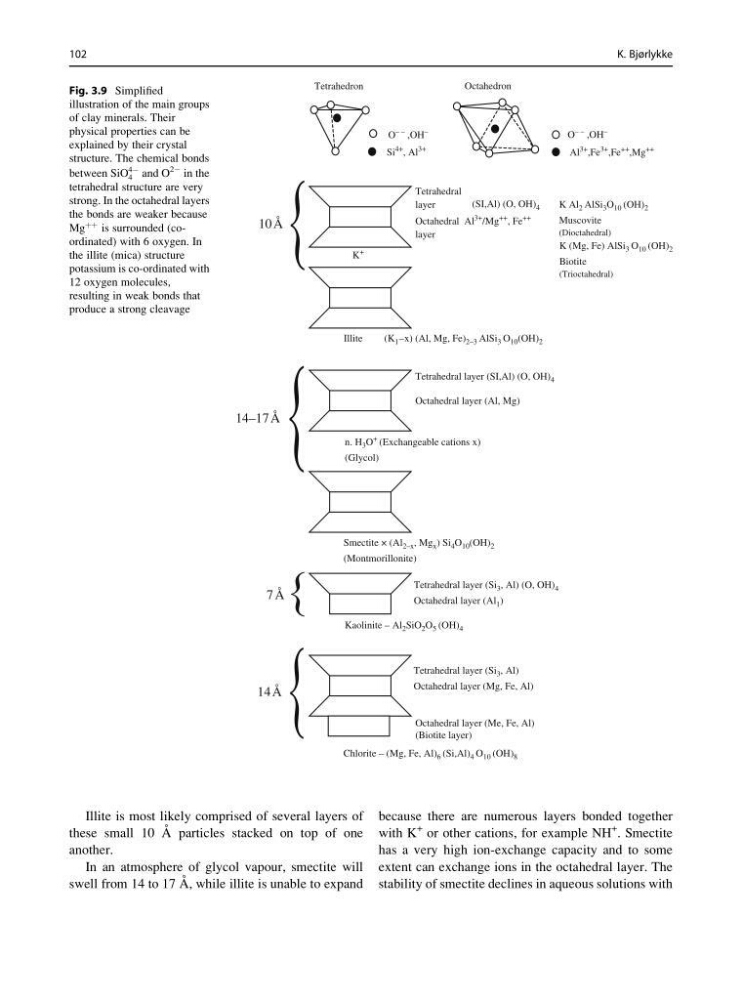
Illite is most likely comprised of several layers of
these small 10 A ˚ particles stacked on top of one
another.
In an atmosphere of glycol vapour, smectite will
swell from 14 to 17 A ˚ , while illite is unable to expand
because there are numerous layers bonded together
with K
+ or other cations, for example NH
+ . Smectite
has a very high ion-exchange capacity and to some
extent can exchange ions in the octahedral layer. The
stability of smectite declines in aqueous solutions with
{
{
{
{
Tetrahedron
Octahedron
Si
4+
, Al
3+
O
– – ,OH
–
O
– – ,OH
–
Tetrahedral
layer
(SI,Al) (O, OH) 4
Octahedral Al
3+ /Mg
++ , Fe
++
layer
Al
3+
,Fe
3+ ,Fe
++
,Mg
++
K Al 2 AlSi 3 O 10 (OH) 2
Muscovite
(Dioctahedral)
K (Mg, Fe) AlSi 3 O 10 (OH) 2
Biotite
(Trioctahedral)
Illite
(K 1 – x) (Al, Mg, Fe) 2–3 AlSi 3 O 10 (OH) 2
Tetrahedral layer (SI,Al) (O, OH) 4
Octahedral layer (Al, Mg)
n. H 3 O
+ (Exchangeable cations x)
(Glycol)
Smectite × (Al 2–x , Mg x ) Si 4 O 10 (OH) 2
(Montmorillonite)
Tetrahedral layer (Si 3 , Al) (O, OH) 4
Octahedral layer (Al 1 )
Kaolinite – Al 2 SiO 2 O 5 (OH) 4
Tetrahedral layer (Si 3 , Al)
Octahedral layer (Mg, Fe, Al)
Octahedral layer (Me, Fe, Al)
(Biotite layer)
Chlorite – (Mg, Fe, Al) 6 (Si,Al) 4 O 10 (OH) 8
14 Å
7 Å
14–17 Å
10 Å
K
+
Fig. 3.9 Simplified
illustration of the main groups
of clay minerals. Their
physical properties can be
explained by their crystal
structure. The chemical bonds
between SiO
4À
4 and O
2À in the
tetrahedral structure are very
strong. In the octahedral layers
the bonds are weaker because
Mg
þþ is surrounded (coordinated) with 6 oxygen. In
the illite (mica) structure
potassium is co-ordinated with
12 oxygen molecules,
resulting in weak bonds that
produce a strong cleavage
102
K. Bjørlykke
these small 10 A ˚ particles stacked on top of one
another.
In an atmosphere of glycol vapour, smectite will
swell from 14 to 17 A ˚ , while illite is unable to expand
because there are numerous layers bonded together
with K
+ or other cations, for example NH
+ . Smectite
has a very high ion-exchange capacity and to some
extent can exchange ions in the octahedral layer. The
stability of smectite declines in aqueous solutions with
{
{
{
{
Tetrahedron
Octahedron
Si
4+
, Al
3+
O
– – ,OH
–
O
– – ,OH
–
Tetrahedral
layer
(SI,Al) (O, OH) 4
Octahedral Al
3+ /Mg
++ , Fe
++
layer
Al
3+
,Fe
3+ ,Fe
++
,Mg
++
K Al 2 AlSi 3 O 10 (OH) 2
Muscovite
(Dioctahedral)
K (Mg, Fe) AlSi 3 O 10 (OH) 2
Biotite
(Trioctahedral)
Illite
(K 1 – x) (Al, Mg, Fe) 2–3 AlSi 3 O 10 (OH) 2
Tetrahedral layer (SI,Al) (O, OH) 4
Octahedral layer (Al, Mg)
n. H 3 O
+ (Exchangeable cations x)
(Glycol)
Smectite × (Al 2–x , Mg x ) Si 4 O 10 (OH) 2
(Montmorillonite)
Tetrahedral layer (Si 3 , Al) (O, OH) 4
Octahedral layer (Al 1 )
Kaolinite – Al 2 SiO 2 O 5 (OH) 4
Tetrahedral layer (Si 3 , Al)
Octahedral layer (Mg, Fe, Al)
Octahedral layer (Me, Fe, Al)
(Biotite layer)
Chlorite – (Mg, Fe, Al) 6 (Si,Al) 4 O 10 (OH) 8
14 Å
7 Å
14–17 Å
10 Å
K
+
Fig. 3.9 Simplified
illustration of the main groups
of clay minerals. Their
physical properties can be
explained by their crystal
structure. The chemical bonds
between SiO
4À
4 and O
2À in the
tetrahedral structure are very
strong. In the octahedral layers
the bonds are weaker because
Mg
þþ is surrounded (coordinated) with 6 oxygen. In
the illite (mica) structure
potassium is co-ordinated with
12 oxygen molecules,
resulting in weak bonds that
produce a strong cleavage
102
K. Bjørlykke