

little potassium and also rubidium which could form
87 Sr.
When there is rapid seafloor spreading a great deal
of water passes through the mid-oceanic ridges, so that
the seawater receives much Sr with a low
87 Sr=
86 S
ratio. During such periods, for example in the Jurassic
– Cretaceous, the creation of new warm sea floor will
lead to a transgression onto the continents. This
reduces the gradients and hence transporting capacity
of rivers, limiting the supply of clastic material to the
ocean.
Since the Jurassic, the
87 Sr=
86 Sr ratio has risen
almost continuously, and by analysing marine calcitic
fossils such as foraminifera, one can obtain rather
accurate age determinations. This applies particularly
to the Tertiary period, when the rise in the
87 Sr=
86 Sr
ratio was particularly rapid (Fig. 3.8).
The isotopic composition of clastic sediments can
also be used for stratigraphical correlation. Then it can
be more useful to employ isotopes which do not go
into solution and react with water, but retain the original age of the rocks from which they were eroded.
In the North Sea and on Haltenbanken the ratio
between the rare earth elements samarium and neodymium ð
147 Sm=
143 NdÞ was used to correlate reservoir rocks both in-field and regionally.
Detrital zirons separated from sandstones can be
used to indicate the source (provenance) of the
sediments based on their U-Pb age (Davis et al. 2003).
The composition of feldspar and heavy minerals
may also be used to indicate the areas of erosion
supplying sediments to the basins.
3.5
Clay Minerals
A number of minerals are referred to as clay minerals
because they predominantly occur in the finest grainsize fraction (clay fraction) of sediments and sedimentary rocks. However, this is not an accurate definition,
because the clay fraction contains many other minerals
than those we call clay minerals, and because the clay
minerals themselves are often larger than 4 μm
(0.004 mm). By “clay minerals” we usually mean
sheet silicates which consist chiefly of oxygen, silicon,
aluminium, magnesium, iron and water (H 2 O, OH
– ).
Clay minerals in sedimentary basins are partly derived
from sheet silicate minerals occurring in metamorphic
and igneous rocks (e.g. biotite, muscovite and chlorite), but during weathering and transport these clastic
minerals are typically altered from their initial composition in the parent rock.
2
δ
18
0 Calcite (PDB)
–4
–6
–10
20
40
80
120
Late Calcite
Cement ( type II )
Temperature o
C
–12 –14
–8
–2
0
0
100
60
140
160
Late Calcite
Cement (type I)
Measured range in calcites ( type I & II )
0
– 4
– 2
2
4
6
8
δ
1 8 O
H 2 O
( S M
O W
) =
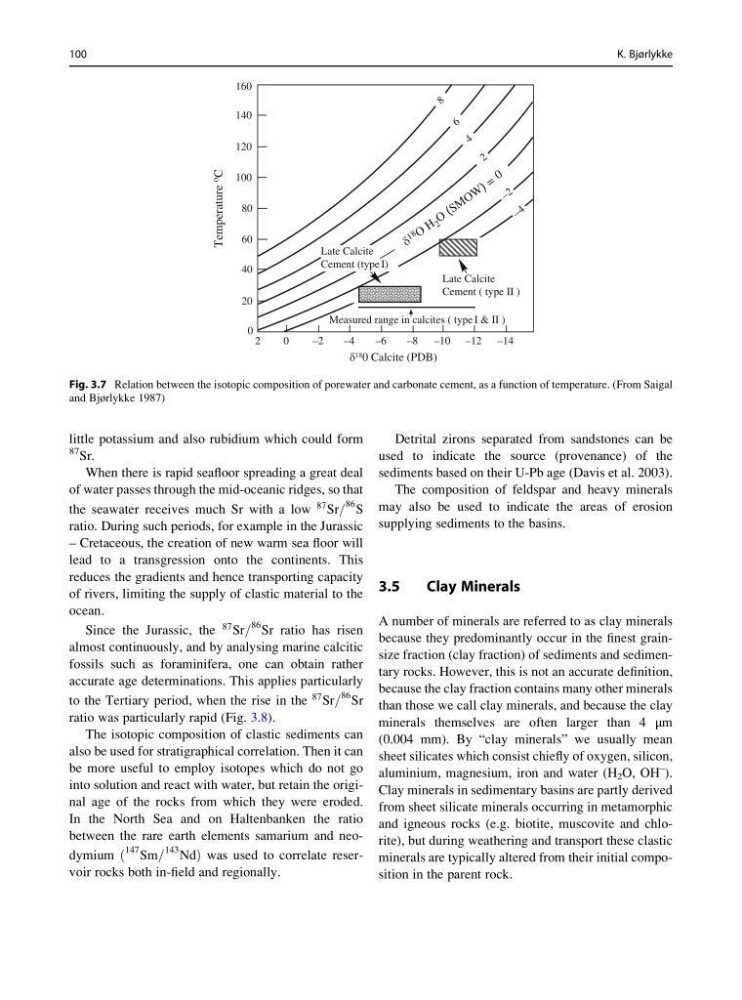
Fig. 3.7 Relation between the isotopic composition of porewater and carbonate cement, as a function of temperature. (From Saigal
and Bjørlykke 1987)
100
K. Bjørlykke
87 Sr.
When there is rapid seafloor spreading a great deal
of water passes through the mid-oceanic ridges, so that
the seawater receives much Sr with a low
87 Sr=
86 S
ratio. During such periods, for example in the Jurassic
– Cretaceous, the creation of new warm sea floor will
lead to a transgression onto the continents. This
reduces the gradients and hence transporting capacity
of rivers, limiting the supply of clastic material to the
ocean.
Since the Jurassic, the
87 Sr=
86 Sr ratio has risen
almost continuously, and by analysing marine calcitic
fossils such as foraminifera, one can obtain rather
accurate age determinations. This applies particularly
to the Tertiary period, when the rise in the
87 Sr=
86 Sr
ratio was particularly rapid (Fig. 3.8).
The isotopic composition of clastic sediments can
also be used for stratigraphical correlation. Then it can
be more useful to employ isotopes which do not go
into solution and react with water, but retain the original age of the rocks from which they were eroded.
In the North Sea and on Haltenbanken the ratio
between the rare earth elements samarium and neodymium ð
147 Sm=
143 NdÞ was used to correlate reservoir rocks both in-field and regionally.
Detrital zirons separated from sandstones can be
used to indicate the source (provenance) of the
sediments based on their U-Pb age (Davis et al. 2003).
The composition of feldspar and heavy minerals
may also be used to indicate the areas of erosion
supplying sediments to the basins.
3.5
Clay Minerals
A number of minerals are referred to as clay minerals
because they predominantly occur in the finest grainsize fraction (clay fraction) of sediments and sedimentary rocks. However, this is not an accurate definition,
because the clay fraction contains many other minerals
than those we call clay minerals, and because the clay
minerals themselves are often larger than 4 μm
(0.004 mm). By “clay minerals” we usually mean
sheet silicates which consist chiefly of oxygen, silicon,
aluminium, magnesium, iron and water (H 2 O, OH
– ).
Clay minerals in sedimentary basins are partly derived
from sheet silicate minerals occurring in metamorphic
and igneous rocks (e.g. biotite, muscovite and chlorite), but during weathering and transport these clastic
minerals are typically altered from their initial composition in the parent rock.
2
δ
18
0 Calcite (PDB)
–4
–6
–10
20
40
80
120
Late Calcite
Cement ( type II )
Temperature o
C
–12 –14
–8
–2
0
0
100
60
140
160
Late Calcite
Cement (type I)
Measured range in calcites ( type I & II )
0
– 4
– 2
2
4
6
8
δ
1 8 O
H 2 O
( S M
O W
) =
Fig. 3.7 Relation between the isotopic composition of porewater and carbonate cement, as a function of temperature. (From Saigal
and Bjørlykke 1987)
100
K. Bjørlykke