

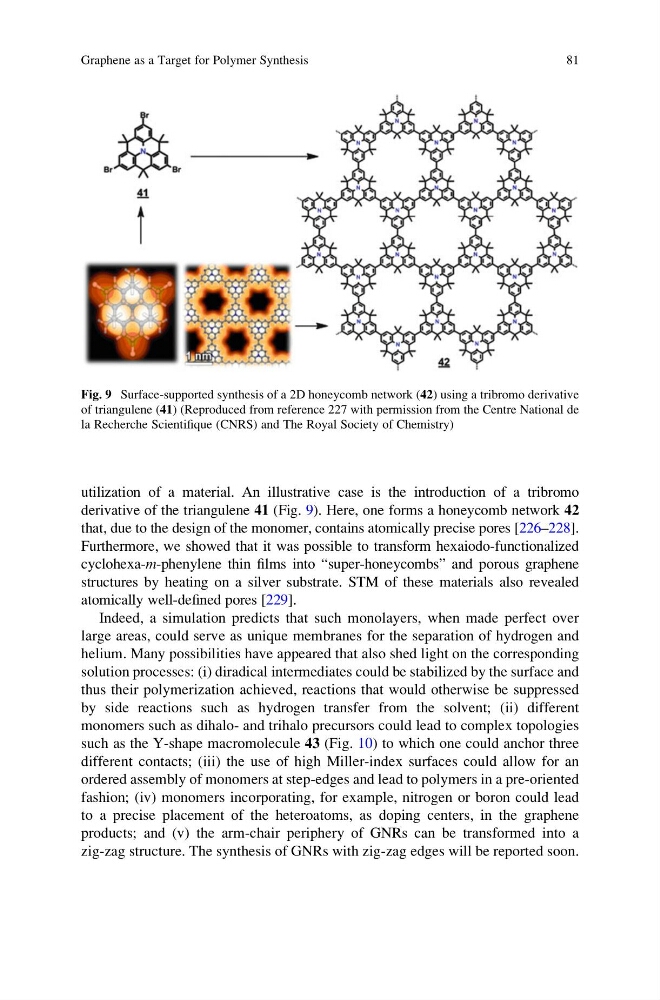
utilization of a material. An illustrative case is the introduction of a tribromo
derivative of the triangulene 41 (Fig. 9). Here, one forms a honeycomb network 42
that, due to the design of the monomer, contains atomically precise pores [226–228].
Furthermore, we showed that it was possible to transform hexaiodo-functionalized
cyclohexa-m-phenylene thin films into “super-honeycombs” and porous graphene
structures by heating on a silver substrate. STM of these materials also revealed
atomically well-defined pores [229].
Indeed, a simulation predicts that such monolayers, when made perfect over
large areas, could serve as unique membranes for the separation of hydrogen and
helium. Many possibilities have appeared that also shed light on the corresponding
solution processes: (i) diradical intermediates could be stabilized by the surface and
thus their polymerization achieved, reactions that would otherwise be suppressed
by side reactions such as hydrogen transfer from the solvent; (ii) different
monomers such as dihalo- and trihalo precursors could lead to complex topologies
such as the Y-shape macromolecule 43 (Fig. 10) to which one could anchor three
different contacts; (iii) the use of high Miller-index surfaces could allow for an
ordered assembly of monomers at step-edges and lead to polymers in a pre-oriented
fashion; (iv) monomers incorporating, for example, nitrogen or boron could lead
to a precise placement of the heteroatoms, as doping centers, in the graphene
products; and (v) the arm-chair periphery of GNRs can be transformed into a
zig-zag structure. The synthesis of GNRs with zig-zag edges will be reported soon.
Fig. 9 Surface-supported synthesis of a 2D honeycomb network (42) using a tribromo derivative
of triangulene (41) (Reproduced from reference 227 with permission from the Centre National de
la Recherche Scientifique (CNRS) and The Royal Society of Chemistry)
Graphene as a Target for Polymer Synthesis
81
derivative of the triangulene 41 (Fig. 9). Here, one forms a honeycomb network 42
that, due to the design of the monomer, contains atomically precise pores [226–228].
Furthermore, we showed that it was possible to transform hexaiodo-functionalized
cyclohexa-m-phenylene thin films into “super-honeycombs” and porous graphene
structures by heating on a silver substrate. STM of these materials also revealed
atomically well-defined pores [229].
Indeed, a simulation predicts that such monolayers, when made perfect over
large areas, could serve as unique membranes for the separation of hydrogen and
helium. Many possibilities have appeared that also shed light on the corresponding
solution processes: (i) diradical intermediates could be stabilized by the surface and
thus their polymerization achieved, reactions that would otherwise be suppressed
by side reactions such as hydrogen transfer from the solvent; (ii) different
monomers such as dihalo- and trihalo precursors could lead to complex topologies
such as the Y-shape macromolecule 43 (Fig. 10) to which one could anchor three
different contacts; (iii) the use of high Miller-index surfaces could allow for an
ordered assembly of monomers at step-edges and lead to polymers in a pre-oriented
fashion; (iv) monomers incorporating, for example, nitrogen or boron could lead
to a precise placement of the heteroatoms, as doping centers, in the graphene
products; and (v) the arm-chair periphery of GNRs can be transformed into a
zig-zag structure. The synthesis of GNRs with zig-zag edges will be reported soon.
Fig. 9 Surface-supported synthesis of a 2D honeycomb network (42) using a tribromo derivative
of triangulene (41) (Reproduced from reference 227 with permission from the Centre National de
la Recherche Scientifique (CNRS) and The Royal Society of Chemistry)
Graphene as a Target for Polymer Synthesis
81