

of this intermediate on the surface, to find a partner for growth of the chain; and
(iii) the non-planarity of the precursor while maintaining minimal steric hindrance
between phenyl substituents. Although it is, of course, fascinating to make polymers
under in-situ control by STM, there remain many critical issues. One point relates to
the occurrence of side reactions such as hydrogen transfer connecting two growing
ribbon structures to form complex networks, and the other concerns the mechanistic
question of how larger oligomers can diffuse on the surface to find their reaction
partner in a step-growth polymerization [224].
The reader might become aware of the fact that this surface-bound polymer
chemistry furnishes monolayers, and thus affords only negligible amounts of product.
It is therefore logical to ask whether this approach can be scaled up, and the answer
is unfortunately, no. In many cases, however, films from a monolayer or from a
few layers might give a desired function such as hole injection from an electrode
or charge carrier transport in a field-effect transistor. Such syntheses of films
made from single or a few layers would represent a highly economic and efficient
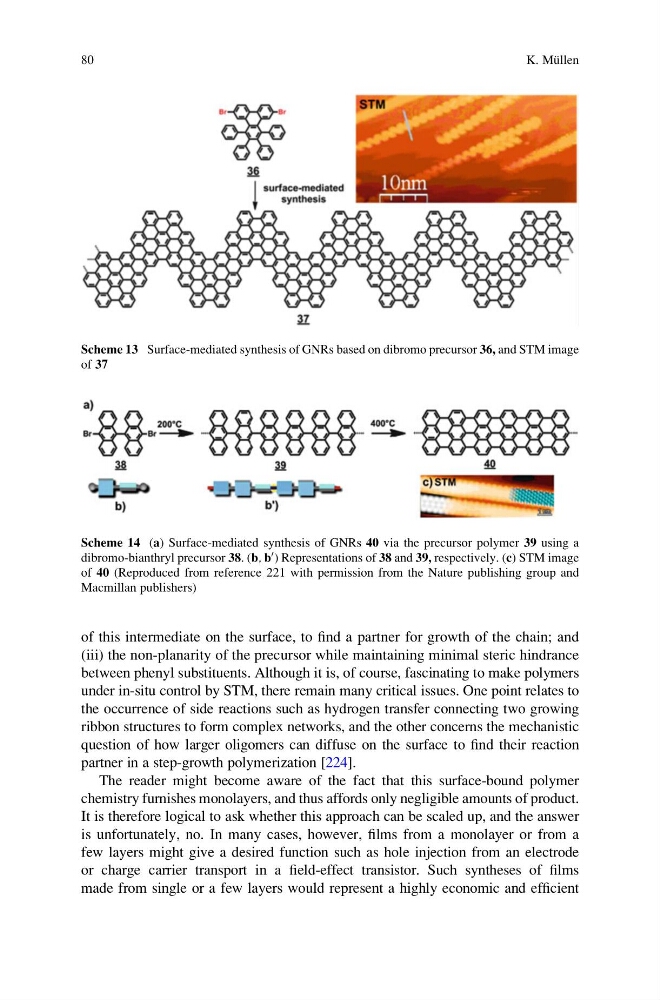
Scheme 13 Surface-mediated synthesis of GNRs based on dibromo precursor 36, and STM image
of 37
Scheme 14 (a) Surface-mediated synthesis of GNRs 40 via the precursor polymer 39 using a
dibromo-bianthryl precursor 38. (b, b
0 ) Representations of 38 and 39, respectively. (c) STM image
of 40 (Reproduced from reference 221 with permission from the Nature publishing group and
Macmillan publishers)
80
K. Mu ¨llen
(iii) the non-planarity of the precursor while maintaining minimal steric hindrance
between phenyl substituents. Although it is, of course, fascinating to make polymers
under in-situ control by STM, there remain many critical issues. One point relates to
the occurrence of side reactions such as hydrogen transfer connecting two growing
ribbon structures to form complex networks, and the other concerns the mechanistic
question of how larger oligomers can diffuse on the surface to find their reaction
partner in a step-growth polymerization [224].
The reader might become aware of the fact that this surface-bound polymer
chemistry furnishes monolayers, and thus affords only negligible amounts of product.
It is therefore logical to ask whether this approach can be scaled up, and the answer
is unfortunately, no. In many cases, however, films from a monolayer or from a
few layers might give a desired function such as hole injection from an electrode
or charge carrier transport in a field-effect transistor. Such syntheses of films
made from single or a few layers would represent a highly economic and efficient
Scheme 13 Surface-mediated synthesis of GNRs based on dibromo precursor 36, and STM image
of 37
Scheme 14 (a) Surface-mediated synthesis of GNRs 40 via the precursor polymer 39 using a
dibromo-bianthryl precursor 38. (b, b
0 ) Representations of 38 and 39, respectively. (c) STM image
of 40 (Reproduced from reference 221 with permission from the Nature publishing group and
Macmillan publishers)
80
K. Mu ¨llen