

monomers onto conducting metal surfaces and investigated opportunities of achieving
(i) polymerization and (ii) dehydrogenation while monitoring the reaction by STM.
Our test case for surface-immobilized chemical transformations of large PAHs
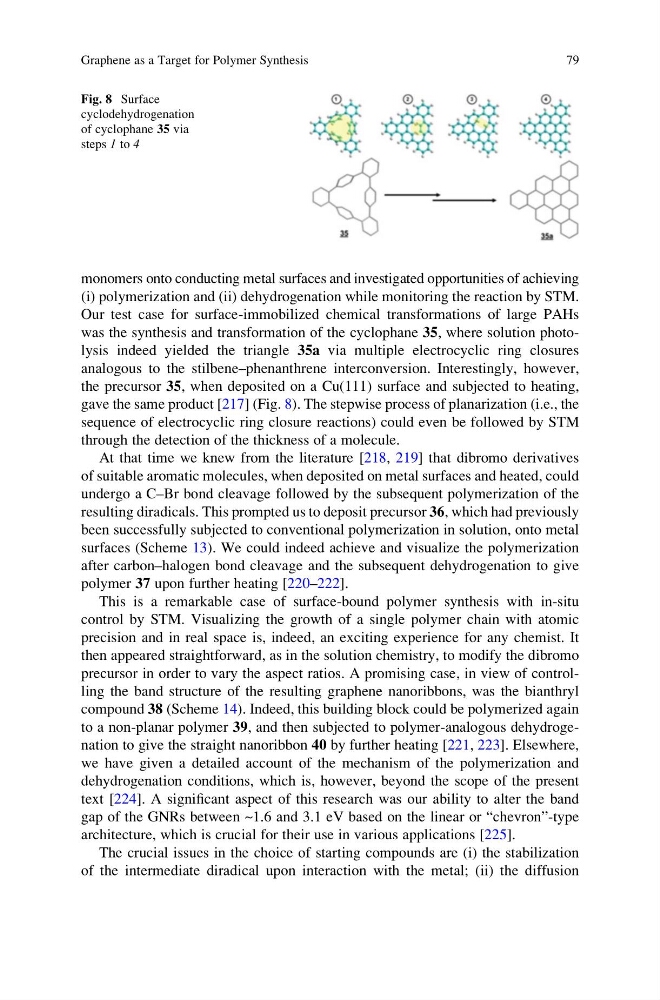
was the synthesis and transformation of the cyclophane 35, where solution photolysis indeed yielded the triangle 35a via multiple electrocyclic ring closures
analogous to the stilbene–phenanthrene interconversion. Interestingly, however,
the precursor 35, when deposited on a Cu(111) surface and subjected to heating,
gave the same product [217] (Fig. 8). The stepwise process of planarization (i.e., the
sequence of electrocyclic ring closure reactions) could even be followed by STM
through the detection of the thickness of a molecule.
At that time we knew from the literature [218, 219] that dibromo derivatives
of suitable aromatic molecules, when deposited on metal surfaces and heated, could
undergo a C–Br bond cleavage followed by the subsequent polymerization of the
resulting diradicals. This prompted us to deposit precursor 36, which had previously
been successfully subjected to conventional polymerization in solution, onto metal
surfaces (Scheme 13). We could indeed achieve and visualize the polymerization
after carbon–halogen bond cleavage and the subsequent dehydrogenation to give
polymer 37 upon further heating [220–222].
This is a remarkable case of surface-bound polymer synthesis with in-situ
control by STM. Visualizing the growth of a single polymer chain with atomic
precision and in real space is, indeed, an exciting experience for any chemist. It
then appeared straightforward, as in the solution chemistry, to modify the dibromo
precursor in order to vary the aspect ratios. A promising case, in view of controlling the band structure of the resulting graphene nanoribbons, was the bianthryl
compound 38 (Scheme 14). Indeed, this building block could be polymerized again
to a non-planar polymer 39, and then subjected to polymer-analogous dehydrogenation to give the straight nanoribbon 40 by further heating [221, 223]. Elsewhere,
we have given a detailed account of the mechanism of the polymerization and
dehydrogenation conditions, which is, however, beyond the scope of the present
text [224]. A significant aspect of this research was our ability to alter the band
gap of the GNRs between ~1.6 and 3.1 eV based on the linear or “chevron”-type
architecture, which is crucial for their use in various applications [225].
The crucial issues in the choice of starting compounds are (i) the stabilization
of the intermediate diradical upon interaction with the metal; (ii) the diffusion
Fig. 8 Surface
cyclodehydrogenation
of cyclophane 35 via
steps 1 to 4
Graphene as a Target for Polymer Synthesis
79
(i) polymerization and (ii) dehydrogenation while monitoring the reaction by STM.
Our test case for surface-immobilized chemical transformations of large PAHs
was the synthesis and transformation of the cyclophane 35, where solution photolysis indeed yielded the triangle 35a via multiple electrocyclic ring closures
analogous to the stilbene–phenanthrene interconversion. Interestingly, however,
the precursor 35, when deposited on a Cu(111) surface and subjected to heating,
gave the same product [217] (Fig. 8). The stepwise process of planarization (i.e., the
sequence of electrocyclic ring closure reactions) could even be followed by STM
through the detection of the thickness of a molecule.
At that time we knew from the literature [218, 219] that dibromo derivatives
of suitable aromatic molecules, when deposited on metal surfaces and heated, could
undergo a C–Br bond cleavage followed by the subsequent polymerization of the
resulting diradicals. This prompted us to deposit precursor 36, which had previously
been successfully subjected to conventional polymerization in solution, onto metal
surfaces (Scheme 13). We could indeed achieve and visualize the polymerization
after carbon–halogen bond cleavage and the subsequent dehydrogenation to give
polymer 37 upon further heating [220–222].
This is a remarkable case of surface-bound polymer synthesis with in-situ
control by STM. Visualizing the growth of a single polymer chain with atomic
precision and in real space is, indeed, an exciting experience for any chemist. It
then appeared straightforward, as in the solution chemistry, to modify the dibromo
precursor in order to vary the aspect ratios. A promising case, in view of controlling the band structure of the resulting graphene nanoribbons, was the bianthryl
compound 38 (Scheme 14). Indeed, this building block could be polymerized again
to a non-planar polymer 39, and then subjected to polymer-analogous dehydrogenation to give the straight nanoribbon 40 by further heating [221, 223]. Elsewhere,
we have given a detailed account of the mechanism of the polymerization and
dehydrogenation conditions, which is, however, beyond the scope of the present
text [224]. A significant aspect of this research was our ability to alter the band
gap of the GNRs between ~1.6 and 3.1 eV based on the linear or “chevron”-type
architecture, which is crucial for their use in various applications [225].
The crucial issues in the choice of starting compounds are (i) the stabilization
of the intermediate diradical upon interaction with the metal; (ii) the diffusion
Fig. 8 Surface
cyclodehydrogenation
of cyclophane 35 via
steps 1 to 4
Graphene as a Target for Polymer Synthesis
79