

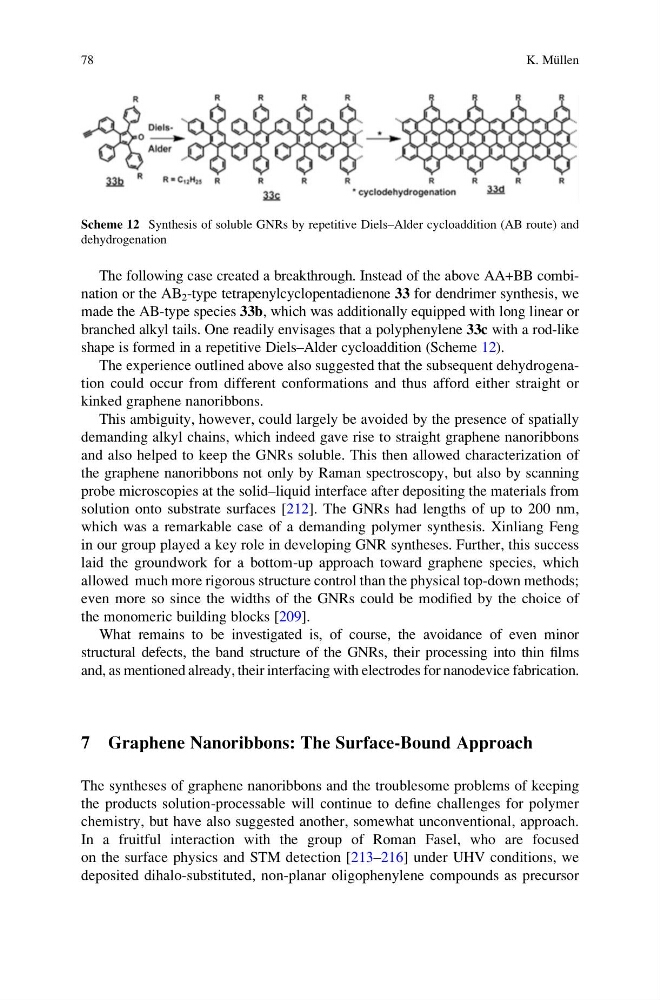
The following case created a breakthrough. Instead of the above AA+BB combination or the AB 2 -type tetrapenylcyclopentadienone 33 for dendrimer synthesis, we
made the AB-type species 33b, which was additionally equipped with long linear or
branched alkyl tails. One readily envisages that a polyphenylene 33c with a rod-like
shape is formed in a repetitive Diels–Alder cycloaddition (Scheme 12).
The experience outlined above also suggested that the subsequent dehydrogenation could occur from different conformations and thus afford either straight or
kinked graphene nanoribbons.
This ambiguity, however, could largely be avoided by the presence of spatially
demanding alkyl chains, which indeed gave rise to straight graphene nanoribbons
and also helped to keep the GNRs soluble. This then allowed characterization of
the graphene nanoribbons not only by Raman spectroscopy, but also by scanning
probe microscopies at the solid–liquid interface after depositing the materials from
solution onto substrate surfaces [212]. The GNRs had lengths of up to 200 nm,
which was a remarkable case of a demanding polymer synthesis. Xinliang Feng
in our group played a key role in developing GNR syntheses. Further, this success
laid the groundwork for a bottom-up approach toward graphene species, which
allowed much more rigorous structure control than the physical top-down methods;
even more so since the widths of the GNRs could be modified by the choice of
the monomeric building blocks [209].
What remains to be investigated is, of course, the avoidance of even minor
structural defects, the band structure of the GNRs, their processing into thin films
and, as mentioned already, their interfacing with electrodes for nanodevice fabrication.
7 Graphene Nanoribbons: The Surface-Bound Approach
The syntheses of graphene nanoribbons and the troublesome problems of keeping
the products solution-processable will continue to define challenges for polymer
chemistry, but have also suggested another, somewhat unconventional, approach.
In a fruitful interaction with the group of Roman Fasel, who are focused
on the surface physics and STM detection [213–216] under UHV conditions, we
deposited dihalo-substituted, non-planar oligophenylene compounds as precursor
Scheme 12 Synthesis of soluble GNRs by repetitive Diels–Alder cycloaddition (AB route) and
dehydrogenation
78
K. Mu ¨llen
made the AB-type species 33b, which was additionally equipped with long linear or
branched alkyl tails. One readily envisages that a polyphenylene 33c with a rod-like
shape is formed in a repetitive Diels–Alder cycloaddition (Scheme 12).
The experience outlined above also suggested that the subsequent dehydrogenation could occur from different conformations and thus afford either straight or
kinked graphene nanoribbons.
This ambiguity, however, could largely be avoided by the presence of spatially
demanding alkyl chains, which indeed gave rise to straight graphene nanoribbons
and also helped to keep the GNRs soluble. This then allowed characterization of
the graphene nanoribbons not only by Raman spectroscopy, but also by scanning
probe microscopies at the solid–liquid interface after depositing the materials from
solution onto substrate surfaces [212]. The GNRs had lengths of up to 200 nm,
which was a remarkable case of a demanding polymer synthesis. Xinliang Feng
in our group played a key role in developing GNR syntheses. Further, this success
laid the groundwork for a bottom-up approach toward graphene species, which
allowed much more rigorous structure control than the physical top-down methods;
even more so since the widths of the GNRs could be modified by the choice of
the monomeric building blocks [209].
What remains to be investigated is, of course, the avoidance of even minor
structural defects, the band structure of the GNRs, their processing into thin films
and, as mentioned already, their interfacing with electrodes for nanodevice fabrication.
7 Graphene Nanoribbons: The Surface-Bound Approach
The syntheses of graphene nanoribbons and the troublesome problems of keeping
the products solution-processable will continue to define challenges for polymer
chemistry, but have also suggested another, somewhat unconventional, approach.
In a fruitful interaction with the group of Roman Fasel, who are focused
on the surface physics and STM detection [213–216] under UHV conditions, we
deposited dihalo-substituted, non-planar oligophenylene compounds as precursor
Scheme 12 Synthesis of soluble GNRs by repetitive Diels–Alder cycloaddition (AB route) and
dehydrogenation
78
K. Mu ¨llen