

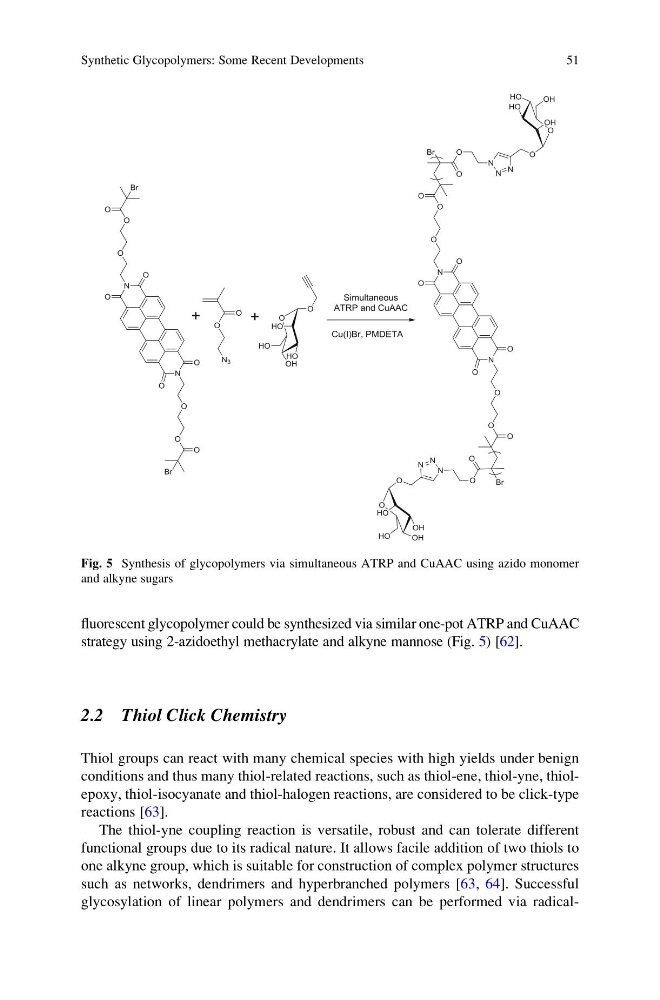
fluorescent glycopolymer could be synthesized via similar one-pot ATRP and CuAAC
strategy using 2-azidoethyl methacrylate and alkyne mannose (Fig. 5) [62].
2.2 Thiol Click Chemistry
Thiol groups can react with many chemical species with high yields under benign
conditions and thus many thiol-related reactions, such as thiol-ene, thiol-yne, thiolepoxy, thiol-isocyanate and thiol-halogen reactions, are considered to be click-type
reactions [63].
The thiol-yne coupling reaction is versatile, robust and can tolerate different
functional groups due to its radical nature. It allows facile addition of two thiols to
one alkyne group, which is suitable for construction of complex polymer structures
such as networks, dendrimers and hyperbranched polymers [63, 64]. Successful
glycosylation of linear polymers and dendrimers can be performed via radicalFig. 5 Synthesis of glycopolymers via simultaneous ATRP and CuAAC using azido monomer
and alkyne sugars
Synthetic Glycopolymers: Some Recent Developments
51
strategy using 2-azidoethyl methacrylate and alkyne mannose (Fig. 5) [62].
2.2 Thiol Click Chemistry
Thiol groups can react with many chemical species with high yields under benign
conditions and thus many thiol-related reactions, such as thiol-ene, thiol-yne, thiolepoxy, thiol-isocyanate and thiol-halogen reactions, are considered to be click-type
reactions [63].
The thiol-yne coupling reaction is versatile, robust and can tolerate different
functional groups due to its radical nature. It allows facile addition of two thiols to
one alkyne group, which is suitable for construction of complex polymer structures
such as networks, dendrimers and hyperbranched polymers [63, 64]. Successful
glycosylation of linear polymers and dendrimers can be performed via radicalFig. 5 Synthesis of glycopolymers via simultaneous ATRP and CuAAC using azido monomer
and alkyne sugars
Synthetic Glycopolymers: Some Recent Developments
51