

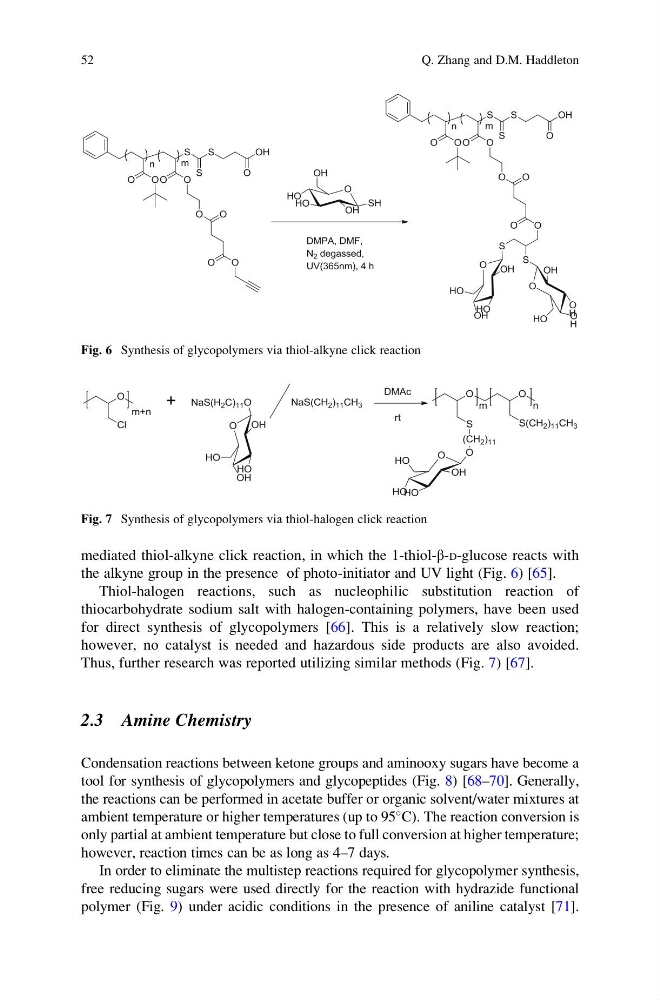
mediated thiol-alkyne click reaction, in which the 1-thiol-β-D-glucose reacts with
the alkyne group in the presence of photo-initiator and UV light (Fig. 6) [65].
Thiol-halogen reactions, such as nucleophilic substitution reaction of
thiocarbohydrate sodium salt with halogen-containing polymers, have been used
for direct synthesis of glycopolymers [66]. This is a relatively slow reaction;
however, no catalyst is needed and hazardous side products are also avoided.
Thus, further research was reported utilizing similar methods (Fig. 7) [67].
2.3 Amine Chemistry
Condensation reactions between ketone groups and aminooxy sugars have become a
tool for synthesis of glycopolymers and glycopeptides (Fig. 8) [68–70]. Generally,
the reactions can be performed in acetate buffer or organic solvent/water mixtures at
ambient temperature or higher temperatures (up to 95
C). The reaction conversion is
only partial at ambient temperature but close to full conversion at higher temperature;
however, reaction times can be as long as 4–7 days.
In order to eliminate the multistep reactions required for glycopolymer synthesis,
free reducing sugars were used directly for the reaction with hydrazide functional
polymer (Fig. 9) under acidic conditions in the presence of aniline catalyst [71].
Fig. 6 Synthesis of glycopolymers via thiol-alkyne click reaction
Fig. 7 Synthesis of glycopolymers via thiol-halogen click reaction
52
Q. Zhang and D.M. Haddleton
the alkyne group in the presence of photo-initiator and UV light (Fig. 6) [65].
Thiol-halogen reactions, such as nucleophilic substitution reaction of
thiocarbohydrate sodium salt with halogen-containing polymers, have been used
for direct synthesis of glycopolymers [66]. This is a relatively slow reaction;
however, no catalyst is needed and hazardous side products are also avoided.
Thus, further research was reported utilizing similar methods (Fig. 7) [67].
2.3 Amine Chemistry
Condensation reactions between ketone groups and aminooxy sugars have become a
tool for synthesis of glycopolymers and glycopeptides (Fig. 8) [68–70]. Generally,
the reactions can be performed in acetate buffer or organic solvent/water mixtures at
ambient temperature or higher temperatures (up to 95
C). The reaction conversion is
only partial at ambient temperature but close to full conversion at higher temperature;
however, reaction times can be as long as 4–7 days.
In order to eliminate the multistep reactions required for glycopolymer synthesis,
free reducing sugars were used directly for the reaction with hydrazide functional
polymer (Fig. 9) under acidic conditions in the presence of aniline catalyst [71].
Fig. 6 Synthesis of glycopolymers via thiol-alkyne click reaction
Fig. 7 Synthesis of glycopolymers via thiol-halogen click reaction
52
Q. Zhang and D.M. Haddleton