

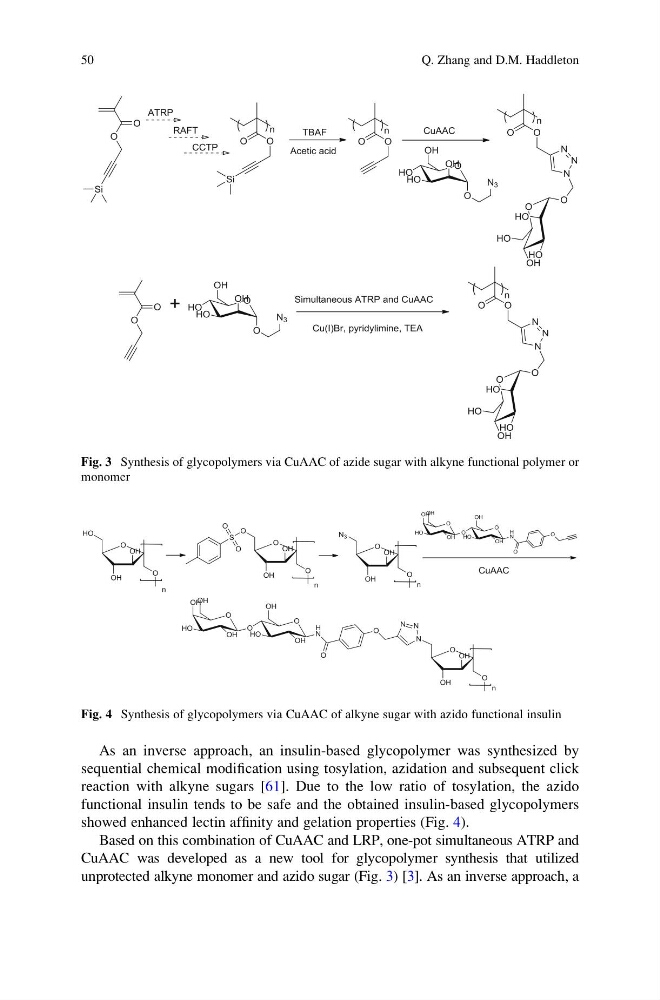
As an inverse approach, an insulin-based glycopolymer was synthesized by
sequential chemical modification using tosylation, azidation and subsequent click
reaction with alkyne sugars [61]. Due to the low ratio of tosylation, the azido
functional insulin tends to be safe and the obtained insulin-based glycopolymers
showed enhanced lectin affinity and gelation properties (Fig. 4).
Based on this combination of CuAAC and LRP, one-pot simultaneous ATRP and
CuAAC was developed as a new tool for glycopolymer synthesis that utilized
unprotected alkyne monomer and azido sugar (Fig. 3) [3]. As an inverse approach, a
Fig. 3 Synthesis of glycopolymers via CuAAC of azide sugar with alkyne functional polymer or
monomer
Fig. 4 Synthesis of glycopolymers via CuAAC of alkyne sugar with azido functional insulin
50
Q. Zhang and D.M. Haddleton
sequential chemical modification using tosylation, azidation and subsequent click
reaction with alkyne sugars [61]. Due to the low ratio of tosylation, the azido
functional insulin tends to be safe and the obtained insulin-based glycopolymers
showed enhanced lectin affinity and gelation properties (Fig. 4).
Based on this combination of CuAAC and LRP, one-pot simultaneous ATRP and
CuAAC was developed as a new tool for glycopolymer synthesis that utilized
unprotected alkyne monomer and azido sugar (Fig. 3) [3]. As an inverse approach, a
Fig. 3 Synthesis of glycopolymers via CuAAC of azide sugar with alkyne functional polymer or
monomer
Fig. 4 Synthesis of glycopolymers via CuAAC of alkyne sugar with azido functional insulin
50
Q. Zhang and D.M. Haddleton