

with brain tissue and represent a new class of synthetic biomaterials with potential
for applications as depots or scaffolds in the CNS [121].
In a follow up study, Sofroniew, Deming and colleagues examined the loading
and release of bioactive hydrophilic molecules from K 180 L 20 and E 180 L 20 hydrogels
in vitro and in vivo [122]. In vitro tests demonstrated sustained release from dialysis
cassettes of the representative protein (lysozyme) dissolved in K 180 L 20 or E 180 L 20
hydrogels. Release times of molecules in vitro varied in relation to hydrogel charge
and mechanical properties, and the ionic strength of the media. To evaluate
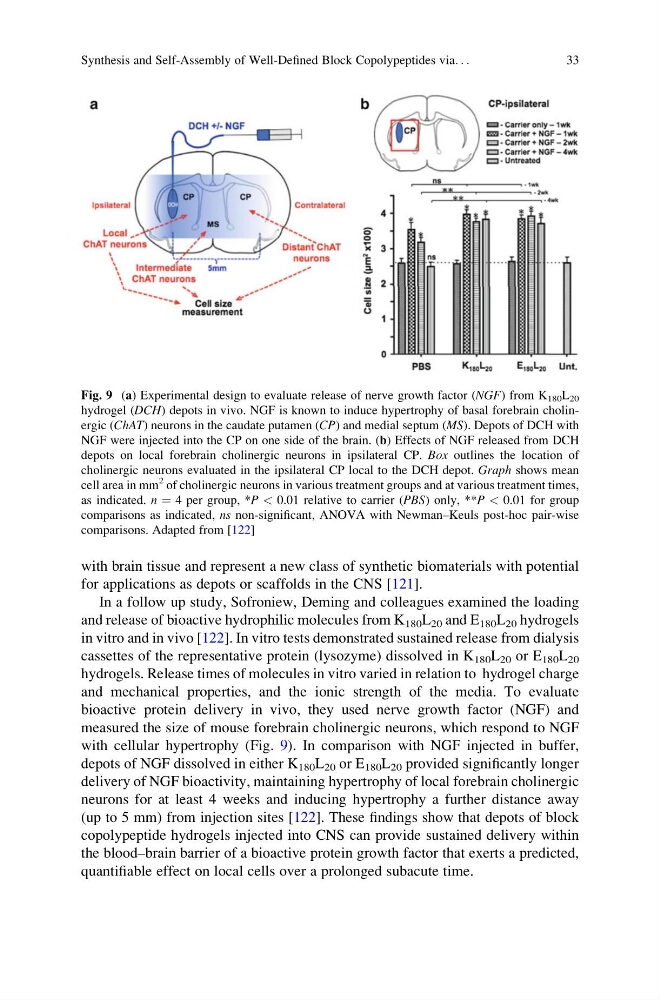
bioactive protein delivery in vivo, they used nerve growth factor (NGF) and
measured the size of mouse forebrain cholinergic neurons, which respond to NGF
with cellular hypertrophy (Fig. 9). In comparison with NGF injected in buffer,
depots of NGF dissolved in either K 180 L 20 or E 180 L 20 provided significantly longer
delivery of NGF bioactivity, maintaining hypertrophy of local forebrain cholinergic
neurons for at least 4 weeks and inducing hypertrophy a further distance away
(up to 5 mm) from injection sites [122]. These findings show that depots of block
copolypeptide hydrogels injected into CNS can provide sustained delivery within
the blood–brain barrier of a bioactive protein growth factor that exerts a predicted,
quantifiable effect on local cells over a prolonged subacute time.
Fig. 9 (a) Experimental design to evaluate release of nerve growth factor (NGF) from K 180 L 20
hydrogel (DCH) depots in vivo. NGF is known to induce hypertrophy of basal forebrain cholinergic (ChAT) neurons in the caudate putamen (CP) and medial septum (MS). Depots of DCH with
NGF were injected into the CP on one side of the brain. (b) Effects of NGF released from DCH
depots on local forebrain cholinergic neurons in ipsilateral CP. Box outlines the location of
cholinergic neurons evaluated in the ipsilateral CP local to the DCH depot. Graph shows mean
cell area in mm
2 of cholinergic neurons in various treatment groups and at various treatment times,
as indicated. n ¼ 4 per group, *P < 0.01 relative to carrier (PBS) only, **P < 0.01 for group
comparisons as indicated, ns non-significant, ANOVA with Newman–Keuls post-hoc pair-wise
comparisons. Adapted from [122]
Synthesis and Self-Assembly of Well-Defined Block Copolypeptides via. . .
33
for applications as depots or scaffolds in the CNS [121].
In a follow up study, Sofroniew, Deming and colleagues examined the loading
and release of bioactive hydrophilic molecules from K 180 L 20 and E 180 L 20 hydrogels
in vitro and in vivo [122]. In vitro tests demonstrated sustained release from dialysis
cassettes of the representative protein (lysozyme) dissolved in K 180 L 20 or E 180 L 20
hydrogels. Release times of molecules in vitro varied in relation to hydrogel charge
and mechanical properties, and the ionic strength of the media. To evaluate
bioactive protein delivery in vivo, they used nerve growth factor (NGF) and
measured the size of mouse forebrain cholinergic neurons, which respond to NGF
with cellular hypertrophy (Fig. 9). In comparison with NGF injected in buffer,
depots of NGF dissolved in either K 180 L 20 or E 180 L 20 provided significantly longer
delivery of NGF bioactivity, maintaining hypertrophy of local forebrain cholinergic
neurons for at least 4 weeks and inducing hypertrophy a further distance away
(up to 5 mm) from injection sites [122]. These findings show that depots of block
copolypeptide hydrogels injected into CNS can provide sustained delivery within
the blood–brain barrier of a bioactive protein growth factor that exerts a predicted,
quantifiable effect on local cells over a prolonged subacute time.
Fig. 9 (a) Experimental design to evaluate release of nerve growth factor (NGF) from K 180 L 20
hydrogel (DCH) depots in vivo. NGF is known to induce hypertrophy of basal forebrain cholinergic (ChAT) neurons in the caudate putamen (CP) and medial septum (MS). Depots of DCH with
NGF were injected into the CP on one side of the brain. (b) Effects of NGF released from DCH
depots on local forebrain cholinergic neurons in ipsilateral CP. Box outlines the location of
cholinergic neurons evaluated in the ipsilateral CP local to the DCH depot. Graph shows mean
cell area in mm
2 of cholinergic neurons in various treatment groups and at various treatment times,
as indicated. n ¼ 4 per group, *P < 0.01 relative to carrier (PBS) only, **P < 0.01 for group
comparisons as indicated, ns non-significant, ANOVA with Newman–Keuls post-hoc pair-wise
comparisons. Adapted from [122]
Synthesis and Self-Assembly of Well-Defined Block Copolypeptides via. . .
33