

preparation. The particles were isolated by centrifugation and washed according to
the procedure for particles prepared without dextran. The loading of the particles by
the Texas Red-labeled dextran was corrected for the dextran washed out during the
washing procedure. The microgel particles were taken up in water for a defined time
and the release of dextran was determined after centrifugation by the calibrated
extinction of the decanted aqueous solution. Sedimented particles were redispersed
in fresh buffer solution and extracted again. The release was analyzed as the
cumulative ratio of the original loading. The procedure was performed at 20
C
with the non-collapsed particles and at 40
, above the coacervation temperature.
Table 2 summarizes data on the initial loading and the hydrodynamic radii of the
microgels prepared at 20
C and characterized for their hydrodynamic radius at
temperatures below and above the volume change transition. Regarding the fact
that the dextran did not participate in the crosslinking reaction but serves just as
another component in the solvent, it appears unsurprising that the particle sizes
came out similar to those prepared without dextran (see Table 1). Figure 7 depicts
Table 2 Loading of Texas Red-marked dextran to PEG-DGE and BS3 microgels
ES 12
Linker
(mol/mol)
Dextran
loading of
microgels
(mg/wt%)
1
PEG-DGE
BS3
Initial uptake
of dextran
(mg/wt%)
2
R h (PDI)
Initial
loading of
microgels
(mg/wt%)
R h (PDI)
20
C
(nm)
40
C
(nm)
20
C
(nm)
40
C
(nm)
4
3.75/15
2.41/64.2
890 (0.3) 510 (0.3) 2.75/73.3
765 (0.5) 450 (0.3)
2
3.75/15
2.89/77.2
750 (0.4) 470 (0.2) 3.01/80.3
456 (0.4) 320 (0.3)
1
Loading is expressed both as milligrams and relative to the weight of elastin (wt%)
2
Uptake expresses both as millograms and percentage relative to the loading (wt%)
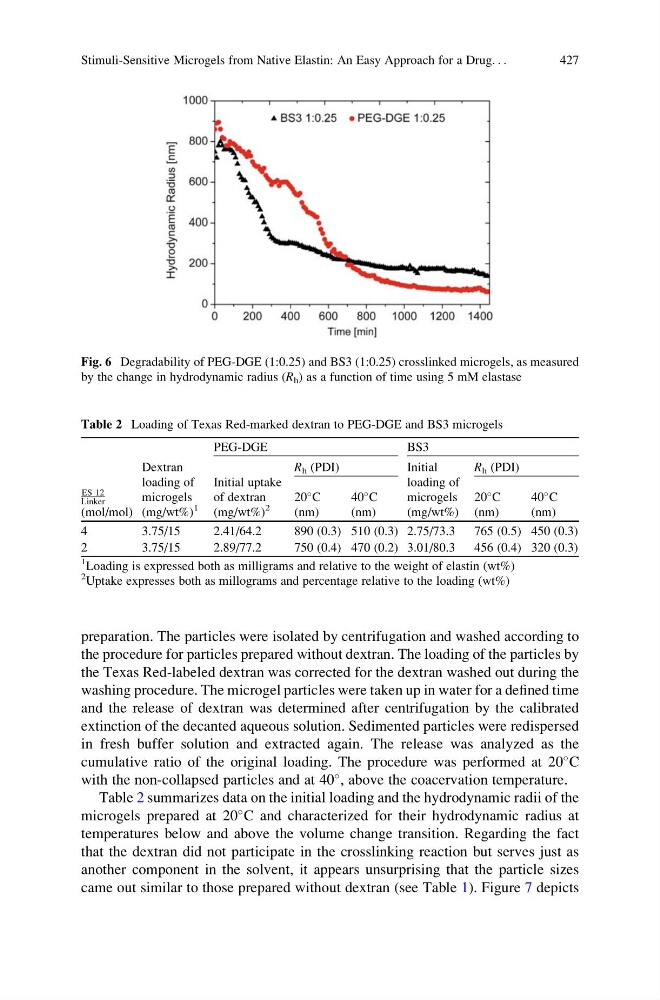
Fig. 6 Degradability of PEG-DGE (1:0.25) and BS3 (1:0.25) crosslinked microgels, as measured
by the change in hydrodynamic radius (R h ) as a function of time using 5 mM elastase
Stimuli-Sensitive Microgels from Native Elastin: An Easy Approach for a Drug. . .
427
the procedure for particles prepared without dextran. The loading of the particles by
the Texas Red-labeled dextran was corrected for the dextran washed out during the
washing procedure. The microgel particles were taken up in water for a defined time
and the release of dextran was determined after centrifugation by the calibrated
extinction of the decanted aqueous solution. Sedimented particles were redispersed
in fresh buffer solution and extracted again. The release was analyzed as the
cumulative ratio of the original loading. The procedure was performed at 20
C
with the non-collapsed particles and at 40
, above the coacervation temperature.
Table 2 summarizes data on the initial loading and the hydrodynamic radii of the
microgels prepared at 20
C and characterized for their hydrodynamic radius at
temperatures below and above the volume change transition. Regarding the fact
that the dextran did not participate in the crosslinking reaction but serves just as
another component in the solvent, it appears unsurprising that the particle sizes
came out similar to those prepared without dextran (see Table 1). Figure 7 depicts
Table 2 Loading of Texas Red-marked dextran to PEG-DGE and BS3 microgels
ES 12
Linker
(mol/mol)
Dextran
loading of
microgels
(mg/wt%)
1
PEG-DGE
BS3
Initial uptake
of dextran
(mg/wt%)
2
R h (PDI)
Initial
loading of
microgels
(mg/wt%)
R h (PDI)
20
C
(nm)
40
C
(nm)
20
C
(nm)
40
C
(nm)
4
3.75/15
2.41/64.2
890 (0.3) 510 (0.3) 2.75/73.3
765 (0.5) 450 (0.3)
2
3.75/15
2.89/77.2
750 (0.4) 470 (0.2) 3.01/80.3
456 (0.4) 320 (0.3)
1
Loading is expressed both as milligrams and relative to the weight of elastin (wt%)
2
Uptake expresses both as millograms and percentage relative to the loading (wt%)
Fig. 6 Degradability of PEG-DGE (1:0.25) and BS3 (1:0.25) crosslinked microgels, as measured
by the change in hydrodynamic radius (R h ) as a function of time using 5 mM elastase
Stimuli-Sensitive Microgels from Native Elastin: An Easy Approach for a Drug. . .
427