

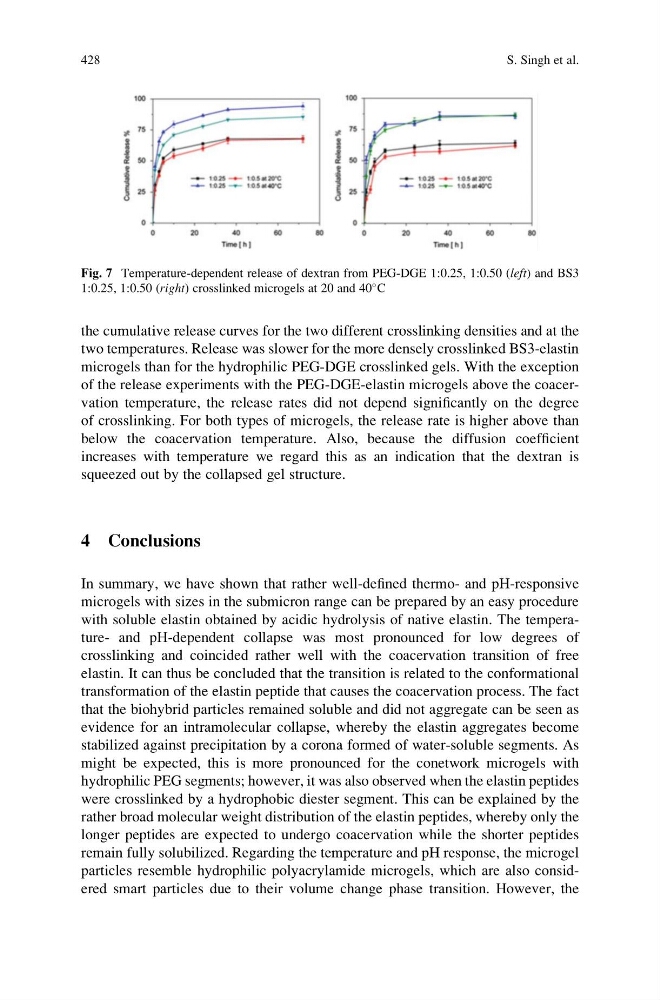
the cumulative release curves for the two different crosslinking densities and at the
two temperatures. Release was slower for the more densely crosslinked BS3-elastin
microgels than for the hydrophilic PEG-DGE crosslinked gels. With the exception
of the release experiments with the PEG-DGE-elastin microgels above the coacervation temperature, the release rates did not depend significantly on the degree
of crosslinking. For both types of microgels, the release rate is higher above than
below the coacervation temperature. Also, because the diffusion coefficient
increases with temperature we regard this as an indication that the dextran is
squeezed out by the collapsed gel structure.
4 Conclusions
In summary, we have shown that rather well-defined thermo- and pH-responsive
microgels with sizes in the submicron range can be prepared by an easy procedure
with soluble elastin obtained by acidic hydrolysis of native elastin. The temperature- and pH-dependent collapse was most pronounced for low degrees of
crosslinking and coincided rather well with the coacervation transition of free
elastin. It can thus be concluded that the transition is related to the conformational
transformation of the elastin peptide that causes the coacervation process. The fact
that the biohybrid particles remained soluble and did not aggregate can be seen as
evidence for an intramolecular collapse, whereby the elastin aggregates become
stabilized against precipitation by a corona formed of water-soluble segments. As
might be expected, this is more pronounced for the conetwork microgels with
hydrophilic PEG segments; however, it was also observed when the elastin peptides
were crosslinked by a hydrophobic diester segment. This can be explained by the
rather broad molecular weight distribution of the elastin peptides, whereby only the
longer peptides are expected to undergo coacervation while the shorter peptides
remain fully solubilized. Regarding the temperature and pH response, the microgel
particles resemble hydrophilic polyacrylamide microgels, which are also considered smart particles due to their volume change phase transition. However, the
Fig. 7 Temperature-dependent release of dextran from PEG-DGE 1:0.25, 1:0.50 (left) and BS3
1:0.25, 1:0.50 (right) crosslinked microgels at 20 and 40
C
428
S. Singh et al.
two temperatures. Release was slower for the more densely crosslinked BS3-elastin
microgels than for the hydrophilic PEG-DGE crosslinked gels. With the exception
of the release experiments with the PEG-DGE-elastin microgels above the coacervation temperature, the release rates did not depend significantly on the degree
of crosslinking. For both types of microgels, the release rate is higher above than
below the coacervation temperature. Also, because the diffusion coefficient
increases with temperature we regard this as an indication that the dextran is
squeezed out by the collapsed gel structure.
4 Conclusions
In summary, we have shown that rather well-defined thermo- and pH-responsive
microgels with sizes in the submicron range can be prepared by an easy procedure
with soluble elastin obtained by acidic hydrolysis of native elastin. The temperature- and pH-dependent collapse was most pronounced for low degrees of
crosslinking and coincided rather well with the coacervation transition of free
elastin. It can thus be concluded that the transition is related to the conformational
transformation of the elastin peptide that causes the coacervation process. The fact
that the biohybrid particles remained soluble and did not aggregate can be seen as
evidence for an intramolecular collapse, whereby the elastin aggregates become
stabilized against precipitation by a corona formed of water-soluble segments. As
might be expected, this is more pronounced for the conetwork microgels with
hydrophilic PEG segments; however, it was also observed when the elastin peptides
were crosslinked by a hydrophobic diester segment. This can be explained by the
rather broad molecular weight distribution of the elastin peptides, whereby only the
longer peptides are expected to undergo coacervation while the shorter peptides
remain fully solubilized. Regarding the temperature and pH response, the microgel
particles resemble hydrophilic polyacrylamide microgels, which are also considered smart particles due to their volume change phase transition. However, the
Fig. 7 Temperature-dependent release of dextran from PEG-DGE 1:0.25, 1:0.50 (left) and BS3
1:0.25, 1:0.50 (right) crosslinked microgels at 20 and 40
C
428
S. Singh et al.