

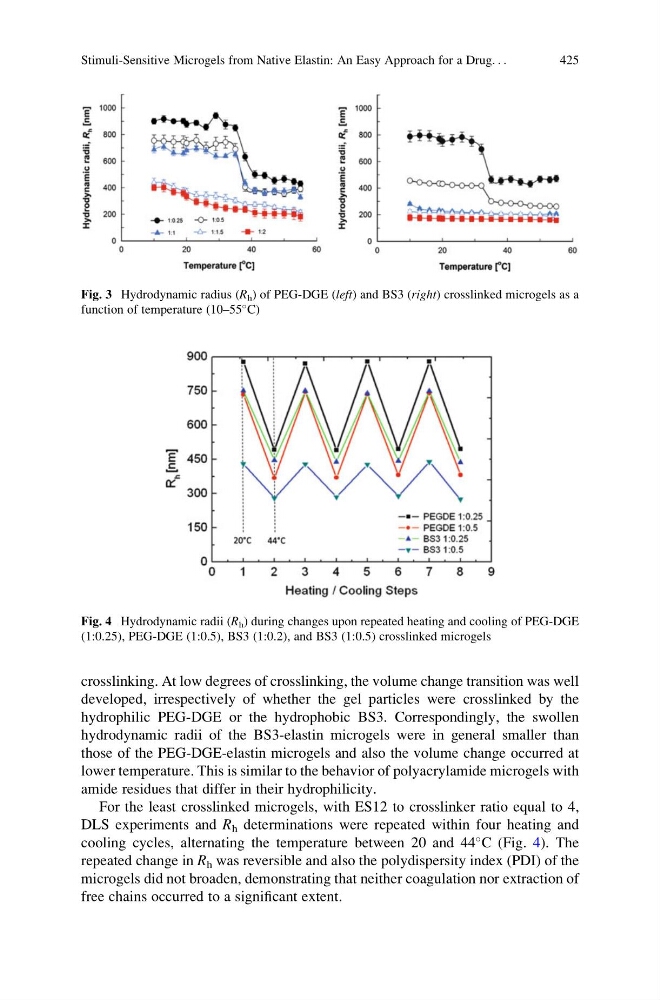
crosslinking. At low degrees of crosslinking, the volume change transition was well
developed, irrespectively of whether the gel particles were crosslinked by the
hydrophilic PEG-DGE or the hydrophobic BS3. Correspondingly, the swollen
hydrodynamic radii of the BS3-elastin microgels were in general smaller than
those of the PEG-DGE-elastin microgels and also the volume change occurred at
lower temperature. This is similar to the behavior of polyacrylamide microgels with
amide residues that differ in their hydrophilicity.
For the least crosslinked microgels, with ES12 to crosslinker ratio equal to 4,
DLS experiments and R h determinations were repeated within four heating and
cooling cycles, alternating the temperature between 20 and 44
C (Fig. 4). The
repeated change in R h was reversible and also the polydispersity index (PDI) of the
microgels did not broaden, demonstrating that neither coagulation nor extraction of
free chains occurred to a significant extent.
Fig. 3 Hydrodynamic radius (R h ) of PEG-DGE (left) and BS3 (right) crosslinked microgels as a
function of temperature (10–55
C)
Fig. 4 Hydrodynamic radii (R h ) during changes upon repeated heating and cooling of PEG-DGE
(1:0.25), PEG-DGE (1:0.5), BS3 (1:0.2), and BS3 (1:0.5) crosslinked microgels
Stimuli-Sensitive Microgels from Native Elastin: An Easy Approach for a Drug. . .
425
developed, irrespectively of whether the gel particles were crosslinked by the
hydrophilic PEG-DGE or the hydrophobic BS3. Correspondingly, the swollen
hydrodynamic radii of the BS3-elastin microgels were in general smaller than
those of the PEG-DGE-elastin microgels and also the volume change occurred at
lower temperature. This is similar to the behavior of polyacrylamide microgels with
amide residues that differ in their hydrophilicity.
For the least crosslinked microgels, with ES12 to crosslinker ratio equal to 4,
DLS experiments and R h determinations were repeated within four heating and
cooling cycles, alternating the temperature between 20 and 44
C (Fig. 4). The
repeated change in R h was reversible and also the polydispersity index (PDI) of the
microgels did not broaden, demonstrating that neither coagulation nor extraction of
free chains occurred to a significant extent.
Fig. 3 Hydrodynamic radius (R h ) of PEG-DGE (left) and BS3 (right) crosslinked microgels as a
function of temperature (10–55
C)
Fig. 4 Hydrodynamic radii (R h ) during changes upon repeated heating and cooling of PEG-DGE
(1:0.25), PEG-DGE (1:0.5), BS3 (1:0.2), and BS3 (1:0.5) crosslinked microgels
Stimuli-Sensitive Microgels from Native Elastin: An Easy Approach for a Drug. . .
425