

Circular dichroism spectroscopy allows one to follow conformational changes of
the elastin peptides that are caused by the crosslinking. Solubilized elastin exhibits a
negative band near 200 nm that is characteristic of unfolded proteins with segments
in the PPII conformation [8, 21]. Upon coacervation, the CD spectra indicate a
conformational change to an α-helix with two negative bands at 208 and 224 nm and
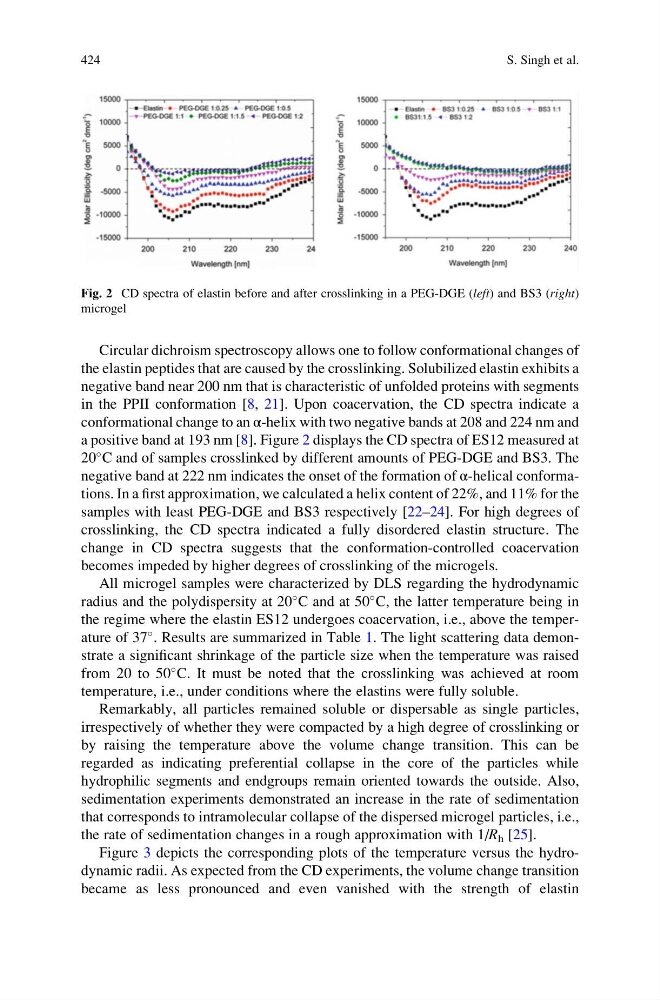
a positive band at 193 nm [8]. Figure 2 displays the CD spectra of ES12 measured at
20
C and of samples crosslinked by different amounts of PEG-DGE and BS3. The
negative band at 222 nm indicates the onset of the formation of α-helical conformations. In a first approximation, we calculated a helix content of 22%, and 11% for the
samples with least PEG-DGE and BS3 respectively [22–24]. For high degrees of
crosslinking, the CD spectra indicated a fully disordered elastin structure. The
change in CD spectra suggests that the conformation-controlled coacervation
becomes impeded by higher degrees of crosslinking of the microgels.
All microgel samples were characterized by DLS regarding the hydrodynamic
radius and the polydispersity at 20
C and at 50
C, the latter temperature being in
the regime where the elastin ES12 undergoes coacervation, i.e., above the temperature of 37
. Results are summarized in Table 1. The light scattering data demonstrate a significant shrinkage of the particle size when the temperature was raised
from 20 to 50
C. It must be noted that the crosslinking was achieved at room
temperature, i.e., under conditions where the elastins were fully soluble.
Remarkably, all particles remained soluble or dispersable as single particles,
irrespectively of whether they were compacted by a high degree of crosslinking or
by raising the temperature above the volume change transition. This can be
regarded as indicating preferential collapse in the core of the particles while
hydrophilic segments and endgroups remain oriented towards the outside. Also,
sedimentation experiments demonstrated an increase in the rate of sedimentation
that corresponds to intramolecular collapse of the dispersed microgel particles, i.e.,
the rate of sedimentation changes in a rough approximation with 1/R h [25].
Figure 3 depicts the corresponding plots of the temperature versus the hydrodynamic radii. As expected from the CD experiments, the volume change transition
became as less pronounced and even vanished with the strength of elastin
Fig. 2 CD spectra of elastin before and after crosslinking in a PEG-DGE (left) and BS3 (right)
microgel
424
S. Singh et al.
the elastin peptides that are caused by the crosslinking. Solubilized elastin exhibits a
negative band near 200 nm that is characteristic of unfolded proteins with segments
in the PPII conformation [8, 21]. Upon coacervation, the CD spectra indicate a
conformational change to an α-helix with two negative bands at 208 and 224 nm and
a positive band at 193 nm [8]. Figure 2 displays the CD spectra of ES12 measured at
20
C and of samples crosslinked by different amounts of PEG-DGE and BS3. The
negative band at 222 nm indicates the onset of the formation of α-helical conformations. In a first approximation, we calculated a helix content of 22%, and 11% for the
samples with least PEG-DGE and BS3 respectively [22–24]. For high degrees of
crosslinking, the CD spectra indicated a fully disordered elastin structure. The
change in CD spectra suggests that the conformation-controlled coacervation
becomes impeded by higher degrees of crosslinking of the microgels.
All microgel samples were characterized by DLS regarding the hydrodynamic
radius and the polydispersity at 20
C and at 50
C, the latter temperature being in
the regime where the elastin ES12 undergoes coacervation, i.e., above the temperature of 37
. Results are summarized in Table 1. The light scattering data demonstrate a significant shrinkage of the particle size when the temperature was raised
from 20 to 50
C. It must be noted that the crosslinking was achieved at room
temperature, i.e., under conditions where the elastins were fully soluble.
Remarkably, all particles remained soluble or dispersable as single particles,
irrespectively of whether they were compacted by a high degree of crosslinking or
by raising the temperature above the volume change transition. This can be
regarded as indicating preferential collapse in the core of the particles while
hydrophilic segments and endgroups remain oriented towards the outside. Also,
sedimentation experiments demonstrated an increase in the rate of sedimentation
that corresponds to intramolecular collapse of the dispersed microgel particles, i.e.,
the rate of sedimentation changes in a rough approximation with 1/R h [25].
Figure 3 depicts the corresponding plots of the temperature versus the hydrodynamic radii. As expected from the CD experiments, the volume change transition
became as less pronounced and even vanished with the strength of elastin
Fig. 2 CD spectra of elastin before and after crosslinking in a PEG-DGE (left) and BS3 (right)
microgel
424
S. Singh et al.