

the trans-conformation was the predominant species. This gives the possibility to
design solvent-dependent folding of peptoids.
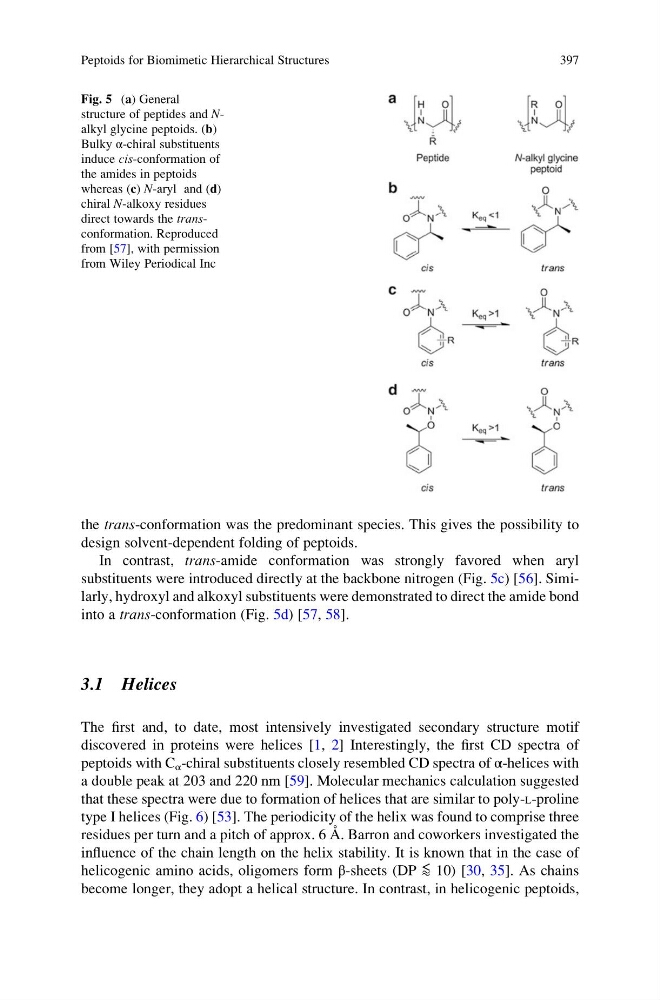
In contrast, trans-amide conformation was strongly favored when aryl
substituents were introduced directly at the backbone nitrogen (Fig. 5c) [56]. Similarly, hydroxyl and alkoxyl substituents were demonstrated to direct the amide bond
into a trans-conformation (Fig. 5d) [57, 58].
3.1 Helices
The first and, to date, most intensively investigated secondary structure motif
discovered in proteins were helices [1, 2] Interestingly, the first CD spectra of
peptoids with C α -chiral substituents closely resembled CD spectra of α-helices with
a double peak at 203 and 220 nm [59]. Molecular mechanics calculation suggested
that these spectra were due to formation of helices that are similar to poly-L-proline
type I helices (Fig. 6) [53]. The periodicity of the helix was found to comprise three
residues per turn and a pitch of approx. 6 A ˚ . Barron and coworkers investigated the
influence of the chain length on the helix stability. It is known that in the case of
helicogenic amino acids, oligomers form β-sheets (DP ⪅ 10) [30, 35]. As chains
become longer, they adopt a helical structure. In contrast, in helicogenic peptoids,
Fig. 5 (a) General
structure of peptides and Nalkyl glycine peptoids. (b)
Bulky α-chiral substituents
induce cis-conformation of
the amides in peptoids
whereas (c) N-aryl and (d)
chiral N-alkoxy residues
direct towards the transconformation. Reproduced
from [57], with permission
from Wiley Periodical Inc
Peptoids for Biomimetic Hierarchical Structures
397
design solvent-dependent folding of peptoids.
In contrast, trans-amide conformation was strongly favored when aryl
substituents were introduced directly at the backbone nitrogen (Fig. 5c) [56]. Similarly, hydroxyl and alkoxyl substituents were demonstrated to direct the amide bond
into a trans-conformation (Fig. 5d) [57, 58].
3.1 Helices
The first and, to date, most intensively investigated secondary structure motif
discovered in proteins were helices [1, 2] Interestingly, the first CD spectra of
peptoids with C α -chiral substituents closely resembled CD spectra of α-helices with
a double peak at 203 and 220 nm [59]. Molecular mechanics calculation suggested
that these spectra were due to formation of helices that are similar to poly-L-proline
type I helices (Fig. 6) [53]. The periodicity of the helix was found to comprise three
residues per turn and a pitch of approx. 6 A ˚ . Barron and coworkers investigated the
influence of the chain length on the helix stability. It is known that in the case of
helicogenic amino acids, oligomers form β-sheets (DP ⪅ 10) [30, 35]. As chains
become longer, they adopt a helical structure. In contrast, in helicogenic peptoids,
Fig. 5 (a) General
structure of peptides and Nalkyl glycine peptoids. (b)
Bulky α-chiral substituents
induce cis-conformation of
the amides in peptoids
whereas (c) N-aryl and (d)
chiral N-alkoxy residues
direct towards the transconformation. Reproduced
from [57], with permission
from Wiley Periodical Inc
Peptoids for Biomimetic Hierarchical Structures
397