

hydrophobic, thermoresponsive [48, 49], or amphiphilic peptoids as well as
multiblock copolypeptoids [50] with high definition and reproducibility. Also,
NNCA polymerization can be performed on surfaces [51] or solid supports [52]
without loss of control (Fig. 1c). The possibility to polymerize NNCAs directly on
solid supports that are also employed in SPPS or SPSS opens new avenues for the
combination of sequence-specific peptoids from step-wise synthesis and narrowly
distributed peptoids obtained via polymerization.
3 Secondary Structure Mimetics
Prediction of the secondary structure in proteins has been very successful from the
start when Pauling and Corey developed a model for helices in polypeptides. Since
then, it has been found that homopolypeptides of natural amino acids have a strong
tendency to form secondary structures, either the α-helix or β-sheets [30].
In contrast, it is well known that polysarcosine adopts a random coil formation in
aqueous solution. In addition, polysarcosine not only exhibits excellent solubility in
water but is also very well soluble in a wide range of organic solvents [45].
Because the backbone of peptoids is inherently flexible and does not favor the
cis- or trans-conformation of the amide moiety sufficiently to induce secondary
structure formation, special synthetic strategies are necessary to favor either cis- or
trans-conformation in peptoids.
Peptoids bearing C α -chiral substituents have been shown to favor the cis-conformation (Fig. 5b) [53, 54]. Another way to favor a cis-conformation of the amide
bond is to implement a favorable interaction between the backbone and the substituent orbital of an adjacent aromatic side chain, which was possible using N-α-chiral
acetanilide or N-1-naphtylethyl substituents (n ! π* C¼O and hydrogen bonding
or n ! π* Ar and steric interactions, respectively) [55]. Interestingly, the cisconformation was only favored in polar solvents, whereas in non-polar solvents
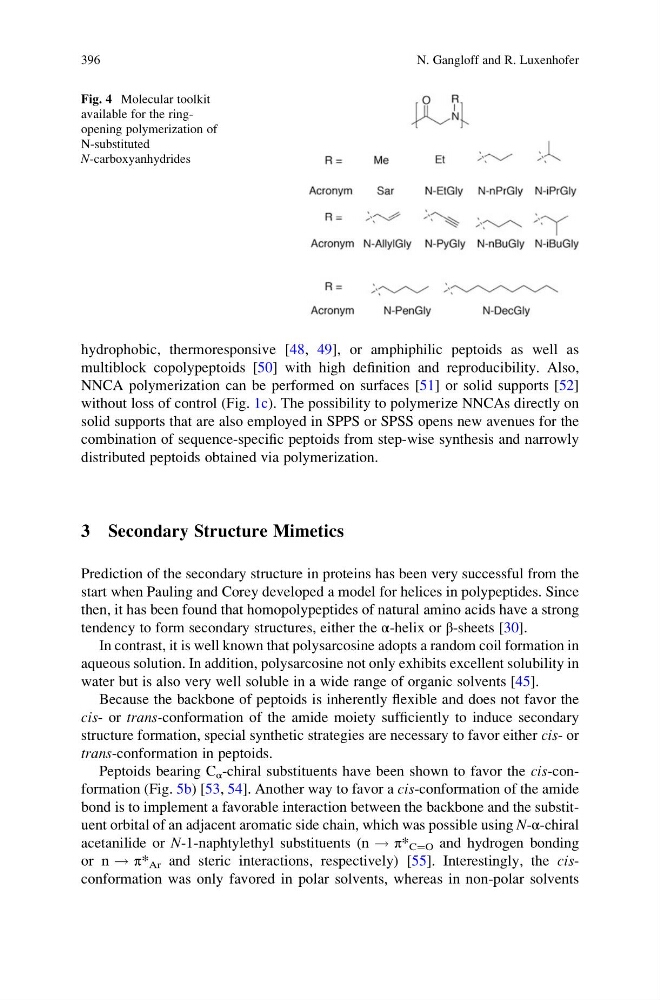
Fig. 4 Molecular toolkit
available for the ringopening polymerization of
N-substituted
N-carboxyanhydrides
396
N. Gangloff and R. Luxenhofer
multiblock copolypeptoids [50] with high definition and reproducibility. Also,
NNCA polymerization can be performed on surfaces [51] or solid supports [52]
without loss of control (Fig. 1c). The possibility to polymerize NNCAs directly on
solid supports that are also employed in SPPS or SPSS opens new avenues for the
combination of sequence-specific peptoids from step-wise synthesis and narrowly
distributed peptoids obtained via polymerization.
3 Secondary Structure Mimetics
Prediction of the secondary structure in proteins has been very successful from the
start when Pauling and Corey developed a model for helices in polypeptides. Since
then, it has been found that homopolypeptides of natural amino acids have a strong
tendency to form secondary structures, either the α-helix or β-sheets [30].
In contrast, it is well known that polysarcosine adopts a random coil formation in
aqueous solution. In addition, polysarcosine not only exhibits excellent solubility in
water but is also very well soluble in a wide range of organic solvents [45].
Because the backbone of peptoids is inherently flexible and does not favor the
cis- or trans-conformation of the amide moiety sufficiently to induce secondary
structure formation, special synthetic strategies are necessary to favor either cis- or
trans-conformation in peptoids.
Peptoids bearing C α -chiral substituents have been shown to favor the cis-conformation (Fig. 5b) [53, 54]. Another way to favor a cis-conformation of the amide
bond is to implement a favorable interaction between the backbone and the substituent orbital of an adjacent aromatic side chain, which was possible using N-α-chiral
acetanilide or N-1-naphtylethyl substituents (n ! π* C¼O and hydrogen bonding
or n ! π* Ar and steric interactions, respectively) [55]. Interestingly, the cisconformation was only favored in polar solvents, whereas in non-polar solvents
Fig. 4 Molecular toolkit
available for the ringopening polymerization of
N-substituted
N-carboxyanhydrides
396
N. Gangloff and R. Luxenhofer