

dendrimeric [39] and polymeric systems [40–42] based on strong hydrogen bonds in
organic solvents or in the solid state have been developed. In contrast, owing to the lack
of directionality of hydrophobic interactions [43], the rational design of supramolecular polymers in water is challenging [34, 40, 43–50]. Can we design a hydrophobic analog of a hydrogen bond where a pair of aromatic units will interact along a
well-defined direction?
3.4.1 Pairwise Interactions in DNA-PDI Dumbbells
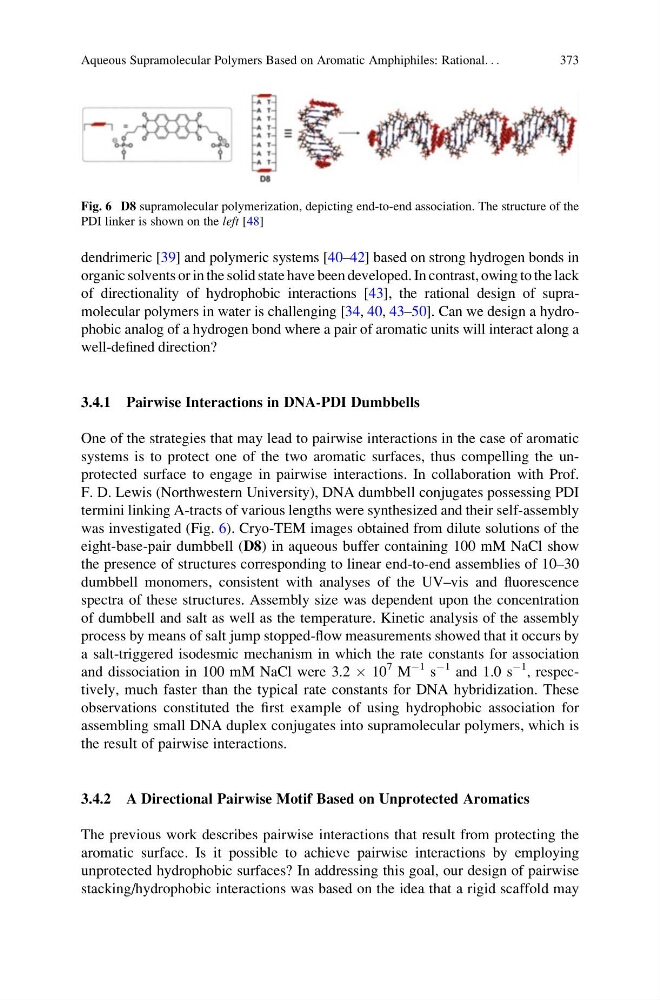
One of the strategies that may lead to pairwise interactions in the case of aromatic
systems is to protect one of the two aromatic surfaces, thus compelling the unprotected surface to engage in pairwise interactions. In collaboration with Prof.
F. D. Lewis (Northwestern University), DNA dumbbell conjugates possessing PDI
termini linking A-tracts of various lengths were synthesized and their self-assembly
was investigated (Fig. 6). Cryo-TEM images obtained from dilute solutions of the
eight-base-pair dumbbell (D8) in aqueous buffer containing 100 mM NaCl show
the presence of structures corresponding to linear end-to-end assemblies of 10–30
dumbbell monomers, consistent with analyses of the UV–vis and fluorescence
spectra of these structures. Assembly size was dependent upon the concentration
of dumbbell and salt as well as the temperature. Kinetic analysis of the assembly
process by means of salt jump stopped-flow measurements showed that it occurs by
a salt-triggered isodesmic mechanism in which the rate constants for association
and dissociation in 100 mM NaCl were 3.2 Â 10
7 M
À1 s
À1 and 1.0 s
À1 , respectively, much faster than the typical rate constants for DNA hybridization. These
observations constituted the first example of using hydrophobic association for
assembling small DNA duplex conjugates into supramolecular polymers, which is
the result of pairwise interactions.
3.4.2 A Directional Pairwise Motif Based on Unprotected Aromatics
The previous work describes pairwise interactions that result from protecting the
aromatic surface. Is it possible to achieve pairwise interactions by employing
unprotected hydrophobic surfaces? In addressing this goal, our design of pairwise
stacking/hydrophobic interactions was based on the idea that a rigid scaffold may
Fig. 6 D8 supramolecular polymerization, depicting end-to-end association. The structure of the
PDI linker is shown on the left [48]
Aqueous Supramolecular Polymers Based on Aromatic Amphiphiles: Rational. . .
373
organic solvents or in the solid state have been developed. In contrast, owing to the lack
of directionality of hydrophobic interactions [43], the rational design of supramolecular polymers in water is challenging [34, 40, 43–50]. Can we design a hydrophobic analog of a hydrogen bond where a pair of aromatic units will interact along a
well-defined direction?
3.4.1 Pairwise Interactions in DNA-PDI Dumbbells
One of the strategies that may lead to pairwise interactions in the case of aromatic
systems is to protect one of the two aromatic surfaces, thus compelling the unprotected surface to engage in pairwise interactions. In collaboration with Prof.
F. D. Lewis (Northwestern University), DNA dumbbell conjugates possessing PDI
termini linking A-tracts of various lengths were synthesized and their self-assembly
was investigated (Fig. 6). Cryo-TEM images obtained from dilute solutions of the
eight-base-pair dumbbell (D8) in aqueous buffer containing 100 mM NaCl show
the presence of structures corresponding to linear end-to-end assemblies of 10–30
dumbbell monomers, consistent with analyses of the UV–vis and fluorescence
spectra of these structures. Assembly size was dependent upon the concentration
of dumbbell and salt as well as the temperature. Kinetic analysis of the assembly
process by means of salt jump stopped-flow measurements showed that it occurs by
a salt-triggered isodesmic mechanism in which the rate constants for association
and dissociation in 100 mM NaCl were 3.2 Â 10
7 M
À1 s
À1 and 1.0 s
À1 , respectively, much faster than the typical rate constants for DNA hybridization. These
observations constituted the first example of using hydrophobic association for
assembling small DNA duplex conjugates into supramolecular polymers, which is
the result of pairwise interactions.
3.4.2 A Directional Pairwise Motif Based on Unprotected Aromatics
The previous work describes pairwise interactions that result from protecting the
aromatic surface. Is it possible to achieve pairwise interactions by employing
unprotected hydrophobic surfaces? In addressing this goal, our design of pairwise
stacking/hydrophobic interactions was based on the idea that a rigid scaffold may
Fig. 6 D8 supramolecular polymerization, depicting end-to-end association. The structure of the
PDI linker is shown on the left [48]
Aqueous Supramolecular Polymers Based on Aromatic Amphiphiles: Rational. . .
373