

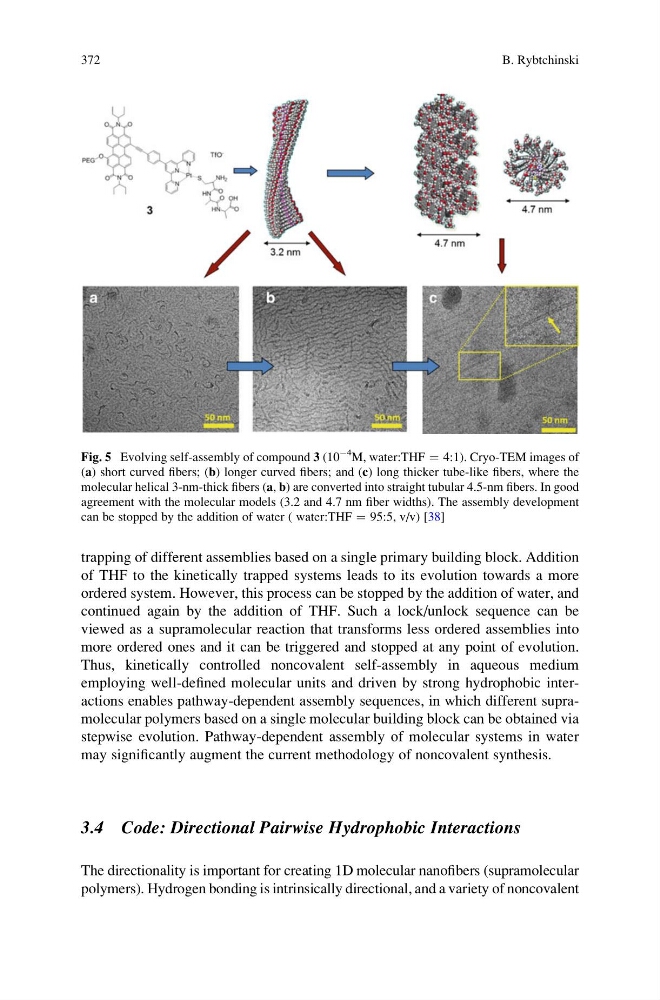
trapping of different assemblies based on a single primary building block. Addition
of THF to the kinetically trapped systems leads to its evolution towards a more
ordered system. However, this process can be stopped by the addition of water, and
continued again by the addition of THF. Such a lock/unlock sequence can be
viewed as a supramolecular reaction that transforms less ordered assemblies into
more ordered ones and it can be triggered and stopped at any point of evolution.
Thus, kinetically controlled noncovalent self-assembly in aqueous medium
employing well-defined molecular units and driven by strong hydrophobic interactions enables pathway-dependent assembly sequences, in which different supramolecular polymers based on a single molecular building block can be obtained via
stepwise evolution. Pathway-dependent assembly of molecular systems in water
may significantly augment the current methodology of noncovalent synthesis.
3.4 Code: Directional Pairwise Hydrophobic Interactions
The directionality is important for creating 1D molecular nanofibers (supramolecular
polymers). Hydrogen bonding is intrinsically directional, and a variety of noncovalent
Fig. 5 Evolving self-assembly of compound 3 (10
À4
M, water:THF ¼ 4:1). Cryo-TEM images of
(a) short curved fibers; (b) longer curved fibers; and (c) long thicker tube-like fibers, where the
molecular helical 3-nm-thick fibers (a, b) are converted into straight tubular 4.5-nm fibers. In good
agreement with the molecular models (3.2 and 4.7 nm fiber widths). The assembly development
can be stopped by the addition of water ( water:THF ¼ 95:5, v/v) [38]
372
B. Rybtchinski
of THF to the kinetically trapped systems leads to its evolution towards a more
ordered system. However, this process can be stopped by the addition of water, and
continued again by the addition of THF. Such a lock/unlock sequence can be
viewed as a supramolecular reaction that transforms less ordered assemblies into
more ordered ones and it can be triggered and stopped at any point of evolution.
Thus, kinetically controlled noncovalent self-assembly in aqueous medium
employing well-defined molecular units and driven by strong hydrophobic interactions enables pathway-dependent assembly sequences, in which different supramolecular polymers based on a single molecular building block can be obtained via
stepwise evolution. Pathway-dependent assembly of molecular systems in water
may significantly augment the current methodology of noncovalent synthesis.
3.4 Code: Directional Pairwise Hydrophobic Interactions
The directionality is important for creating 1D molecular nanofibers (supramolecular
polymers). Hydrogen bonding is intrinsically directional, and a variety of noncovalent
Fig. 5 Evolving self-assembly of compound 3 (10
À4
M, water:THF ¼ 4:1). Cryo-TEM images of
(a) short curved fibers; (b) longer curved fibers; and (c) long thicker tube-like fibers, where the
molecular helical 3-nm-thick fibers (a, b) are converted into straight tubular 4.5-nm fibers. In good
agreement with the molecular models (3.2 and 4.7 nm fiber widths). The assembly development
can be stopped by the addition of water ( water:THF ¼ 95:5, v/v) [38]
372
B. Rybtchinski