

3.3 Code: The Self-Assembly Pathway. Complexity via
Kinetic Control
Metals can serve as advantageous codes for modifying the covalent units to regulate
hydrophobic assembly, but whether it is possible to obtain diverse products from an
unmodified primary building block is an intriguing question. In covalent polymerization, identical monomers may result in different polymer structures (e.g., isotactic versus syndiotactic); the same is generally true for many covalent
transformations. Can this be achieved for supramolecular polymers? This relates
to a fundamental issue in aqueous self-assembly: if strong hydrophobic interactions
are involved, one can expect a breakdown of thermodynamic control. Thus, in the
regime of strong noncovalent interactions (multiple) stable kinetic products may
form from a single primary building block, along the supramolecular reaction path,
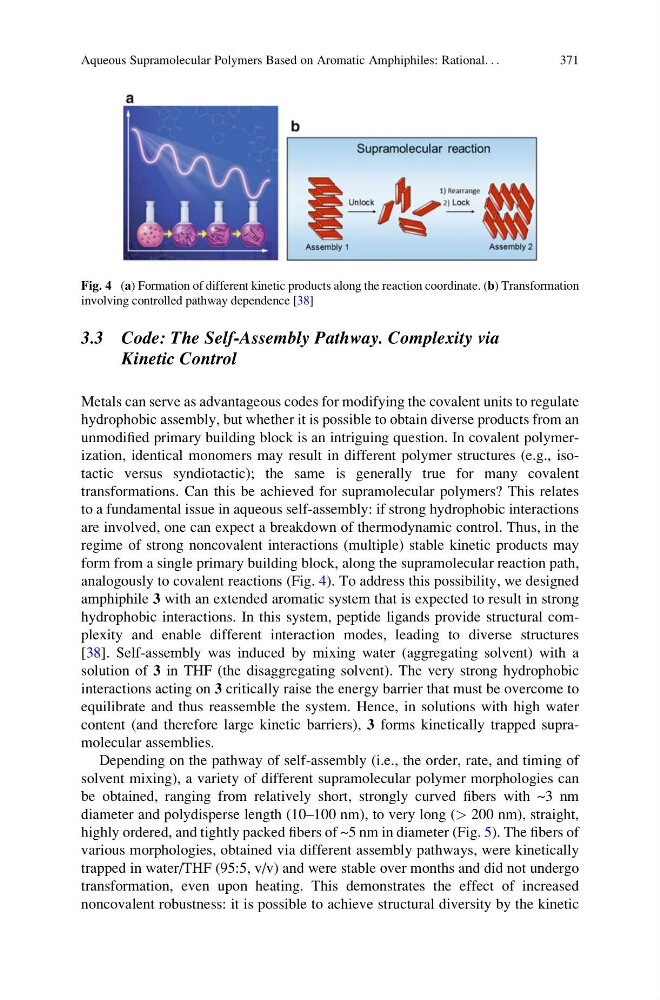
analogously to covalent reactions (Fig. 4). To address this possibility, we designed
amphiphile 3 with an extended aromatic system that is expected to result in strong
hydrophobic interactions. In this system, peptide ligands provide structural complexity and enable different interaction modes, leading to diverse structures
[38]. Self-assembly was induced by mixing water (aggregating solvent) with a
solution of 3 in THF (the disaggregating solvent). The very strong hydrophobic
interactions acting on 3 critically raise the energy barrier that must be overcome to
equilibrate and thus reassemble the system. Hence, in solutions with high water
content (and therefore large kinetic barriers), 3 forms kinetically trapped supramolecular assemblies.
Depending on the pathway of self-assembly (i.e., the order, rate, and timing of
solvent mixing), a variety of different supramolecular polymer morphologies can
be obtained, ranging from relatively short, strongly curved fibers with ~3 nm
diameter and polydisperse length (10–100 nm), to very long (> 200 nm), straight,
highly ordered, and tightly packed fibers of ~5 nm in diameter (Fig. 5). The fibers of
various morphologies, obtained via different assembly pathways, were kinetically
trapped in water/THF (95:5, v/v) and were stable over months and did not undergo
transformation, even upon heating. This demonstrates the effect of increased
noncovalent robustness: it is possible to achieve structural diversity by the kinetic
Fig. 4 (a) Formation of different kinetic products along the reaction coordinate. (b) Transformation
involving controlled pathway dependence [38]
Aqueous Supramolecular Polymers Based on Aromatic Amphiphiles: Rational. . .
371
Kinetic Control
Metals can serve as advantageous codes for modifying the covalent units to regulate
hydrophobic assembly, but whether it is possible to obtain diverse products from an
unmodified primary building block is an intriguing question. In covalent polymerization, identical monomers may result in different polymer structures (e.g., isotactic versus syndiotactic); the same is generally true for many covalent
transformations. Can this be achieved for supramolecular polymers? This relates
to a fundamental issue in aqueous self-assembly: if strong hydrophobic interactions
are involved, one can expect a breakdown of thermodynamic control. Thus, in the
regime of strong noncovalent interactions (multiple) stable kinetic products may
form from a single primary building block, along the supramolecular reaction path,
analogously to covalent reactions (Fig. 4). To address this possibility, we designed
amphiphile 3 with an extended aromatic system that is expected to result in strong
hydrophobic interactions. In this system, peptide ligands provide structural complexity and enable different interaction modes, leading to diverse structures
[38]. Self-assembly was induced by mixing water (aggregating solvent) with a
solution of 3 in THF (the disaggregating solvent). The very strong hydrophobic
interactions acting on 3 critically raise the energy barrier that must be overcome to
equilibrate and thus reassemble the system. Hence, in solutions with high water
content (and therefore large kinetic barriers), 3 forms kinetically trapped supramolecular assemblies.
Depending on the pathway of self-assembly (i.e., the order, rate, and timing of
solvent mixing), a variety of different supramolecular polymer morphologies can
be obtained, ranging from relatively short, strongly curved fibers with ~3 nm
diameter and polydisperse length (10–100 nm), to very long (> 200 nm), straight,
highly ordered, and tightly packed fibers of ~5 nm in diameter (Fig. 5). The fibers of
various morphologies, obtained via different assembly pathways, were kinetically
trapped in water/THF (95:5, v/v) and were stable over months and did not undergo
transformation, even upon heating. This demonstrates the effect of increased
noncovalent robustness: it is possible to achieve structural diversity by the kinetic
Fig. 4 (a) Formation of different kinetic products along the reaction coordinate. (b) Transformation
involving controlled pathway dependence [38]
Aqueous Supramolecular Polymers Based on Aromatic Amphiphiles: Rational. . .
371