

covalent building block: a permanent self-assembly motif and a tunable motif that
allows diverse modifications. Based on this idea, our primary building block,
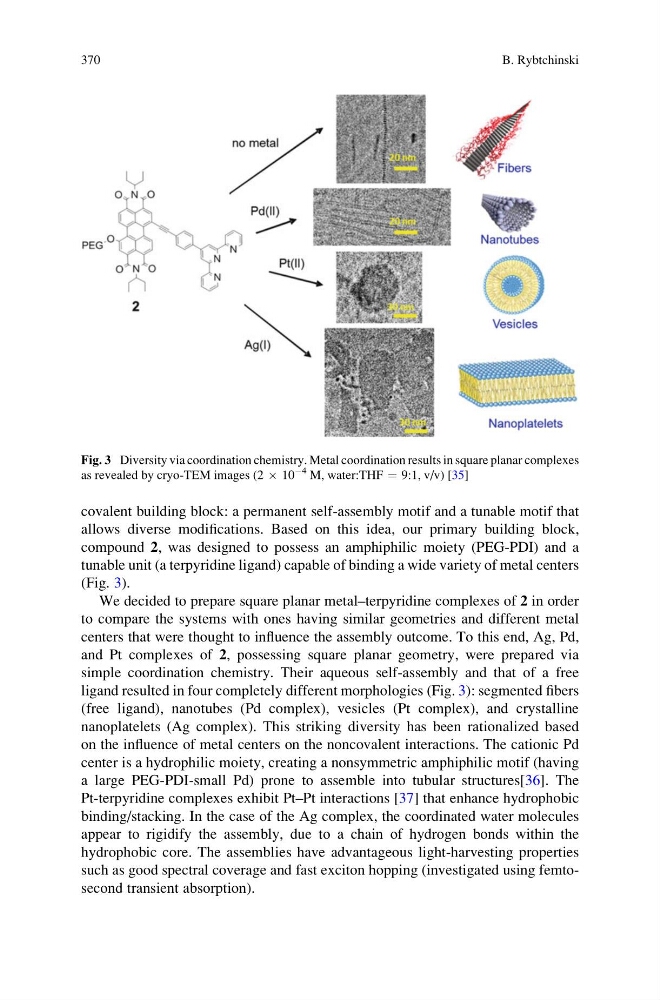
compound 2, was designed to possess an amphiphilic moiety (PEG-PDI) and a
tunable unit (a terpyridine ligand) capable of binding a wide variety of metal centers
(Fig. 3).
We decided to prepare square planar metal–terpyridine complexes of 2 in order
to compare the systems with ones having similar geometries and different metal
centers that were thought to influence the assembly outcome. To this end, Ag, Pd,
and Pt complexes of 2, possessing square planar geometry, were prepared via
simple coordination chemistry. Their aqueous self-assembly and that of a free
ligand resulted in four completely different morphologies (Fig. 3): segmented fibers
(free ligand), nanotubes (Pd complex), vesicles (Pt complex), and crystalline
nanoplatelets (Ag complex). This striking diversity has been rationalized based
on the influence of metal centers on the noncovalent interactions. The cationic Pd
center is a hydrophilic moiety, creating a nonsymmetric amphiphilic motif (having
a large PEG-PDI-small Pd) prone to assemble into tubular structures[36]. The
Pt-terpyridine complexes exhibit Pt–Pt interactions [37] that enhance hydrophobic
binding/stacking. In the case of the Ag complex, the coordinated water molecules
appear to rigidify the assembly, due to a chain of hydrogen bonds within the
hydrophobic core. The assemblies have advantageous light-harvesting properties
such as good spectral coverage and fast exciton hopping (investigated using femtosecond transient absorption).
Fig. 3 Diversity via coordination chemistry. Metal coordination results in square planar complexes
as revealed by cryo-TEM images (2 Â 10
À4 M, water:THF ¼ 9:1, v/v) [35]
370
B. Rybtchinski
allows diverse modifications. Based on this idea, our primary building block,
compound 2, was designed to possess an amphiphilic moiety (PEG-PDI) and a
tunable unit (a terpyridine ligand) capable of binding a wide variety of metal centers
(Fig. 3).
We decided to prepare square planar metal–terpyridine complexes of 2 in order
to compare the systems with ones having similar geometries and different metal
centers that were thought to influence the assembly outcome. To this end, Ag, Pd,
and Pt complexes of 2, possessing square planar geometry, were prepared via
simple coordination chemistry. Their aqueous self-assembly and that of a free
ligand resulted in four completely different morphologies (Fig. 3): segmented fibers
(free ligand), nanotubes (Pd complex), vesicles (Pt complex), and crystalline
nanoplatelets (Ag complex). This striking diversity has been rationalized based
on the influence of metal centers on the noncovalent interactions. The cationic Pd
center is a hydrophilic moiety, creating a nonsymmetric amphiphilic motif (having
a large PEG-PDI-small Pd) prone to assemble into tubular structures[36]. The
Pt-terpyridine complexes exhibit Pt–Pt interactions [37] that enhance hydrophobic
binding/stacking. In the case of the Ag complex, the coordinated water molecules
appear to rigidify the assembly, due to a chain of hydrogen bonds within the
hydrophobic core. The assemblies have advantageous light-harvesting properties
such as good spectral coverage and fast exciton hopping (investigated using femtosecond transient absorption).
Fig. 3 Diversity via coordination chemistry. Metal coordination results in square planar complexes
as revealed by cryo-TEM images (2 Â 10
À4 M, water:THF ¼ 9:1, v/v) [35]
370
B. Rybtchinski