

restrict interactions between hydrophobic moieties, provided that their hydrophobic
surfaces are approximately parallel to the axis of the scaffold (and the polymer),
in contrast to a conventional perpendicular arrangement (as in discotic systems). As
a scaffold, we employed hexa-substituted benzenes (HSB), which are bi-facially
segregated systems where 1,3,5 substituents are situated above the phenyl plane and
the 2,4,6 substituents below it, rendering HSB platforms advantageous for construction of tripodal ligands, receptors, and cages [51, 52]. In order to create a
directional self-assembling motif based on π–π stacking and hydrophobic interactions, we designed and synthesized (using click chemistry) 1,3,5-trisubstituted
(bearing ethyl groups at 2,4,6 positions) and hexasubstituted molecules, in which
aromatic amphiphiles (PDIs bearing PEG) are attached to a HSB scaffold through
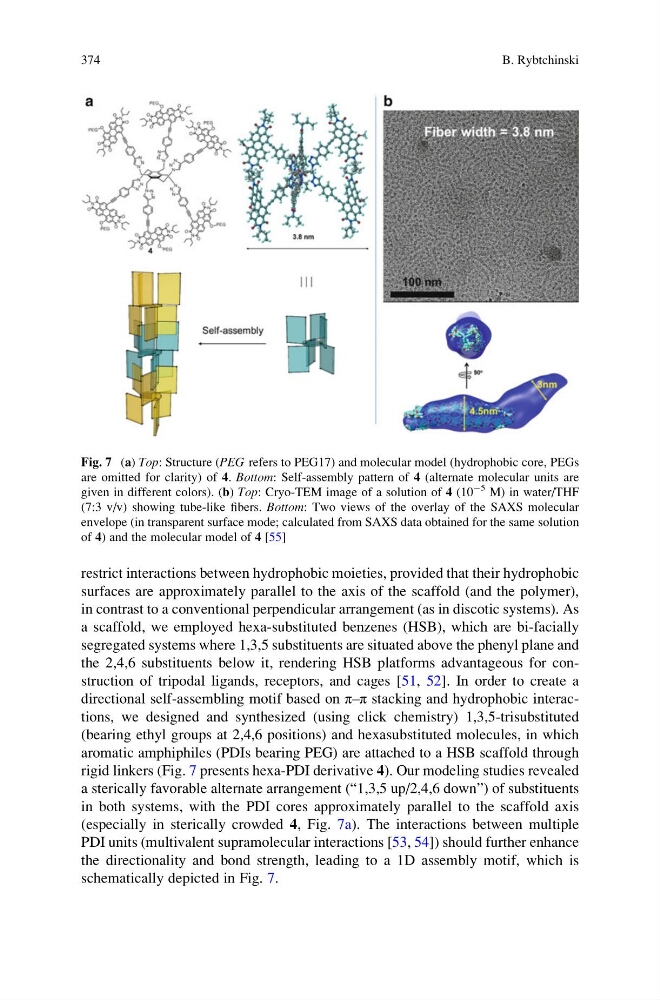
rigid linkers (Fig. 7 presents hexa-PDI derivative 4). Our modeling studies revealed
a sterically favorable alternate arrangement (“1,3,5 up/2,4,6 down”) of substituents
in both systems, with the PDI cores approximately parallel to the scaffold axis
(especially in sterically crowded 4, Fig. 7a). The interactions between multiple
PDI units (multivalent supramolecular interactions [53, 54]) should further enhance
the directionality and bond strength, leading to a 1D assembly motif, which is
schematically depicted in Fig. 7.
Fig. 7 (a) Top: Structure (PEG refers to PEG17) and molecular model (hydrophobic core, PEGs
are omitted for clarity) of 4. Bottom: Self-assembly pattern of 4 (alternate molecular units are
given in different colors). (b) Top: Cryo-TEM image of a solution of 4 (10
À5 M) in water/THF
(7:3 v/v) showing tube-like fibers. Bottom: Two views of the overlay of the SAXS molecular
envelope (in transparent surface mode; calculated from SAXS data obtained for the same solution
of 4) and the molecular model of 4 [55]
374
B. Rybtchinski
surfaces are approximately parallel to the axis of the scaffold (and the polymer),
in contrast to a conventional perpendicular arrangement (as in discotic systems). As
a scaffold, we employed hexa-substituted benzenes (HSB), which are bi-facially
segregated systems where 1,3,5 substituents are situated above the phenyl plane and
the 2,4,6 substituents below it, rendering HSB platforms advantageous for construction of tripodal ligands, receptors, and cages [51, 52]. In order to create a
directional self-assembling motif based on π–π stacking and hydrophobic interactions, we designed and synthesized (using click chemistry) 1,3,5-trisubstituted
(bearing ethyl groups at 2,4,6 positions) and hexasubstituted molecules, in which
aromatic amphiphiles (PDIs bearing PEG) are attached to a HSB scaffold through
rigid linkers (Fig. 7 presents hexa-PDI derivative 4). Our modeling studies revealed
a sterically favorable alternate arrangement (“1,3,5 up/2,4,6 down”) of substituents
in both systems, with the PDI cores approximately parallel to the scaffold axis
(especially in sterically crowded 4, Fig. 7a). The interactions between multiple
PDI units (multivalent supramolecular interactions [53, 54]) should further enhance
the directionality and bond strength, leading to a 1D assembly motif, which is
schematically depicted in Fig. 7.
Fig. 7 (a) Top: Structure (PEG refers to PEG17) and molecular model (hydrophobic core, PEGs
are omitted for clarity) of 4. Bottom: Self-assembly pattern of 4 (alternate molecular units are
given in different colors). (b) Top: Cryo-TEM image of a solution of 4 (10
À5 M) in water/THF
(7:3 v/v) showing tube-like fibers. Bottom: Two views of the overlay of the SAXS molecular
envelope (in transparent surface mode; calculated from SAXS data obtained for the same solution
of 4) and the molecular model of 4 [55]
374
B. Rybtchinski