

[122–125]. By orienting the cylindrical polymers along the length of the fiber, the
conformational changes and the molecular scale extension/contraction are also
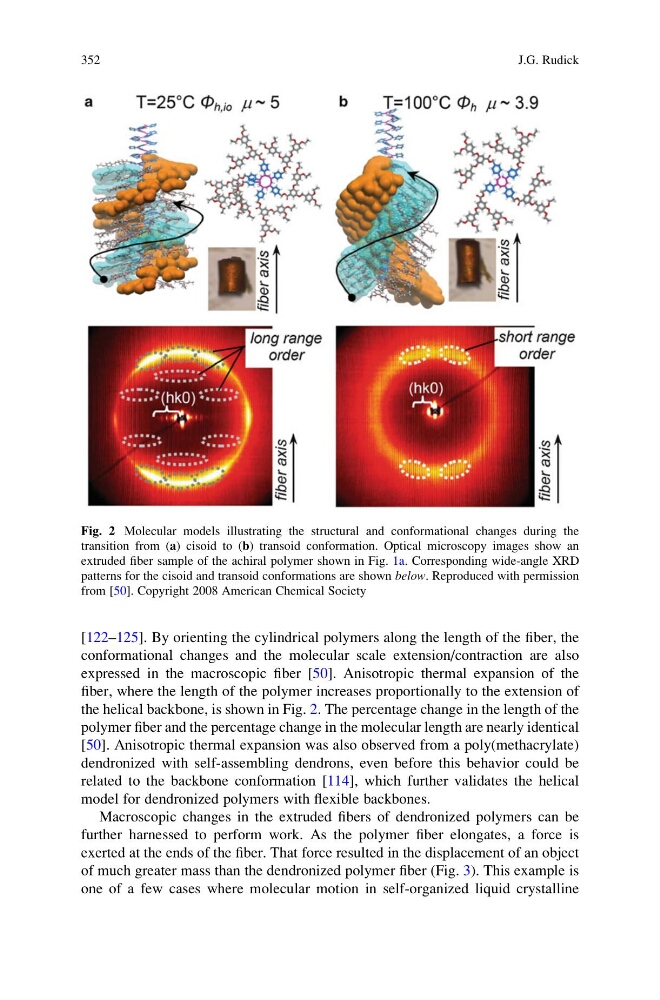
expressed in the macroscopic fiber [50]. Anisotropic thermal expansion of the
fiber, where the length of the polymer increases proportionally to the extension of
the helical backbone, is shown in Fig. 2. The percentage change in the length of the
polymer fiber and the percentage change in the molecular length are nearly identical
[50]. Anisotropic thermal expansion was also observed from a poly(methacrylate)
dendronized with self-assembling dendrons, even before this behavior could be
related to the backbone conformation [114], which further validates the helical
model for dendronized polymers with flexible backbones.
Macroscopic changes in the extruded fibers of dendronized polymers can be
further harnessed to perform work. As the polymer fiber elongates, a force is
exerted at the ends of the fiber. That force resulted in the displacement of an object
of much greater mass than the dendronized polymer fiber (Fig. 3). This example is
one of a few cases where molecular motion in self-organized liquid crystalline
Fig. 2 Molecular models illustrating the structural and conformational changes during the
transition from (a) cisoid to (b) transoid conformation. Optical microscopy images show an
extruded fiber sample of the achiral polymer shown in Fig. 1a. Corresponding wide-angle XRD
patterns for the cisoid and transoid conformations are shown below. Reproduced with permission
from [50]. Copyright 2008 American Chemical Society
352
J.G. Rudick
conformational changes and the molecular scale extension/contraction are also
expressed in the macroscopic fiber [50]. Anisotropic thermal expansion of the
fiber, where the length of the polymer increases proportionally to the extension of
the helical backbone, is shown in Fig. 2. The percentage change in the length of the
polymer fiber and the percentage change in the molecular length are nearly identical
[50]. Anisotropic thermal expansion was also observed from a poly(methacrylate)
dendronized with self-assembling dendrons, even before this behavior could be
related to the backbone conformation [114], which further validates the helical
model for dendronized polymers with flexible backbones.
Macroscopic changes in the extruded fibers of dendronized polymers can be
further harnessed to perform work. As the polymer fiber elongates, a force is
exerted at the ends of the fiber. That force resulted in the displacement of an object
of much greater mass than the dendronized polymer fiber (Fig. 3). This example is
one of a few cases where molecular motion in self-organized liquid crystalline
Fig. 2 Molecular models illustrating the structural and conformational changes during the
transition from (a) cisoid to (b) transoid conformation. Optical microscopy images show an
extruded fiber sample of the achiral polymer shown in Fig. 1a. Corresponding wide-angle XRD
patterns for the cisoid and transoid conformations are shown below. Reproduced with permission
from [50]. Copyright 2008 American Chemical Society
352
J.G. Rudick