

dendronized polymer is more extended. The transition between cisoid and transoid
conformations is observed as a first-order transtion in differential scanning calorimetry (DSC) experiments. By avoiding the cis-cisoidal conformation, triene
sequences in the backbone are less likely to undergo cyclization [122].
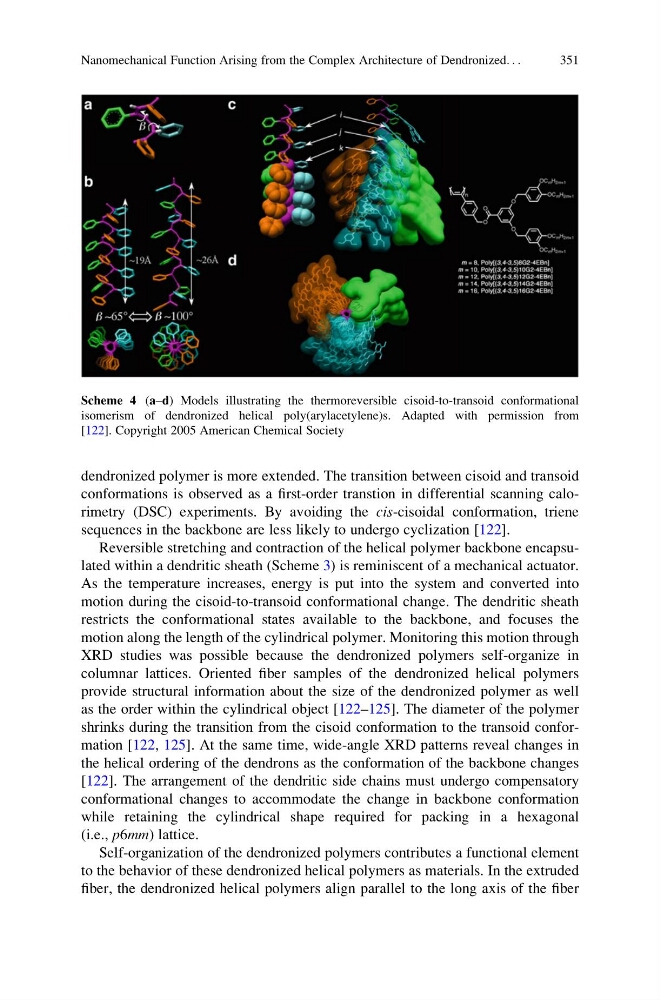
Reversible stretching and contraction of the helical polymer backbone encapsulated within a dendritic sheath (Scheme 3) is reminiscent of a mechanical actuator.
As the temperature increases, energy is put into the system and converted into
motion during the cisoid-to-transoid conformational change. The dendritic sheath
restricts the conformational states available to the backbone, and focuses the
motion along the length of the cylindrical polymer. Monitoring this motion through
XRD studies was possible because the dendronized polymers self-organize in
columnar lattices. Oriented fiber samples of the dendronized helical polymers
provide structural information about the size of the dendronized polymer as well
as the order within the cylindrical object [122–125]. The diameter of the polymer
shrinks during the transition from the cisoid conformation to the transoid conformation [122, 125]. At the same time, wide-angle XRD patterns reveal changes in
the helical ordering of the dendrons as the conformation of the backbone changes
[122]. The arrangement of the dendritic side chains must undergo compensatory
conformational changes to accommodate the change in backbone conformation
while retaining the cylindrical shape required for packing in a hexagonal
(i.e., p6mm) lattice.
Self-organization of the dendronized polymers contributes a functional element
to the behavior of these dendronized helical polymers as materials. In the extruded
fiber, the dendronized helical polymers align parallel to the long axis of the fiber
Scheme 4 (a–d) Models illustrating the thermoreversible cisoid-to-transoid conformational
isomerism of dendronized helical poly(arylacetylene)s. Adapted with permission from
[122]. Copyright 2005 American Chemical Society
Nanomechanical Function Arising from the Complex Architecture of Dendronized. . .
351
conformations is observed as a first-order transtion in differential scanning calorimetry (DSC) experiments. By avoiding the cis-cisoidal conformation, triene
sequences in the backbone are less likely to undergo cyclization [122].
Reversible stretching and contraction of the helical polymer backbone encapsulated within a dendritic sheath (Scheme 3) is reminiscent of a mechanical actuator.
As the temperature increases, energy is put into the system and converted into
motion during the cisoid-to-transoid conformational change. The dendritic sheath
restricts the conformational states available to the backbone, and focuses the
motion along the length of the cylindrical polymer. Monitoring this motion through
XRD studies was possible because the dendronized polymers self-organize in
columnar lattices. Oriented fiber samples of the dendronized helical polymers
provide structural information about the size of the dendronized polymer as well
as the order within the cylindrical object [122–125]. The diameter of the polymer
shrinks during the transition from the cisoid conformation to the transoid conformation [122, 125]. At the same time, wide-angle XRD patterns reveal changes in
the helical ordering of the dendrons as the conformation of the backbone changes
[122]. The arrangement of the dendritic side chains must undergo compensatory
conformational changes to accommodate the change in backbone conformation
while retaining the cylindrical shape required for packing in a hexagonal
(i.e., p6mm) lattice.
Self-organization of the dendronized polymers contributes a functional element
to the behavior of these dendronized helical polymers as materials. In the extruded
fiber, the dendronized helical polymers align parallel to the long axis of the fiber
Scheme 4 (a–d) Models illustrating the thermoreversible cisoid-to-transoid conformational
isomerism of dendronized helical poly(arylacetylene)s. Adapted with permission from
[122]. Copyright 2005 American Chemical Society
Nanomechanical Function Arising from the Complex Architecture of Dendronized. . .
351