

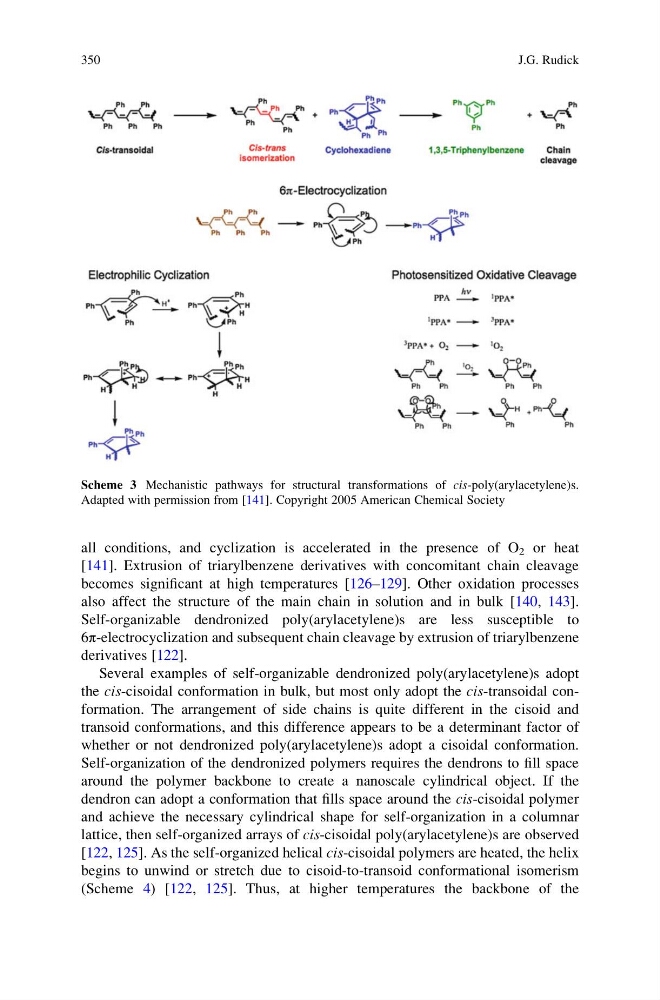
all conditions, and cyclization is accelerated in the presence of O 2 or heat
[141]. Extrusion of triarylbenzene derivatives with concomitant chain cleavage
becomes significant at high temperatures [126–129]. Other oxidation processes
also affect the structure of the main chain in solution and in bulk [140, 143].
Self-organizable dendronized poly(arylacetylene)s are less susceptible to
6π-electrocyclization and subsequent chain cleavage by extrusion of triarylbenzene
derivatives [122].
Several examples of self-organizable dendronized poly(arylacetylene)s adopt
the cis-cisoidal conformation in bulk, but most only adopt the cis-transoidal conformation. The arrangement of side chains is quite different in the cisoid and
transoid conformations, and this difference appears to be a determinant factor of
whether or not dendronized poly(arylacetylene)s adopt a cisoidal conformation.
Self-organization of the dendronized polymers requires the dendrons to fill space
around the polymer backbone to create a nanoscale cylindrical object. If the
dendron can adopt a conformation that fills space around the cis-cisoidal polymer
and achieve the necessary cylindrical shape for self-organization in a columnar
lattice, then self-organized arrays of cis-cisoidal poly(arylacetylene)s are observed
[122, 125]. As the self-organized helical cis-cisoidal polymers are heated, the helix
begins to unwind or stretch due to cisoid-to-transoid conformational isomerism
(Scheme 4) [122, 125]. Thus, at higher temperatures the backbone of the
Scheme 3 Mechanistic pathways for structural transformations of cis-poly(arylacetylene)s.
Adapted with permission from [141]. Copyright 2005 American Chemical Society
350
J.G. Rudick
[141]. Extrusion of triarylbenzene derivatives with concomitant chain cleavage
becomes significant at high temperatures [126–129]. Other oxidation processes
also affect the structure of the main chain in solution and in bulk [140, 143].
Self-organizable dendronized poly(arylacetylene)s are less susceptible to
6π-electrocyclization and subsequent chain cleavage by extrusion of triarylbenzene
derivatives [122].
Several examples of self-organizable dendronized poly(arylacetylene)s adopt
the cis-cisoidal conformation in bulk, but most only adopt the cis-transoidal conformation. The arrangement of side chains is quite different in the cisoid and
transoid conformations, and this difference appears to be a determinant factor of
whether or not dendronized poly(arylacetylene)s adopt a cisoidal conformation.
Self-organization of the dendronized polymers requires the dendrons to fill space
around the polymer backbone to create a nanoscale cylindrical object. If the
dendron can adopt a conformation that fills space around the cis-cisoidal polymer
and achieve the necessary cylindrical shape for self-organization in a columnar
lattice, then self-organized arrays of cis-cisoidal poly(arylacetylene)s are observed
[122, 125]. As the self-organized helical cis-cisoidal polymers are heated, the helix
begins to unwind or stretch due to cisoid-to-transoid conformational isomerism
(Scheme 4) [122, 125]. Thus, at higher temperatures the backbone of the
Scheme 3 Mechanistic pathways for structural transformations of cis-poly(arylacetylene)s.
Adapted with permission from [141]. Copyright 2005 American Chemical Society
350
J.G. Rudick