

polymer diameter and dendron packing [28]. A proposed helical backbone conformation with frequent helix inversions was also consistent with the apparent contour
length of individual dendronized polymers visualized by atomic force microscopy
(AFM) [27]. Direct evidence for a helical conformation of the backbone in
self-organizable dendronized polymers was obtained through circular dichroism
(CD) spectroscopy of dendronized poly(arylacetylene)s in solution [120–125]. CisPoly(arylacetylene)s adopt helical conformations [126–129], and the handedness of
the helix can be determined by chiral side chains [130–135]. Conjugation along the
polyene backbone serves as a unique chromophore with which to interrogate
conformational order in the dendronized polymers without the interference of
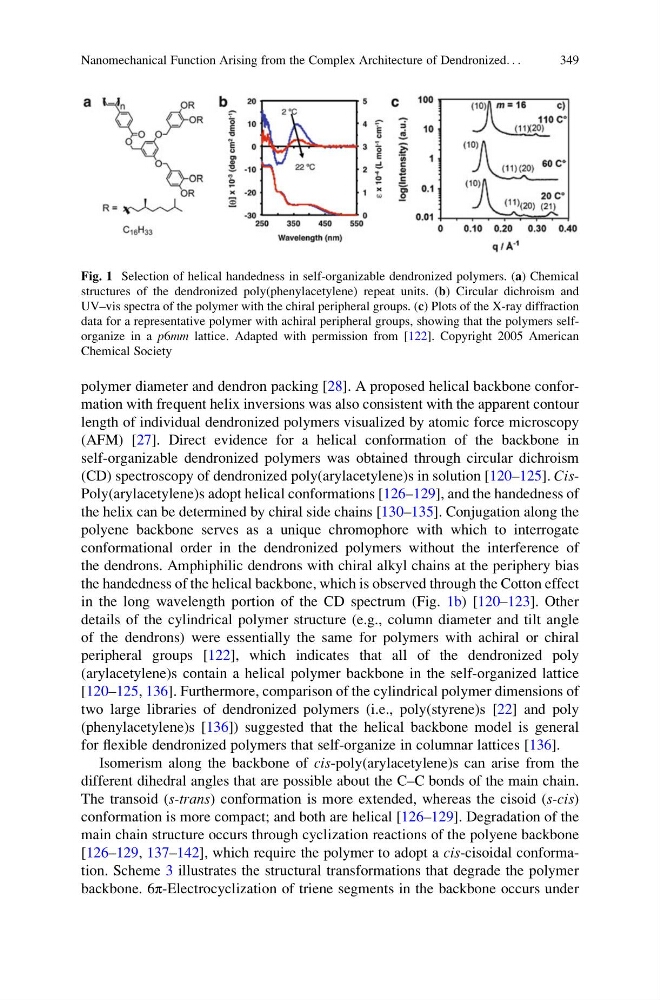
the dendrons. Amphiphilic dendrons with chiral alkyl chains at the periphery bias
the handedness of the helical backbone, which is observed through the Cotton effect
in the long wavelength portion of the CD spectrum (Fig. 1b) [120–123]. Other
details of the cylindrical polymer structure (e.g., column diameter and tilt angle
of the dendrons) were essentially the same for polymers with achiral or chiral
peripheral groups [122], which indicates that all of the dendronized poly
(arylacetylene)s contain a helical polymer backbone in the self-organized lattice
[120–125, 136]. Furthermore, comparison of the cylindrical polymer dimensions of
two large libraries of dendronized polymers (i.e., poly(styrene)s [22] and poly
(phenylacetylene)s [136]) suggested that the helical backbone model is general
for flexible dendronized polymers that self-organize in columnar lattices [136].
Isomerism along the backbone of cis-poly(arylacetylene)s can arise from the
different dihedral angles that are possible about the C–C bonds of the main chain.
The transoid (s-trans) conformation is more extended, whereas the cisoid (s-cis)
conformation is more compact; and both are helical [126–129]. Degradation of the
main chain structure occurs through cyclization reactions of the polyene backbone
[126–129, 137–142], which require the polymer to adopt a cis-cisoidal conformation. Scheme 3 illustrates the structural transformations that degrade the polymer
backbone. 6π-Electrocyclization of triene segments in the backbone occurs under
Fig. 1 Selection of helical handedness in self-organizable dendronized polymers. (a) Chemical
structures of the dendronized poly(phenylacetylene) repeat units. (b) Circular dichroism and
UV–vis spectra of the polymer with the chiral peripheral groups. (c) Plots of the X-ray diffraction
data for a representative polymer with achiral peripheral groups, showing that the polymers selforganize in a p6mm lattice. Adapted with permission from [122]. Copyright 2005 American
Chemical Society
Nanomechanical Function Arising from the Complex Architecture of Dendronized. . .
349
length of individual dendronized polymers visualized by atomic force microscopy
(AFM) [27]. Direct evidence for a helical conformation of the backbone in
self-organizable dendronized polymers was obtained through circular dichroism
(CD) spectroscopy of dendronized poly(arylacetylene)s in solution [120–125]. CisPoly(arylacetylene)s adopt helical conformations [126–129], and the handedness of
the helix can be determined by chiral side chains [130–135]. Conjugation along the
polyene backbone serves as a unique chromophore with which to interrogate
conformational order in the dendronized polymers without the interference of
the dendrons. Amphiphilic dendrons with chiral alkyl chains at the periphery bias
the handedness of the helical backbone, which is observed through the Cotton effect
in the long wavelength portion of the CD spectrum (Fig. 1b) [120–123]. Other
details of the cylindrical polymer structure (e.g., column diameter and tilt angle
of the dendrons) were essentially the same for polymers with achiral or chiral
peripheral groups [122], which indicates that all of the dendronized poly
(arylacetylene)s contain a helical polymer backbone in the self-organized lattice
[120–125, 136]. Furthermore, comparison of the cylindrical polymer dimensions of
two large libraries of dendronized polymers (i.e., poly(styrene)s [22] and poly
(phenylacetylene)s [136]) suggested that the helical backbone model is general
for flexible dendronized polymers that self-organize in columnar lattices [136].
Isomerism along the backbone of cis-poly(arylacetylene)s can arise from the
different dihedral angles that are possible about the C–C bonds of the main chain.
The transoid (s-trans) conformation is more extended, whereas the cisoid (s-cis)
conformation is more compact; and both are helical [126–129]. Degradation of the
main chain structure occurs through cyclization reactions of the polyene backbone
[126–129, 137–142], which require the polymer to adopt a cis-cisoidal conformation. Scheme 3 illustrates the structural transformations that degrade the polymer
backbone. 6π-Electrocyclization of triene segments in the backbone occurs under
Fig. 1 Selection of helical handedness in self-organizable dendronized polymers. (a) Chemical
structures of the dendronized poly(phenylacetylene) repeat units. (b) Circular dichroism and
UV–vis spectra of the polymer with the chiral peripheral groups. (c) Plots of the X-ray diffraction
data for a representative polymer with achiral peripheral groups, showing that the polymers selforganize in a p6mm lattice. Adapted with permission from [122]. Copyright 2005 American
Chemical Society
Nanomechanical Function Arising from the Complex Architecture of Dendronized. . .
349