

[21, 106–108]. Because these dendronized polymers self-organize, X-ray diffraction (XRD) studies can provide detailed structural information about the lattice
symmetry, diameter of individual dendronized polymer chains, and the internal
structure of the polymer. In the columnar lattice, each polymer chain behaves
as an individual cylindrical object [109–112]. The polymer backbone is encapsulated in the core of the cylindrical macromolecule, and must adopt a compact
conformation that is most likely helical [113, 114]. Drawing or extruding fibers
of self-organizable dendronized polymers in the melt induces ordering of the
columnar lattice domains so that the cylindrical polymers are aligned along the
fiber axis [113–119]. Early XRD studies of oriented fiber samples demonstrated
that there is helical order within the individual dendronized polymer chains in a
hexagonal columnar ( p6mm) lattice [113–117]. However, these studies could not
definitively show that the polymer backbone adopted a helical conformation,
because scattering from the aromatic groups in the dendrons dominates the XRD
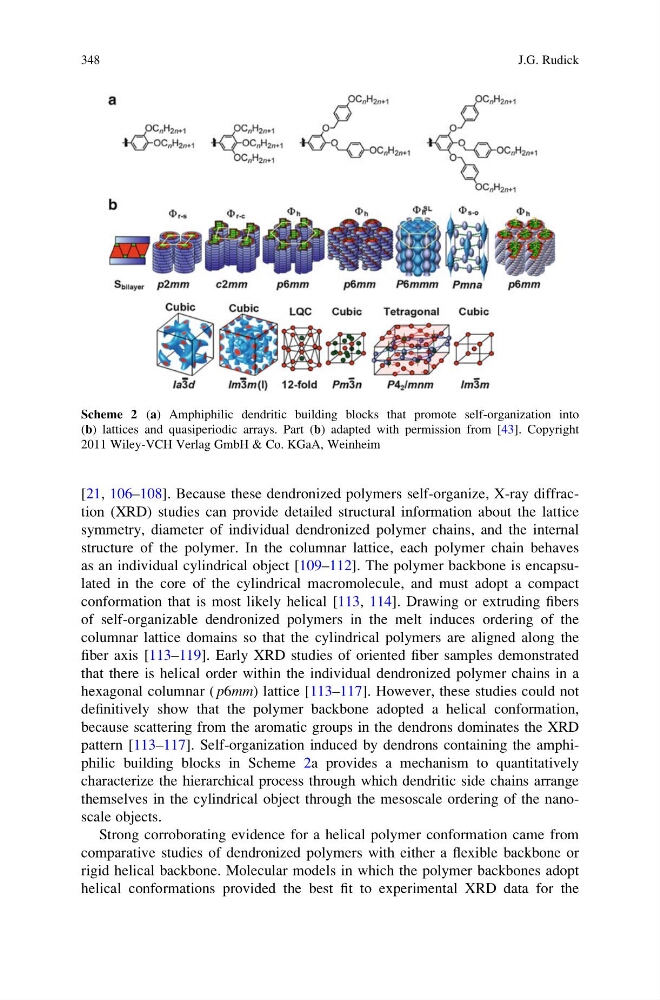
pattern [113–117]. Self-organization induced by dendrons containing the amphiphilic building blocks in Scheme 2a provides a mechanism to quantitatively
characterize the hierarchical process through which dendritic side chains arrange
themselves in the cylindrical object through the mesoscale ordering of the nanoscale objects.
Strong corroborating evidence for a helical polymer conformation came from
comparative studies of dendronized polymers with either a flexible backbone or
rigid helical backbone. Molecular models in which the polymer backbones adopt
helical conformations provided the best fit to experimental XRD data for the
Scheme 2 (a) Amphiphilic dendritic building blocks that promote self-organization into
(b) lattices and quasiperiodic arrays. Part (b) adapted with permission from [43]. Copyright
2011 Wiley-VCH Verlag GmbH & Co. KGaA, Weinheim
348
J.G. Rudick
symmetry, diameter of individual dendronized polymer chains, and the internal
structure of the polymer. In the columnar lattice, each polymer chain behaves
as an individual cylindrical object [109–112]. The polymer backbone is encapsulated in the core of the cylindrical macromolecule, and must adopt a compact
conformation that is most likely helical [113, 114]. Drawing or extruding fibers
of self-organizable dendronized polymers in the melt induces ordering of the
columnar lattice domains so that the cylindrical polymers are aligned along the
fiber axis [113–119]. Early XRD studies of oriented fiber samples demonstrated
that there is helical order within the individual dendronized polymer chains in a
hexagonal columnar ( p6mm) lattice [113–117]. However, these studies could not
definitively show that the polymer backbone adopted a helical conformation,
because scattering from the aromatic groups in the dendrons dominates the XRD
pattern [113–117]. Self-organization induced by dendrons containing the amphiphilic building blocks in Scheme 2a provides a mechanism to quantitatively
characterize the hierarchical process through which dendritic side chains arrange
themselves in the cylindrical object through the mesoscale ordering of the nanoscale objects.
Strong corroborating evidence for a helical polymer conformation came from
comparative studies of dendronized polymers with either a flexible backbone or
rigid helical backbone. Molecular models in which the polymer backbones adopt
helical conformations provided the best fit to experimental XRD data for the
Scheme 2 (a) Amphiphilic dendritic building blocks that promote self-organization into
(b) lattices and quasiperiodic arrays. Part (b) adapted with permission from [43]. Copyright
2011 Wiley-VCH Verlag GmbH & Co. KGaA, Weinheim
348
J.G. Rudick