

stabilization of nanoemulsion droplets [84]. In these studies, the racemic hydrophobic
segment provides better miscibility with the oil phase compared to enantiomerically
pure hydrophobic polypeptide segments, and gives much higher surface activity. The
resulting emulsions were very stable, and were obtained with nanoscale (10–100 nm)
diameters using microfluidic homogenization, making them attractive for delivery of
hydrophobic cargos. Remarkably, it was found that the copolypeptide amphiphiles
also promote formation of very stable double emulsion droplets that for the first time
could be prepared with outer droplet diameters down to 10 nm [84]. The block
copolypeptide surfactants designed have the general structure poly(L-lysine · HBr) x -
b-poly(racemic-leucine) y , K x (rac-L) y , where x ranged from 20 to 100, and y ranged
from 5 to 30 residues. Diblock copolypeptides were screened for emulsification
activity by adding silicone oil (PDMS) to aqueous K x (rac-L) y solutions followed by
rotary homogenization and then high-pressure microfluidic homogenization. All
K x (rac-L) y samples gave stable nanoemulsions that did not ripen or phase-separate
for over 9 months. In addition to PDMS, other immiscible liquids such as dodecane,
soybean oil, and methyl oleate gave emulsions using 1 mM K 40 (rac-L) 20 in water.
The versatility of this system was shown by formation of stable double emulsions
using R 40 (rac-L) 10 or E 40 (rac-L) 10 , containing guanidinium or carboxylate functionality of L-arginine (R) and L-glutamate (E), respectively [84].
To demonstrate their encapsulating ability, both water-soluble and oil-soluble
fluorescent markers were loaded into copolypeptide stabilized double emulsions.
Water-soluble InGaP/ZnS quantum dots were mixed with fluorescein-labeled
Micelles
N
H
N
H
N
H
H
O
O
R
R'
x
y
R
a
R = (CH 2 ) 4 NHC(O)CH 2 (OCH 2 CH 2 )OCH 3
R’ = CH 2 CH(CH 3 ) 2
K P x (rac-L) y =
Micelles
N
H
N
H
N
H
H
O
O
R
R'
x
y
R
R = (CH 2 ) 4 NHC(O)CH 2 (OCH 2 CH 2 )OCH 3
R’ = CH 2 CH(CH 3 ) 2
K P x (rac-L) y =
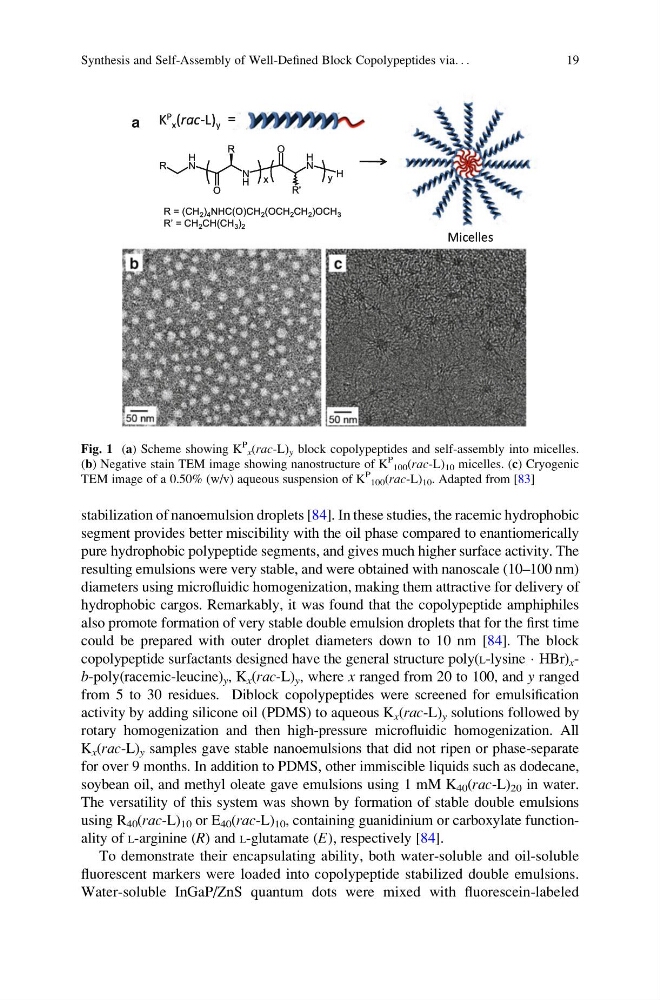
Fig. 1 (a) Scheme showing K
P
x (rac-L) y block copolypeptides and self-assembly into micelles.
(b) Negative stain TEM image showing nanostructure of K
P
100 (rac-L) 10 micelles. (c) Cryogenic
TEM image of a 0.50% (w/v) aqueous suspension of K
P
100 (rac-L) 10 . Adapted from [83]
Synthesis and Self-Assembly of Well-Defined Block Copolypeptides via. . .
19
segment provides better miscibility with the oil phase compared to enantiomerically
pure hydrophobic polypeptide segments, and gives much higher surface activity. The
resulting emulsions were very stable, and were obtained with nanoscale (10–100 nm)
diameters using microfluidic homogenization, making them attractive for delivery of
hydrophobic cargos. Remarkably, it was found that the copolypeptide amphiphiles
also promote formation of very stable double emulsion droplets that for the first time
could be prepared with outer droplet diameters down to 10 nm [84]. The block
copolypeptide surfactants designed have the general structure poly(L-lysine · HBr) x -
b-poly(racemic-leucine) y , K x (rac-L) y , where x ranged from 20 to 100, and y ranged
from 5 to 30 residues. Diblock copolypeptides were screened for emulsification
activity by adding silicone oil (PDMS) to aqueous K x (rac-L) y solutions followed by
rotary homogenization and then high-pressure microfluidic homogenization. All
K x (rac-L) y samples gave stable nanoemulsions that did not ripen or phase-separate
for over 9 months. In addition to PDMS, other immiscible liquids such as dodecane,
soybean oil, and methyl oleate gave emulsions using 1 mM K 40 (rac-L) 20 in water.
The versatility of this system was shown by formation of stable double emulsions
using R 40 (rac-L) 10 or E 40 (rac-L) 10 , containing guanidinium or carboxylate functionality of L-arginine (R) and L-glutamate (E), respectively [84].
To demonstrate their encapsulating ability, both water-soluble and oil-soluble
fluorescent markers were loaded into copolypeptide stabilized double emulsions.
Water-soluble InGaP/ZnS quantum dots were mixed with fluorescein-labeled
Micelles
N
H
N
H
N
H
H
O
O
R
R'
x
y
R
a
R = (CH 2 ) 4 NHC(O)CH 2 (OCH 2 CH 2 )OCH 3
R’ = CH 2 CH(CH 3 ) 2
K P x (rac-L) y =
Micelles
N
H
N
H
N
H
H
O
O
R
R'
x
y
R
R = (CH 2 ) 4 NHC(O)CH 2 (OCH 2 CH 2 )OCH 3
R’ = CH 2 CH(CH 3 ) 2
K P x (rac-L) y =
Fig. 1 (a) Scheme showing K
P
x (rac-L) y block copolypeptides and self-assembly into micelles.
(b) Negative stain TEM image showing nanostructure of K
P
100 (rac-L) 10 micelles. (c) Cryogenic
TEM image of a 0.50% (w/v) aqueous suspension of K
P
100 (rac-L) 10 . Adapted from [83]
Synthesis and Self-Assembly of Well-Defined Block Copolypeptides via. . .
19