

Co
N
H
N
O
R
R
N
H
O
N
H
R3
O
z
R2
O
N
H O
N
H
R
R1
y
x
(PMe 3 ) 2
x R 1 -NCA
A------------B------------C
triblock copolypeptide
(PMe 3 ) 4 Co
y R 2 -NCA z R 3 -NCA
ð17Þ
3.1 Copolypeptide Nanoparticles with Hydrophobic Cores
Micellar nanoparticles and emulsion droplets are widely used to disperse materials
for a range of food [74], cosmetic [75], and pharmaceutical [76] applications. These
nanoscale assemblies are composed of amphiphilic molecules that self-assemble in
water, and include the addition of an oil phase in the case of emulsions [76]. Block
copolymers make up a large class of micelle-forming molecules [75, 77, 78] and
include some that contain polypeptide segments, which can be enzymatically
degraded to natural metabolites and possess ordered conformations not found in
conventional polymers. Numerous “rod–coil” micelles have been prepared using
α-helical hydrophobic polypeptides conjugated to hydrophilic polyethylene glycol
(PEG) segments, such as PEG-b-PBLG [79, 80] and PEG-b-PBLA [81]. β-Strand
polypeptide segments have also been used to facilitate interchain interactions
and increase micelle stability [82]. By contrast, micelles prepared solely from
polypeptide segments have not been reported until recently. One key reason is the
structure inherent in peptides, which typically favors extended conformations
and strong interchain interactions that usually prevent formation of a disordered
spherical micelle core.
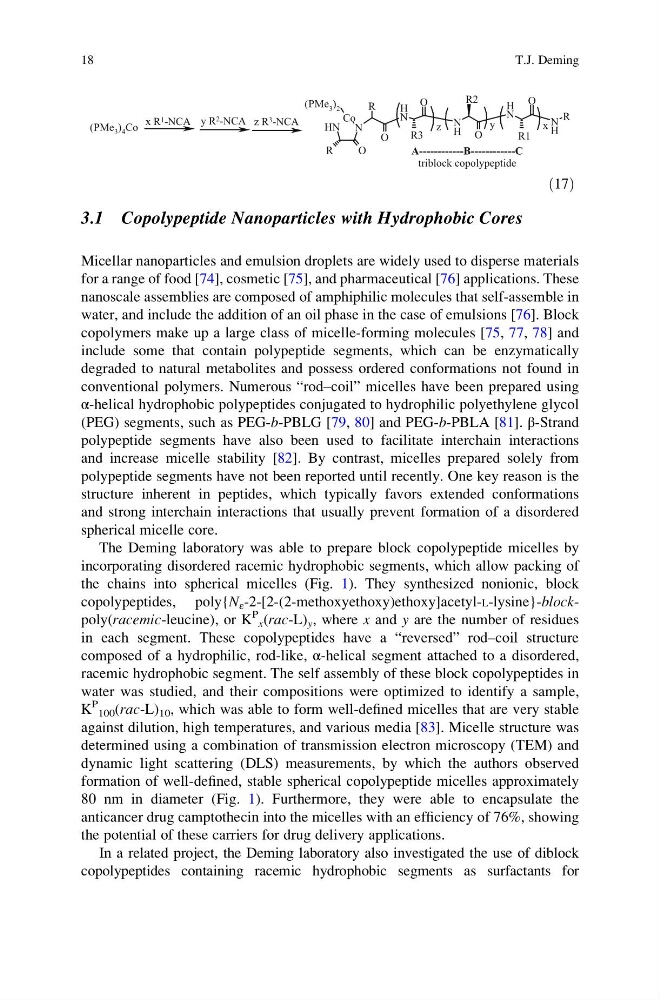
The Deming laboratory was able to prepare block copolypeptide micelles by
incorporating disordered racemic hydrophobic segments, which allow packing of
the chains into spherical micelles (Fig. 1). They synthesized nonionic, block
copolypeptides, poly{N ε -2-[2-(2-methoxyethoxy)ethoxy]acetyl-L-lysine}-blockpoly(racemic-leucine), or K
P
x (rac-L) y , where x and y are the number of residues
in each segment. These copolypeptides have a “reversed” rod–coil structure
composed of a hydrophilic, rod-like, α-helical segment attached to a disordered,
racemic hydrophobic segment. The self assembly of these block copolypeptides in
water was studied, and their compositions were optimized to identify a sample,
K
P
100 (rac-L) 10 , which was able to form well-defined micelles that are very stable
against dilution, high temperatures, and various media [83]. Micelle structure was
determined using a combination of transmission electron microscopy (TEM) and
dynamic light scattering (DLS) measurements, by which the authors observed
formation of well-defined, stable spherical copolypeptide micelles approximately
80 nm in diameter (Fig. 1). Furthermore, they were able to encapsulate the
anticancer drug camptothecin into the micelles with an efficiency of 76%, showing
the potential of these carriers for drug delivery applications.
In a related project, the Deming laboratory also investigated the use of diblock
copolypeptides containing racemic hydrophobic segments as surfactants for
18
T.J. Deming
N
H
N
O
R
R
N
H
O
N
H
R3
O
z
R2
O
N
H O
N
H
R
R1
y
x
(PMe 3 ) 2
x R 1 -NCA
A------------B------------C
triblock copolypeptide
(PMe 3 ) 4 Co
y R 2 -NCA z R 3 -NCA
ð17Þ
3.1 Copolypeptide Nanoparticles with Hydrophobic Cores
Micellar nanoparticles and emulsion droplets are widely used to disperse materials
for a range of food [74], cosmetic [75], and pharmaceutical [76] applications. These
nanoscale assemblies are composed of amphiphilic molecules that self-assemble in
water, and include the addition of an oil phase in the case of emulsions [76]. Block
copolymers make up a large class of micelle-forming molecules [75, 77, 78] and
include some that contain polypeptide segments, which can be enzymatically
degraded to natural metabolites and possess ordered conformations not found in
conventional polymers. Numerous “rod–coil” micelles have been prepared using
α-helical hydrophobic polypeptides conjugated to hydrophilic polyethylene glycol
(PEG) segments, such as PEG-b-PBLG [79, 80] and PEG-b-PBLA [81]. β-Strand
polypeptide segments have also been used to facilitate interchain interactions
and increase micelle stability [82]. By contrast, micelles prepared solely from
polypeptide segments have not been reported until recently. One key reason is the
structure inherent in peptides, which typically favors extended conformations
and strong interchain interactions that usually prevent formation of a disordered
spherical micelle core.
The Deming laboratory was able to prepare block copolypeptide micelles by
incorporating disordered racemic hydrophobic segments, which allow packing of
the chains into spherical micelles (Fig. 1). They synthesized nonionic, block
copolypeptides, poly{N ε -2-[2-(2-methoxyethoxy)ethoxy]acetyl-L-lysine}-blockpoly(racemic-leucine), or K
P
x (rac-L) y , where x and y are the number of residues
in each segment. These copolypeptides have a “reversed” rod–coil structure
composed of a hydrophilic, rod-like, α-helical segment attached to a disordered,
racemic hydrophobic segment. The self assembly of these block copolypeptides in
water was studied, and their compositions were optimized to identify a sample,
K
P
100 (rac-L) 10 , which was able to form well-defined micelles that are very stable
against dilution, high temperatures, and various media [83]. Micelle structure was
determined using a combination of transmission electron microscopy (TEM) and
dynamic light scattering (DLS) measurements, by which the authors observed
formation of well-defined, stable spherical copolypeptide micelles approximately
80 nm in diameter (Fig. 1). Furthermore, they were able to encapsulate the
anticancer drug camptothecin into the micelles with an efficiency of 76%, showing
the potential of these carriers for drug delivery applications.
In a related project, the Deming laboratory also investigated the use of diblock
copolypeptides containing racemic hydrophobic segments as surfactants for
18
T.J. Deming