

K 40 (rac-L) 10 prior to emulsification with silicone oil containing pyrene. Using
fluorescence microscopy, both markers and the labeled polypeptide were imaged
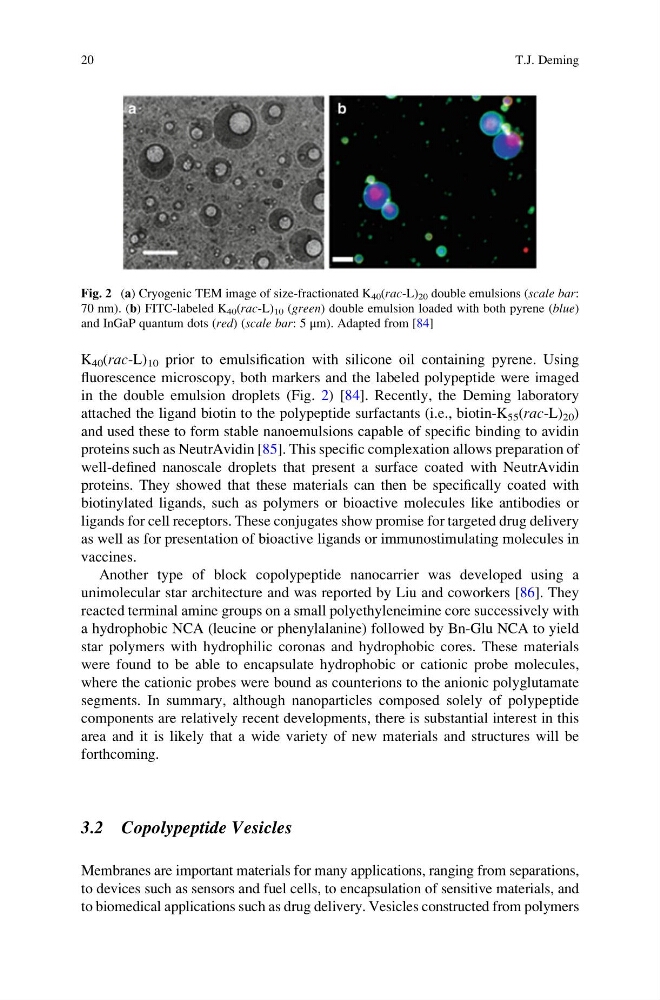
in the double emulsion droplets (Fig. 2) [84]. Recently, the Deming laboratory
attached the ligand biotin to the polypeptide surfactants (i.e., biotin-K 55 (rac-L) 20 )
and used these to form stable nanoemulsions capable of specific binding to avidin
proteins such as NeutrAvidin [85]. This specific complexation allows preparation of
well-defined nanoscale droplets that present a surface coated with NeutrAvidin
proteins. They showed that these materials can then be specifically coated with
biotinylated ligands, such as polymers or bioactive molecules like antibodies or
ligands for cell receptors. These conjugates show promise for targeted drug delivery
as well as for presentation of bioactive ligands or immunostimulating molecules in
vaccines.
Another type of block copolypeptide nanocarrier was developed using a
unimolecular star architecture and was reported by Liu and coworkers [86]. They
reacted terminal amine groups on a small polyethyleneimine core successively with
a hydrophobic NCA (leucine or phenylalanine) followed by Bn-Glu NCA to yield
star polymers with hydrophilic coronas and hydrophobic cores. These materials
were found to be able to encapsulate hydrophobic or cationic probe molecules,
where the cationic probes were bound as counterions to the anionic polyglutamate
segments. In summary, although nanoparticles composed solely of polypeptide
components are relatively recent developments, there is substantial interest in this
area and it is likely that a wide variety of new materials and structures will be
forthcoming.
3.2 Copolypeptide Vesicles
Membranes are important materials for many applications, ranging from separations,
to devices such as sensors and fuel cells, to encapsulation of sensitive materials, and
to biomedical applications such as drug delivery. Vesicles constructed from polymers
Fig. 2 (a) Cryogenic TEM image of size-fractionated K 40 (rac-L) 20 double emulsions (scale bar:
70 nm). (b) FITC-labeled K 40 (rac-L) 10 (green) double emulsion loaded with both pyrene (blue)
and InGaP quantum dots (red) (scale bar: 5 μm). Adapted from [84]
20
T.J. Deming
fluorescence microscopy, both markers and the labeled polypeptide were imaged
in the double emulsion droplets (Fig. 2) [84]. Recently, the Deming laboratory
attached the ligand biotin to the polypeptide surfactants (i.e., biotin-K 55 (rac-L) 20 )
and used these to form stable nanoemulsions capable of specific binding to avidin
proteins such as NeutrAvidin [85]. This specific complexation allows preparation of
well-defined nanoscale droplets that present a surface coated with NeutrAvidin
proteins. They showed that these materials can then be specifically coated with
biotinylated ligands, such as polymers or bioactive molecules like antibodies or
ligands for cell receptors. These conjugates show promise for targeted drug delivery
as well as for presentation of bioactive ligands or immunostimulating molecules in
vaccines.
Another type of block copolypeptide nanocarrier was developed using a
unimolecular star architecture and was reported by Liu and coworkers [86]. They
reacted terminal amine groups on a small polyethyleneimine core successively with
a hydrophobic NCA (leucine or phenylalanine) followed by Bn-Glu NCA to yield
star polymers with hydrophilic coronas and hydrophobic cores. These materials
were found to be able to encapsulate hydrophobic or cationic probe molecules,
where the cationic probes were bound as counterions to the anionic polyglutamate
segments. In summary, although nanoparticles composed solely of polypeptide
components are relatively recent developments, there is substantial interest in this
area and it is likely that a wide variety of new materials and structures will be
forthcoming.
3.2 Copolypeptide Vesicles
Membranes are important materials for many applications, ranging from separations,
to devices such as sensors and fuel cells, to encapsulation of sensitive materials, and
to biomedical applications such as drug delivery. Vesicles constructed from polymers
Fig. 2 (a) Cryogenic TEM image of size-fractionated K 40 (rac-L) 20 double emulsions (scale bar:
70 nm). (b) FITC-labeled K 40 (rac-L) 10 (green) double emulsion loaded with both pyrene (blue)
and InGaP quantum dots (red) (scale bar: 5 μm). Adapted from [84]
20
T.J. Deming