

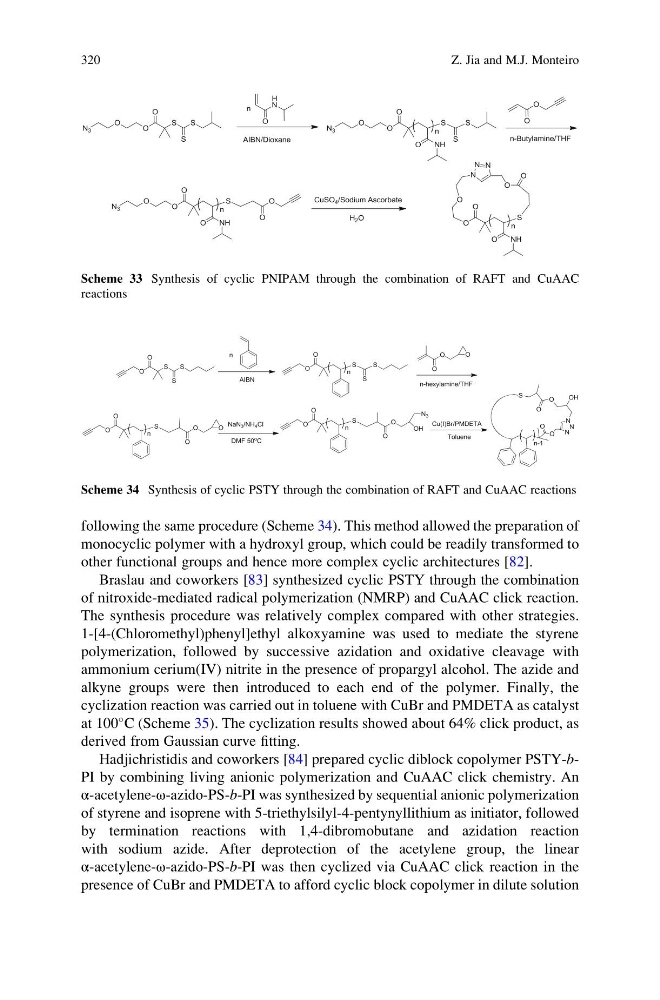
following the same procedure (Scheme 34). This method allowed the preparation of
monocyclic polymer with a hydroxyl group, which could be readily transformed to
other functional groups and hence more complex cyclic architectures [82].
Braslau and coworkers [83] synthesized cyclic PSTY through the combination
of nitroxide-mediated radical polymerization (NMRP) and CuAAC click reaction.
The synthesis procedure was relatively complex compared with other strategies.
1-[4-(Chloromethyl)phenyl]ethyl alkoxyamine was used to mediate the styrene
polymerization, followed by successive azidation and oxidative cleavage with
ammonium cerium(IV) nitrite in the presence of propargyl alcohol. The azide and
alkyne groups were then introduced to each end of the polymer. Finally, the
cyclization reaction was carried out in toluene with CuBr and PMDETA as catalyst
at 100
C (Scheme 35). The cyclization results showed about 64% click product, as
derived from Gaussian curve fitting.
Hadjichristidis and coworkers [84] prepared cyclic diblock copolymer PSTY-bPI by combining living anionic polymerization and CuAAC click chemistry. An
α-acetylene-ω-azido-PS-b-PI was synthesized by sequential anionic polymerization
of styrene and isoprene with 5-triethylsilyl-4-pentynyllithium as initiator, followed
by termination reactions with 1,4-dibromobutane and azidation reaction
with sodium azide. After deprotection of the acetylene group, the linear
α-acetylene-ω-azido-PS-b-PI was then cyclized via CuAAC click reaction in the
presence of CuBr and PMDETA to afford cyclic block copolymer in dilute solution
Scheme 33 Synthesis of cyclic PNIPAM through the combination of RAFT and CuAAC
reactions
Scheme 34 Synthesis of cyclic PSTY through the combination of RAFT and CuAAC reactions
320
Z. Jia and M.J. Monteiro
monocyclic polymer with a hydroxyl group, which could be readily transformed to
other functional groups and hence more complex cyclic architectures [82].
Braslau and coworkers [83] synthesized cyclic PSTY through the combination
of nitroxide-mediated radical polymerization (NMRP) and CuAAC click reaction.
The synthesis procedure was relatively complex compared with other strategies.
1-[4-(Chloromethyl)phenyl]ethyl alkoxyamine was used to mediate the styrene
polymerization, followed by successive azidation and oxidative cleavage with
ammonium cerium(IV) nitrite in the presence of propargyl alcohol. The azide and
alkyne groups were then introduced to each end of the polymer. Finally, the
cyclization reaction was carried out in toluene with CuBr and PMDETA as catalyst
at 100
C (Scheme 35). The cyclization results showed about 64% click product, as
derived from Gaussian curve fitting.
Hadjichristidis and coworkers [84] prepared cyclic diblock copolymer PSTY-bPI by combining living anionic polymerization and CuAAC click chemistry. An
α-acetylene-ω-azido-PS-b-PI was synthesized by sequential anionic polymerization
of styrene and isoprene with 5-triethylsilyl-4-pentynyllithium as initiator, followed
by termination reactions with 1,4-dibromobutane and azidation reaction
with sodium azide. After deprotection of the acetylene group, the linear
α-acetylene-ω-azido-PS-b-PI was then cyclized via CuAAC click reaction in the
presence of CuBr and PMDETA to afford cyclic block copolymer in dilute solution
Scheme 33 Synthesis of cyclic PNIPAM through the combination of RAFT and CuAAC
reactions
Scheme 34 Synthesis of cyclic PSTY through the combination of RAFT and CuAAC reactions
320
Z. Jia and M.J. Monteiro