

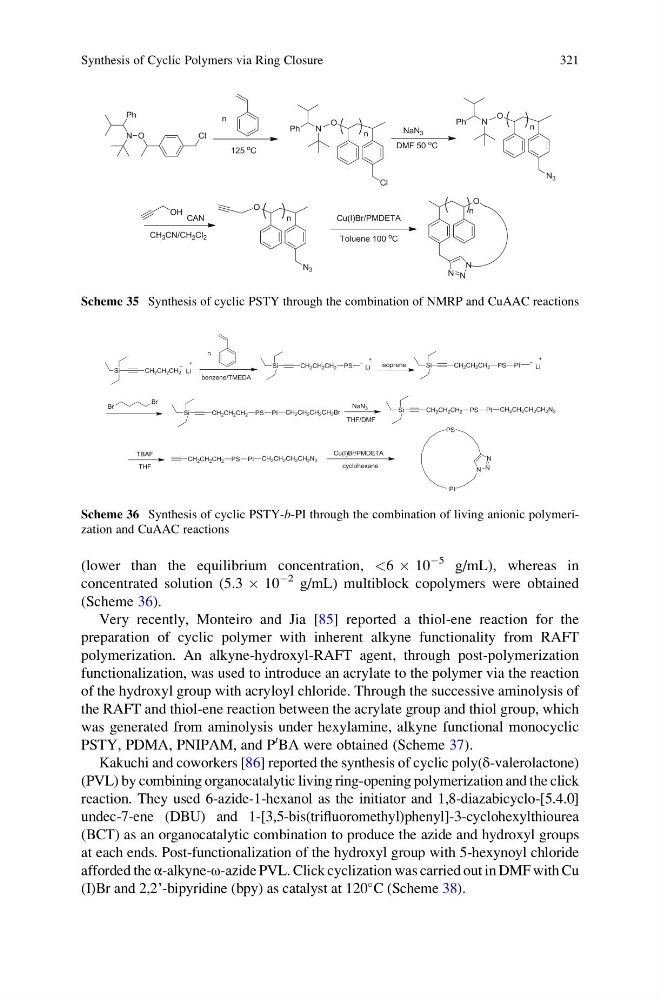
(lower than the equilibrium concentration, <6 Â 10
À5 g/mL), whereas in
concentrated solution (5.3 Â 10
À2 g/mL) multiblock copolymers were obtained
(Scheme 36).
Very recently, Monteiro and Jia [85] reported a thiol-ene reaction for the
preparation of cyclic polymer with inherent alkyne functionality from RAFT
polymerization. An alkyne-hydroxyl-RAFT agent, through post-polymerization
functionalization, was used to introduce an acrylate to the polymer via the reaction
of the hydroxyl group with acryloyl chloride. Through the successive aminolysis of
the RAFT and thiol-ene reaction between the acrylate group and thiol group, which
was generated from aminolysis under hexylamine, alkyne functional monocyclic
PSTY, PDMA, PNIPAM, and P
t BA were obtained (Scheme 37).
Kakuchi and coworkers [86] reported the synthesis of cyclic poly(δ-valerolactone)
(PVL) by combining organocatalytic living ring-opening polymerization and the click
reaction. They used 6-azide-1-hexanol as the initiator and 1,8-diazabicyclo-[5.4.0]
undec-7-ene (DBU) and 1-[3,5-bis(trifluoromethyl)phenyl]-3-cyclohexylthiourea
(BCT) as an organocatalytic combination to produce the azide and hydroxyl groups
at each ends. Post-functionalization of the hydroxyl group with 5-hexynoyl chloride
afforded the α-alkyne-ω-azide PVL. Click cyclization was carried out in DMF with Cu
(I)Br and 2,2’-bipyridine (bpy) as catalyst at 120
C (Scheme 38).
Scheme 35 Synthesis of cyclic PSTY through the combination of NMRP and CuAAC reactions
Scheme 36 Synthesis of cyclic PSTY-b-PI through the combination of living anionic polymerization and CuAAC reactions
Synthesis of Cyclic Polymers via Ring Closure
321
À5 g/mL), whereas in
concentrated solution (5.3 Â 10
À2 g/mL) multiblock copolymers were obtained
(Scheme 36).
Very recently, Monteiro and Jia [85] reported a thiol-ene reaction for the
preparation of cyclic polymer with inherent alkyne functionality from RAFT
polymerization. An alkyne-hydroxyl-RAFT agent, through post-polymerization
functionalization, was used to introduce an acrylate to the polymer via the reaction
of the hydroxyl group with acryloyl chloride. Through the successive aminolysis of
the RAFT and thiol-ene reaction between the acrylate group and thiol group, which
was generated from aminolysis under hexylamine, alkyne functional monocyclic
PSTY, PDMA, PNIPAM, and P
t BA were obtained (Scheme 37).
Kakuchi and coworkers [86] reported the synthesis of cyclic poly(δ-valerolactone)
(PVL) by combining organocatalytic living ring-opening polymerization and the click
reaction. They used 6-azide-1-hexanol as the initiator and 1,8-diazabicyclo-[5.4.0]
undec-7-ene (DBU) and 1-[3,5-bis(trifluoromethyl)phenyl]-3-cyclohexylthiourea
(BCT) as an organocatalytic combination to produce the azide and hydroxyl groups
at each ends. Post-functionalization of the hydroxyl group with 5-hexynoyl chloride
afforded the α-alkyne-ω-azide PVL. Click cyclization was carried out in DMF with Cu
(I)Br and 2,2’-bipyridine (bpy) as catalyst at 120
C (Scheme 38).
Scheme 35 Synthesis of cyclic PSTY through the combination of NMRP and CuAAC reactions
Scheme 36 Synthesis of cyclic PSTY-b-PI through the combination of living anionic polymerization and CuAAC reactions
Synthesis of Cyclic Polymers via Ring Closure
321