

Winnik and coworkers [11] utilized an azide functional RAFT agent to synthesize
azide functional linear PNIPAM followed by a thiol-ene Michael addition reaction
with propargyl acrylate, producing α-alkyne-ω-azide PNIPAM. Consequently, the
cyclization reaction by CuAAC was achieved in water with CuSO 4 and ascorbic acid
as the catalyst (Scheme 33). Further, the solution properties showed that the cyclic
PNIPAM had higher phase transition temperature due to the endless chain structure
of the cyclic compared to the linear counterpart with the same molecular weight.
Monteiro and coworkers [82] reported a RAFT polymerization and CuAAC
click reaction combination for the synthesis of functional monocyclic PSTY. An
alkyne functional RAFT agent was used to control the polymerization of styrene.
The RAFT moiety was converted to an epoxy group by a cascade aminolysis and
Michael addition reaction with hexylamine and glycidyl methacrylate, respectively.
The epoxy chain end was then converted in one step through the ring-opening
reaction with NaN 3 to form an azido and a secondary hydroxyl group. The cyclization was carried out in toluene with CuBr and PMDETA as catalyst at 25
C
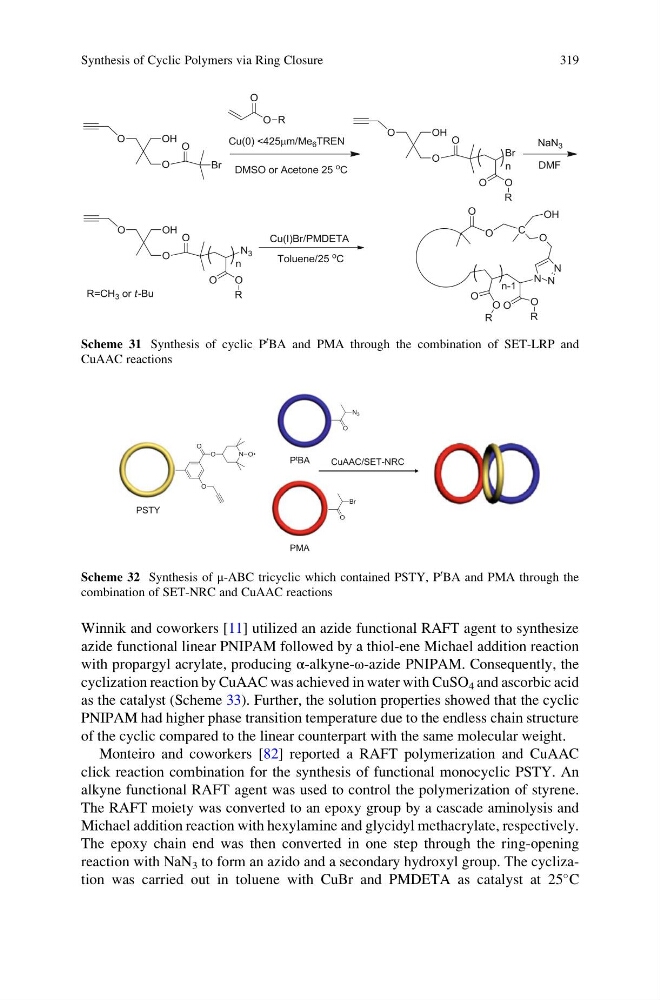
Scheme 31 Synthesis of cyclic P
t
BA and PMA through the combination of SET-LRP and
CuAAC reactions
CuAAC/SET-NRC
PSTY
P t BA
PMA
Scheme 32 Synthesis of μ-ABC tricyclic which contained PSTY, P
t BA and PMA through the
combination of SET-NRC and CuAAC reactions
Synthesis of Cyclic Polymers via Ring Closure
319
azide functional linear PNIPAM followed by a thiol-ene Michael addition reaction
with propargyl acrylate, producing α-alkyne-ω-azide PNIPAM. Consequently, the
cyclization reaction by CuAAC was achieved in water with CuSO 4 and ascorbic acid
as the catalyst (Scheme 33). Further, the solution properties showed that the cyclic
PNIPAM had higher phase transition temperature due to the endless chain structure
of the cyclic compared to the linear counterpart with the same molecular weight.
Monteiro and coworkers [82] reported a RAFT polymerization and CuAAC
click reaction combination for the synthesis of functional monocyclic PSTY. An
alkyne functional RAFT agent was used to control the polymerization of styrene.
The RAFT moiety was converted to an epoxy group by a cascade aminolysis and
Michael addition reaction with hexylamine and glycidyl methacrylate, respectively.
The epoxy chain end was then converted in one step through the ring-opening
reaction with NaN 3 to form an azido and a secondary hydroxyl group. The cyclization was carried out in toluene with CuBr and PMDETA as catalyst at 25
C
Scheme 31 Synthesis of cyclic P
t
BA and PMA through the combination of SET-LRP and
CuAAC reactions
CuAAC/SET-NRC
PSTY
P t BA
PMA
Scheme 32 Synthesis of μ-ABC tricyclic which contained PSTY, P
t BA and PMA through the
combination of SET-NRC and CuAAC reactions
Synthesis of Cyclic Polymers via Ring Closure
319