

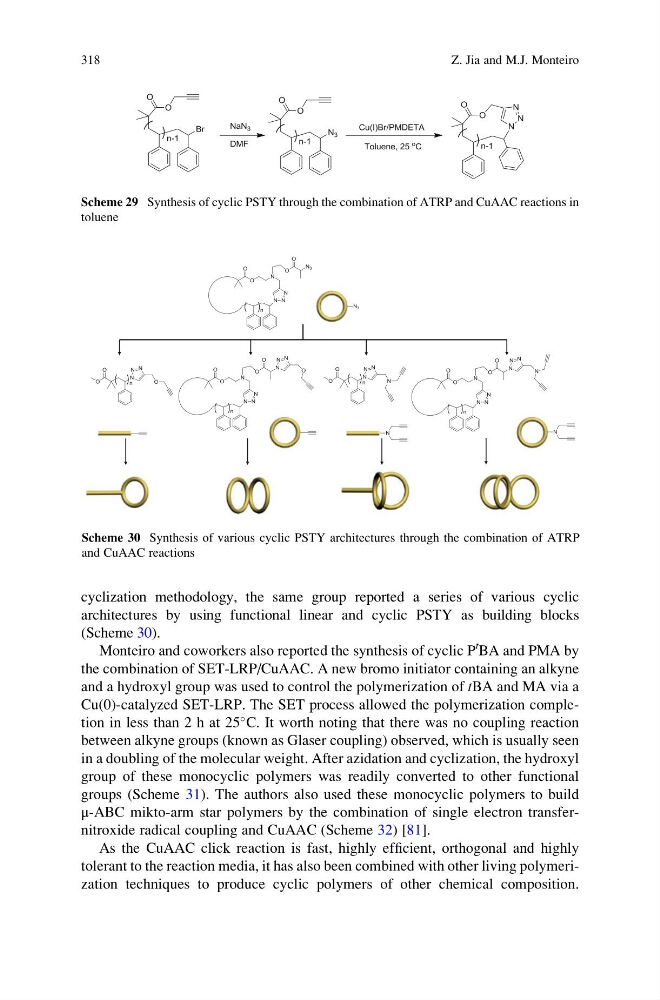
cyclization methodology, the same group reported a series of various cyclic
architectures by using functional linear and cyclic PSTY as building blocks
(Scheme 30).
Monteiro and coworkers also reported the synthesis of cyclic P
t BA and PMA by
the combination of SET-LRP/CuAAC. A new bromo initiator containing an alkyne
and a hydroxyl group was used to control the polymerization of tBA and MA via a
Cu(0)-catalyzed SET-LRP. The SET process allowed the polymerization completion in less than 2 h at 25
C. It worth noting that there was no coupling reaction
between alkyne groups (known as Glaser coupling) observed, which is usually seen
in a doubling of the molecular weight. After azidation and cyclization, the hydroxyl
group of these monocyclic polymers was readily converted to other functional
groups (Scheme 31). The authors also used these monocyclic polymers to build
μ-ABC mikto-arm star polymers by the combination of single electron transfernitroxide radical coupling and CuAAC (Scheme 32) [81].
As the CuAAC click reaction is fast, highly efficient, orthogonal and highly
tolerant to the reaction media, it has also been combined with other living polymerization techniques to produce cyclic polymers of other chemical composition.
Scheme 29 Synthesis of cyclic PSTY through the combination of ATRP and CuAAC reactions in
toluene
Scheme 30 Synthesis of various cyclic PSTY architectures through the combination of ATRP
and CuAAC reactions
318
Z. Jia and M.J. Monteiro
architectures by using functional linear and cyclic PSTY as building blocks
(Scheme 30).
Monteiro and coworkers also reported the synthesis of cyclic P
t BA and PMA by
the combination of SET-LRP/CuAAC. A new bromo initiator containing an alkyne
and a hydroxyl group was used to control the polymerization of tBA and MA via a
Cu(0)-catalyzed SET-LRP. The SET process allowed the polymerization completion in less than 2 h at 25
C. It worth noting that there was no coupling reaction
between alkyne groups (known as Glaser coupling) observed, which is usually seen
in a doubling of the molecular weight. After azidation and cyclization, the hydroxyl
group of these monocyclic polymers was readily converted to other functional
groups (Scheme 31). The authors also used these monocyclic polymers to build
μ-ABC mikto-arm star polymers by the combination of single electron transfernitroxide radical coupling and CuAAC (Scheme 32) [81].
As the CuAAC click reaction is fast, highly efficient, orthogonal and highly
tolerant to the reaction media, it has also been combined with other living polymerization techniques to produce cyclic polymers of other chemical composition.
Scheme 29 Synthesis of cyclic PSTY through the combination of ATRP and CuAAC reactions in
toluene
Scheme 30 Synthesis of various cyclic PSTY architectures through the combination of ATRP
and CuAAC reactions
318
Z. Jia and M.J. Monteiro