

versatile techniques is the CuAAC “click” reaction. Combining this with LRP gives
a new strategy for the preparation of cyclic polymers. The pioneer work was first
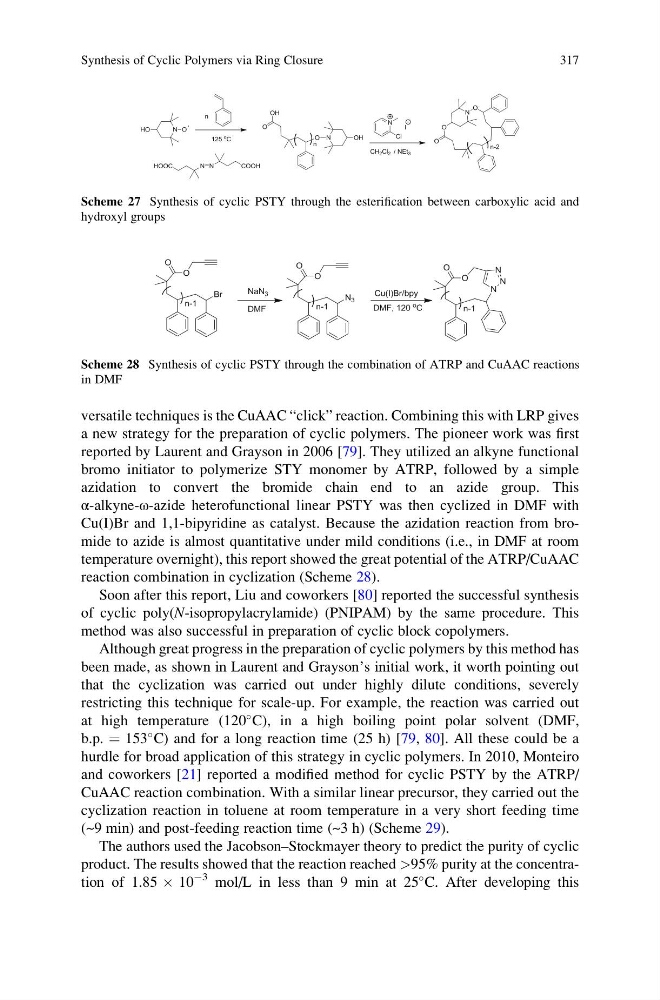
reported by Laurent and Grayson in 2006 [79]. They utilized an alkyne functional
bromo initiator to polymerize STY monomer by ATRP, followed by a simple
azidation to convert the bromide chain end to an azide group. This
α-alkyne-ω-azide heterofunctional linear PSTY was then cyclized in DMF with
Cu(I)Br and 1,1-bipyridine as catalyst. Because the azidation reaction from bromide to azide is almost quantitative under mild conditions (i.e., in DMF at room
temperature overnight), this report showed the great potential of the ATRP/CuAAC
reaction combination in cyclization (Scheme 28).
Soon after this report, Liu and coworkers [80] reported the successful synthesis
of cyclic poly(N-isopropylacrylamide) (PNIPAM) by the same procedure. This
method was also successful in preparation of cyclic block copolymers.
Although great progress in the preparation of cyclic polymers by this method has
been made, as shown in Laurent and Grayson’s initial work, it worth pointing out
that the cyclization was carried out under highly dilute conditions, severely
restricting this technique for scale-up. For example, the reaction was carried out
at high temperature (120
C), in a high boiling point polar solvent (DMF,
b.p. ¼ 153
C) and for a long reaction time (25 h) [79, 80]. All these could be a
hurdle for broad application of this strategy in cyclic polymers. In 2010, Monteiro
and coworkers [21] reported a modified method for cyclic PSTY by the ATRP/
CuAAC reaction combination. With a similar linear precursor, they carried out the
cyclization reaction in toluene at room temperature in a very short feeding time
(~9 min) and post-feeding reaction time (~3 h) (Scheme 29).
The authors used the Jacobson–Stockmayer theory to predict the purity of cyclic
product. The results showed that the reaction reached >95% purity at the concentration of 1.85 Â 10
À3 mol/L in less than 9 min at 25
C. After developing this
Scheme 27 Synthesis of cyclic PSTY through the esterification between carboxylic acid and
hydroxyl groups
Scheme 28 Synthesis of cyclic PSTY through the combination of ATRP and CuAAC reactions
in DMF
Synthesis of Cyclic Polymers via Ring Closure
317
a new strategy for the preparation of cyclic polymers. The pioneer work was first
reported by Laurent and Grayson in 2006 [79]. They utilized an alkyne functional
bromo initiator to polymerize STY monomer by ATRP, followed by a simple
azidation to convert the bromide chain end to an azide group. This
α-alkyne-ω-azide heterofunctional linear PSTY was then cyclized in DMF with
Cu(I)Br and 1,1-bipyridine as catalyst. Because the azidation reaction from bromide to azide is almost quantitative under mild conditions (i.e., in DMF at room
temperature overnight), this report showed the great potential of the ATRP/CuAAC
reaction combination in cyclization (Scheme 28).
Soon after this report, Liu and coworkers [80] reported the successful synthesis
of cyclic poly(N-isopropylacrylamide) (PNIPAM) by the same procedure. This
method was also successful in preparation of cyclic block copolymers.
Although great progress in the preparation of cyclic polymers by this method has
been made, as shown in Laurent and Grayson’s initial work, it worth pointing out
that the cyclization was carried out under highly dilute conditions, severely
restricting this technique for scale-up. For example, the reaction was carried out
at high temperature (120
C), in a high boiling point polar solvent (DMF,
b.p. ¼ 153
C) and for a long reaction time (25 h) [79, 80]. All these could be a
hurdle for broad application of this strategy in cyclic polymers. In 2010, Monteiro
and coworkers [21] reported a modified method for cyclic PSTY by the ATRP/
CuAAC reaction combination. With a similar linear precursor, they carried out the
cyclization reaction in toluene at room temperature in a very short feeding time
(~9 min) and post-feeding reaction time (~3 h) (Scheme 29).
The authors used the Jacobson–Stockmayer theory to predict the purity of cyclic
product. The results showed that the reaction reached >95% purity at the concentration of 1.85 Â 10
À3 mol/L in less than 9 min at 25
C. After developing this
Scheme 27 Synthesis of cyclic PSTY through the esterification between carboxylic acid and
hydroxyl groups
Scheme 28 Synthesis of cyclic PSTY through the combination of ATRP and CuAAC reactions
in DMF
Synthesis of Cyclic Polymers via Ring Closure
317