

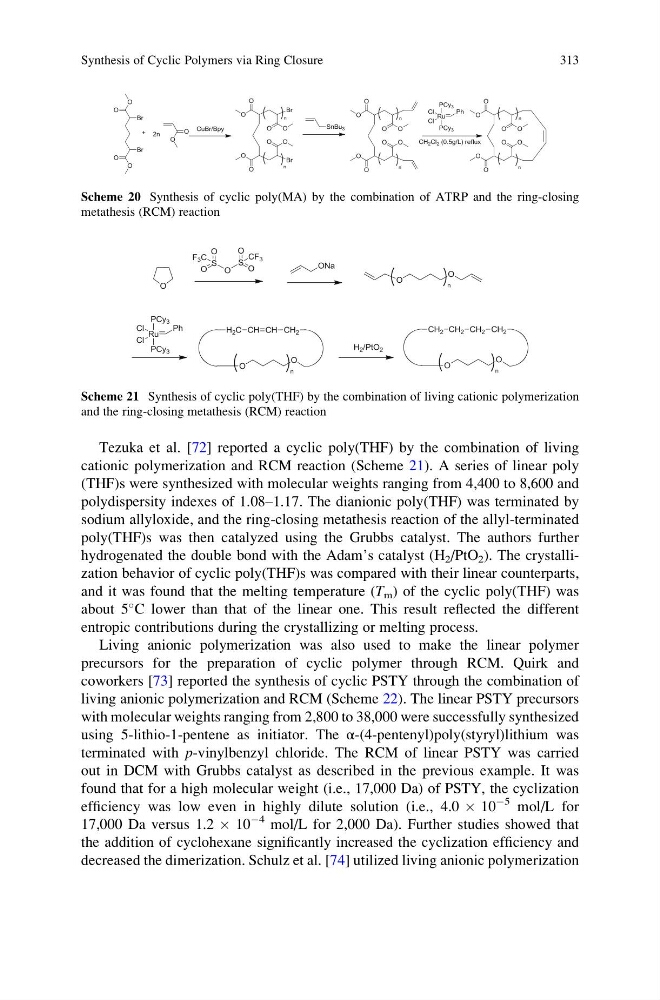
Tezuka et al. [72] reported a cyclic poly(THF) by the combination of living
cationic polymerization and RCM reaction (Scheme 21). A series of linear poly
(THF)s were synthesized with molecular weights ranging from 4,400 to 8,600 and
polydispersity indexes of 1.08–1.17. The dianionic poly(THF) was terminated by
sodium allyloxide, and the ring-closing metathesis reaction of the allyl-terminated
poly(THF)s was then catalyzed using the Grubbs catalyst. The authors further
hydrogenated the double bond with the Adam’s catalyst (H 2 /PtO 2 ). The crystallization behavior of cyclic poly(THF)s was compared with their linear counterparts,
and it was found that the melting temperature (T m ) of the cyclic poly(THF) was
about 5
C lower than that of the linear one. This result reflected the different
entropic contributions during the crystallizing or melting process.
Living anionic polymerization was also used to make the linear polymer
precursors for the preparation of cyclic polymer through RCM. Quirk and
coworkers [73] reported the synthesis of cyclic PSTY through the combination of
living anionic polymerization and RCM (Scheme 22). The linear PSTY precursors
with molecular weights ranging from 2,800 to 38,000 were successfully synthesized
using 5-lithio-1-pentene as initiator. The α-(4-pentenyl)poly(styryl)lithium was
terminated with p-vinylbenzyl chloride. The RCM of linear PSTY was carried
out in DCM with Grubbs catalyst as described in the previous example. It was
found that for a high molecular weight (i.e., 17,000 Da) of PSTY, the cyclization
efficiency was low even in highly dilute solution (i.e., 4.0 Â 10
À5 mol/L for
17,000 Da versus 1.2 Â 10
À4 mol/L for 2,000 Da). Further studies showed that
the addition of cyclohexane significantly increased the cyclization efficiency and
decreased the dimerization. Schulz et al. [74] utilized living anionic polymerization
Scheme 20 Synthesis of cyclic poly(MA) by the combination of ATRP and the ring-closing
metathesis (RCM) reaction
Scheme 21 Synthesis of cyclic poly(THF) by the combination of living cationic polymerization
and the ring-closing metathesis (RCM) reaction
Synthesis of Cyclic Polymers via Ring Closure
313
cationic polymerization and RCM reaction (Scheme 21). A series of linear poly
(THF)s were synthesized with molecular weights ranging from 4,400 to 8,600 and
polydispersity indexes of 1.08–1.17. The dianionic poly(THF) was terminated by
sodium allyloxide, and the ring-closing metathesis reaction of the allyl-terminated
poly(THF)s was then catalyzed using the Grubbs catalyst. The authors further
hydrogenated the double bond with the Adam’s catalyst (H 2 /PtO 2 ). The crystallization behavior of cyclic poly(THF)s was compared with their linear counterparts,
and it was found that the melting temperature (T m ) of the cyclic poly(THF) was
about 5
C lower than that of the linear one. This result reflected the different
entropic contributions during the crystallizing or melting process.
Living anionic polymerization was also used to make the linear polymer
precursors for the preparation of cyclic polymer through RCM. Quirk and
coworkers [73] reported the synthesis of cyclic PSTY through the combination of
living anionic polymerization and RCM (Scheme 22). The linear PSTY precursors
with molecular weights ranging from 2,800 to 38,000 were successfully synthesized
using 5-lithio-1-pentene as initiator. The α-(4-pentenyl)poly(styryl)lithium was
terminated with p-vinylbenzyl chloride. The RCM of linear PSTY was carried
out in DCM with Grubbs catalyst as described in the previous example. It was
found that for a high molecular weight (i.e., 17,000 Da) of PSTY, the cyclization
efficiency was low even in highly dilute solution (i.e., 4.0 Â 10
À5 mol/L for
17,000 Da versus 1.2 Â 10
À4 mol/L for 2,000 Da). Further studies showed that
the addition of cyclohexane significantly increased the cyclization efficiency and
decreased the dimerization. Schulz et al. [74] utilized living anionic polymerization
Scheme 20 Synthesis of cyclic poly(MA) by the combination of ATRP and the ring-closing
metathesis (RCM) reaction
Scheme 21 Synthesis of cyclic poly(THF) by the combination of living cationic polymerization
and the ring-closing metathesis (RCM) reaction
Synthesis of Cyclic Polymers via Ring Closure
313