

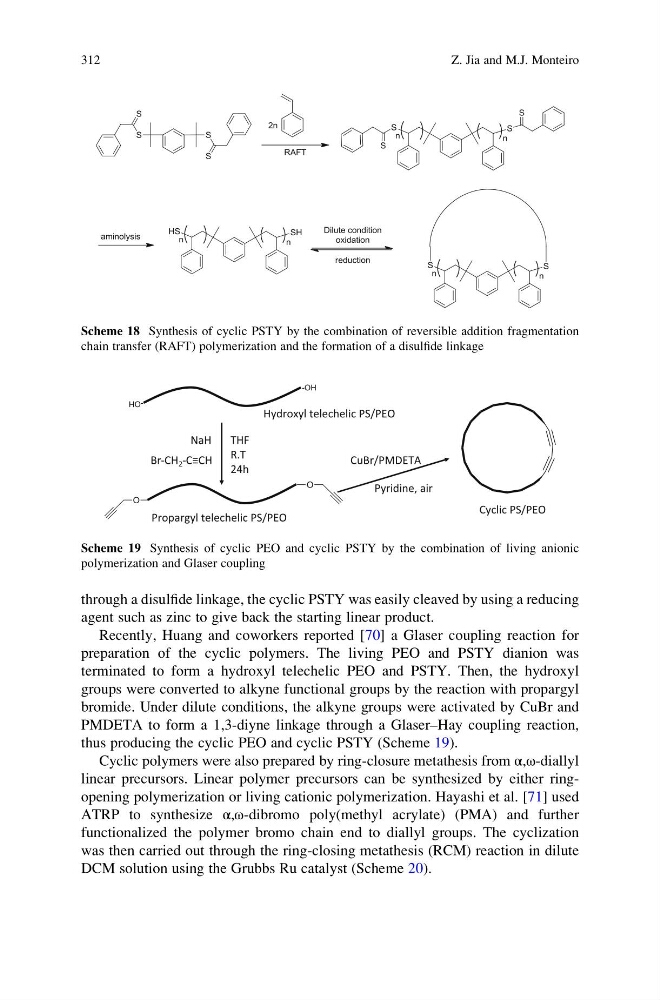
through a disulfide linkage, the cyclic PSTY was easily cleaved by using a reducing
agent such as zinc to give back the starting linear product.
Recently, Huang and coworkers reported [70] a Glaser coupling reaction for
preparation of the cyclic polymers. The living PEO and PSTY dianion was
terminated to form a hydroxyl telechelic PEO and PSTY. Then, the hydroxyl
groups were converted to alkyne functional groups by the reaction with propargyl
bromide. Under dilute conditions, the alkyne groups were activated by CuBr and
PMDETA to form a 1,3-diyne linkage through a Glaser–Hay coupling reaction,
thus producing the cyclic PEO and cyclic PSTY (Scheme 19).
Cyclic polymers were also prepared by ring-closure metathesis from α,ω-diallyl
linear precursors. Linear polymer precursors can be synthesized by either ringopening polymerization or living cationic polymerization. Hayashi et al. [71] used
ATRP to synthesize α,ω-dibromo poly(methyl acrylate) (PMA) and further
functionalized the polymer bromo chain end to diallyl groups. The cyclization
was then carried out through the ring-closing metathesis (RCM) reaction in dilute
DCM solution using the Grubbs Ru catalyst (Scheme 20).
Scheme 18 Synthesis of cyclic PSTY by the combination of reversible addition fragmentation
chain transfer (RAFT) polymerization and the formation of a disulfide linkage
-OH
-OH
NaH
Br-CH 2 -C≡CH
THF
R.T
24h
Hydroxyl telechelic PS/PEO
Propargyl telechelic PS/PEO
CuBr/PMDETA
Pyridine, air
Cyclic PS/PEO
Scheme 19 Synthesis of cyclic PEO and cyclic PSTY by the combination of living anionic
polymerization and Glaser coupling
312
Z. Jia and M.J. Monteiro
agent such as zinc to give back the starting linear product.
Recently, Huang and coworkers reported [70] a Glaser coupling reaction for
preparation of the cyclic polymers. The living PEO and PSTY dianion was
terminated to form a hydroxyl telechelic PEO and PSTY. Then, the hydroxyl
groups were converted to alkyne functional groups by the reaction with propargyl
bromide. Under dilute conditions, the alkyne groups were activated by CuBr and
PMDETA to form a 1,3-diyne linkage through a Glaser–Hay coupling reaction,
thus producing the cyclic PEO and cyclic PSTY (Scheme 19).
Cyclic polymers were also prepared by ring-closure metathesis from α,ω-diallyl
linear precursors. Linear polymer precursors can be synthesized by either ringopening polymerization or living cationic polymerization. Hayashi et al. [71] used
ATRP to synthesize α,ω-dibromo poly(methyl acrylate) (PMA) and further
functionalized the polymer bromo chain end to diallyl groups. The cyclization
was then carried out through the ring-closing metathesis (RCM) reaction in dilute
DCM solution using the Grubbs Ru catalyst (Scheme 20).
Scheme 18 Synthesis of cyclic PSTY by the combination of reversible addition fragmentation
chain transfer (RAFT) polymerization and the formation of a disulfide linkage
-OH
-OH
NaH
Br-CH 2 -C≡CH
THF
R.T
24h
Hydroxyl telechelic PS/PEO
Propargyl telechelic PS/PEO
CuBr/PMDETA
Pyridine, air
Cyclic PS/PEO
Scheme 19 Synthesis of cyclic PEO and cyclic PSTY by the combination of living anionic
polymerization and Glaser coupling
312
Z. Jia and M.J. Monteiro